<< Prev Question Next Question >>
Question 4/33
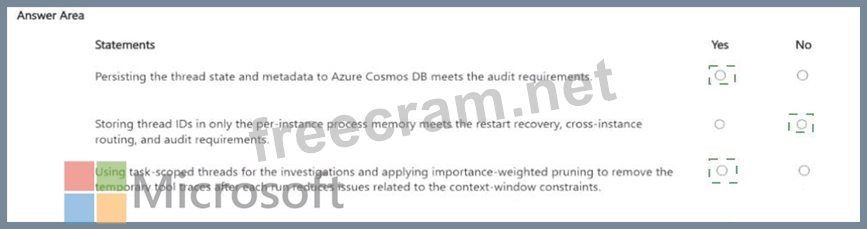
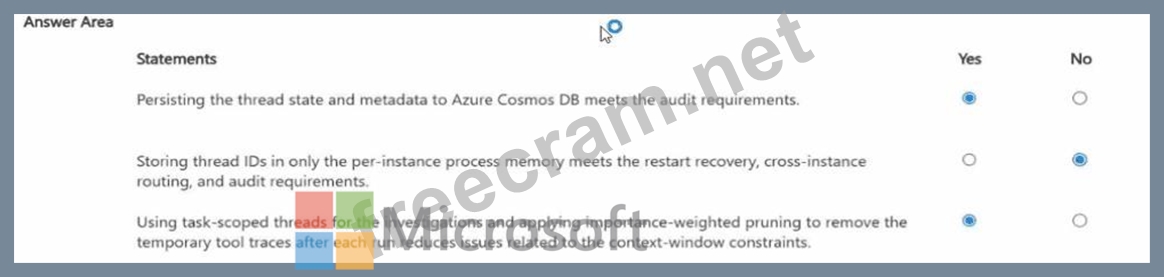
You have a single-agent customer support copilot built by using Microsoft Foundry. The application that hosts the copilot runs on multiple stateless instances, and rolling upgrades restart the instances.
[Architect multi-agent solutions]
Customer investigations can last for several days. A user can have multiple unrelated investigations, and stable user preferences, such as a preferred contact method, must be available across sessions and devices Compliance reporting requires a one-year, queryable audit trail of thread messages and session metadata.
During long investigations, the model context window regularly approaches its limits. Temporary tool traces do NOT affect final outcomes after the run completes.
For each of the following statements, select Yes if the statement is true. Otherwise, select No.
NOTE: Each correct selection is worth one point.
[Architect multi-agent solutions]
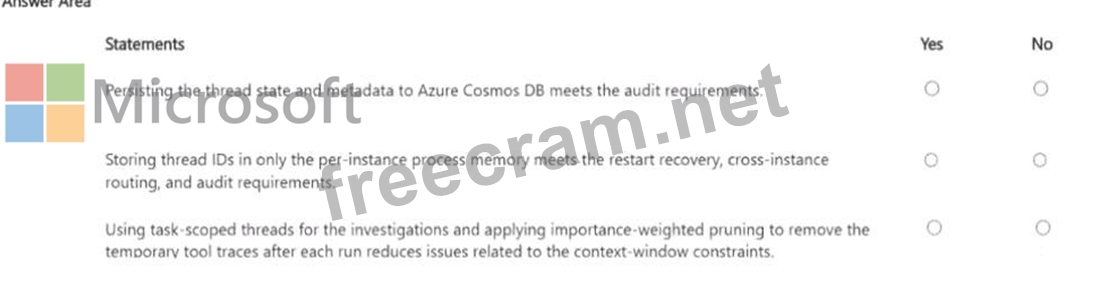
Customer investigations can last for several days. A user can have multiple unrelated investigations, and stable user preferences, such as a preferred contact method, must be available across sessions and devices Compliance reporting requires a one-year, queryable audit trail of thread messages and session metadata.
During long investigations, the model context window regularly approaches its limits. Temporary tool traces do NOT affect final outcomes after the run completes.
For each of the following statements, select Yes if the statement is true. Otherwise, select No.
NOTE: Each correct selection is worth one point.