<< Prev Question Next Question >>
Question 23/33
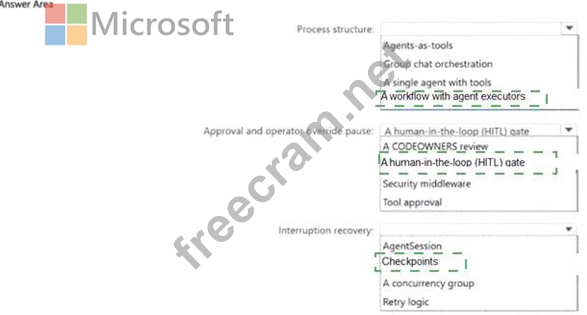
You have a Microsoft Foundry multi-agent solution that includes a planning agent and an execution agent You are designing a fixed order process where executions can run for several hours and can be interrupted by worker restarts.
You need to implement orchestration for the process. The solution must meet the following requirements
* Pause at predefined points.
* Resume from the last saved state after an interruption.
Which mechanisms should you use? To answer, select the appropriate options in the answer area.
NOTE: Each correct selection is worth one point.