<< Prev Question
Question 33/33
You have a Microsoft Foundry multi-agent assistant that uses a Retrieval-Augmented Generation (RAG)- enabled workflow. A retrieval agent returns document chunks to an answer agent, and the answer agent produces the final response.
You have a dataset that contains query, context, and response without document relevance labels.
You need to implement built-in RAG evaluators that meet the following requirements:
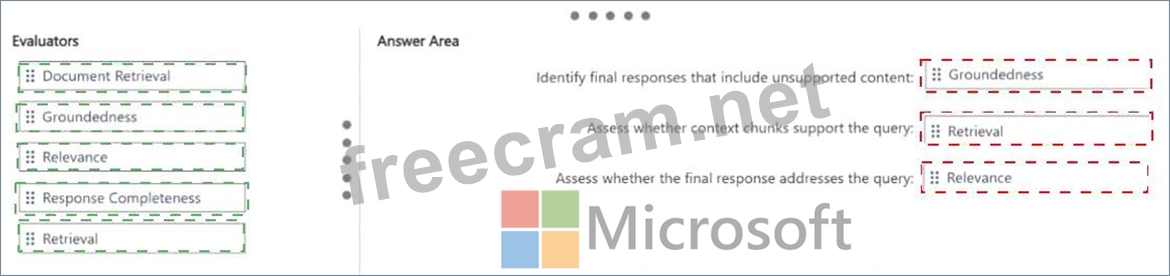
* Identify final responses that include content that is NOT supported by the retrieved context.
* Assess whether the retrieved context chunks and final responses support the user query.
Which evaluator should you use for each requirement? To answer, drag the appropriate evaluators to the correct requirements. Each evaluator may be used once, more than once, or not at all. You may need to drag the split bar between panes or scroll to view content.
NOTE: Each correct selection is worth one point.
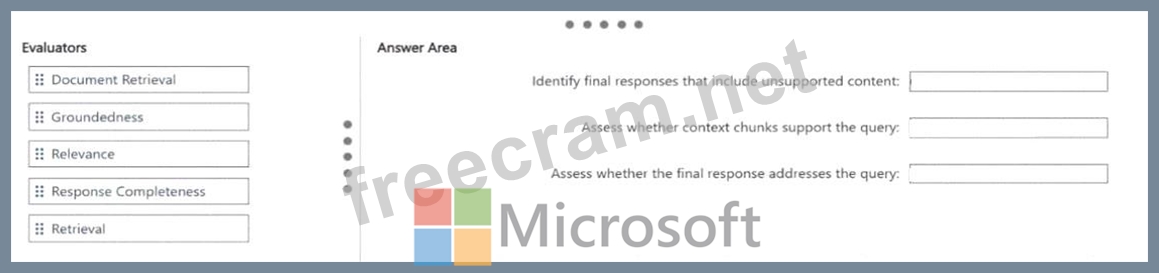
You have a dataset that contains query, context, and response without document relevance labels.
You need to implement built-in RAG evaluators that meet the following requirements:
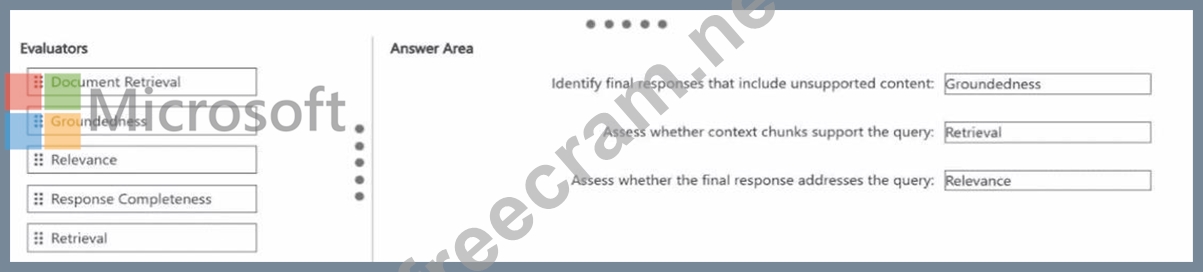
* Identify final responses that include content that is NOT supported by the retrieved context.
* Assess whether the retrieved context chunks and final responses support the user query.
Which evaluator should you use for each requirement? To answer, drag the appropriate evaluators to the correct requirements. Each evaluator may be used once, more than once, or not at all. You may need to drag the split bar between panes or scroll to view content.
NOTE: Each correct selection is worth one point.