Valid AB-Abdomen Dumps shared by ExamDiscuss.com for Helping Passing AB-Abdomen Exam! ExamDiscuss.com now offer the newest AB-Abdomen exam dumps, the ExamDiscuss.com AB-Abdomen exam questions have been updated and answers have been corrected get the newest ExamDiscuss.com AB-Abdomen dumps with Test Engine here:
Access AB-Abdomen Dumps Premium Version
(165 Q&As Dumps, 35%OFF Special Discount Code: freecram)
<< Prev Question Next Question >>
Question 69/76
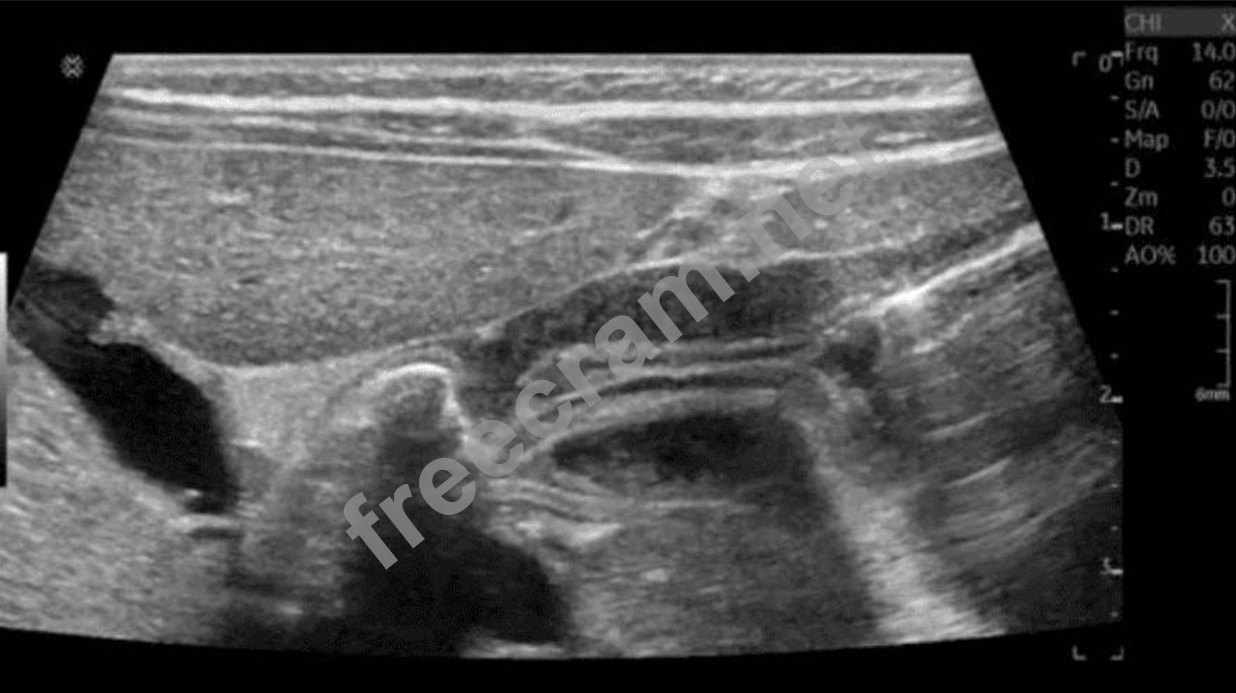
Which clinical finding is most likely associated with the pathology in this image?
Correct Answer: A
The ultrasound image shows a classic longitudinal view of a markedly thickened pyloric muscle with an elongated pyloric channel. This finding is consistent with hypertrophic pyloric stenosis (HPS), a condition most commonly seen in male infants between 2 and 8 weeks of age.
The most characteristic clinical finding associated with HPS is an "olive-shaped" palpable mass in the right upper quadrant or epigastric region, which represents the hypertrophied pylorus.
Clinical presentation of HPS includes:
* Non-bilious projectile vomiting (due to gastric outlet obstruction)
* Dehydration and weight loss
* A palpable "olive" mass on physical exam
* Visible peristalsis may be noted on the abdominal wall
Sonographic diagnostic criteria for HPS:
* Pyloric muscle thickness # 3 mm
* Pyloric channel length # 15-17 mm
* "Cervix sign" or "target sign" (transverse view)
* Failure of gastric contents to pass through the pylorus on real-time imaging Differentiation from other options:
* B. Fever of unknown origin: Not characteristic of HPS.
* C. Red currant jelly stools: Classic for intussusception.
* D. Bilious vomiting: Seen in distal duodenal or jejunal obstruction, not in pyloric stenosis (vomiting is non-bilious in HPS).
References:
Rumack CM, Wilson SR, Charboneau JW, Levine D. Diagnostic Ultrasound. 5th Edition. Elsevier, 2018.
Chapter: Gastrointestinal Tract, pp. 474-479.
American College of Radiology (ACR). Appropriateness Criteria - Vomiting in Infants Up to 3 Months of Age.
Radiopaedia.org. Hypertrophic pyloric stenosis:https://radiopaedia.org/articles/hypertrophic-pyloric-stenosis
The most characteristic clinical finding associated with HPS is an "olive-shaped" palpable mass in the right upper quadrant or epigastric region, which represents the hypertrophied pylorus.
Clinical presentation of HPS includes:
* Non-bilious projectile vomiting (due to gastric outlet obstruction)
* Dehydration and weight loss
* A palpable "olive" mass on physical exam
* Visible peristalsis may be noted on the abdominal wall
Sonographic diagnostic criteria for HPS:
* Pyloric muscle thickness # 3 mm
* Pyloric channel length # 15-17 mm
* "Cervix sign" or "target sign" (transverse view)
* Failure of gastric contents to pass through the pylorus on real-time imaging Differentiation from other options:
* B. Fever of unknown origin: Not characteristic of HPS.
* C. Red currant jelly stools: Classic for intussusception.
* D. Bilious vomiting: Seen in distal duodenal or jejunal obstruction, not in pyloric stenosis (vomiting is non-bilious in HPS).
References:
Rumack CM, Wilson SR, Charboneau JW, Levine D. Diagnostic Ultrasound. 5th Edition. Elsevier, 2018.
Chapter: Gastrointestinal Tract, pp. 474-479.
American College of Radiology (ACR). Appropriateness Criteria - Vomiting in Infants Up to 3 Months of Age.
Radiopaedia.org. Hypertrophic pyloric stenosis:https://radiopaedia.org/articles/hypertrophic-pyloric-stenosis


- Question List (76q)
- Question 1: Which condition is most consistent with this image of a post...
- Question 2: Which normal anatomical structure is also known as the acces...
- Question 3: Which of the following is the most common symptom of choleli...
- Question 4: Which condition is demonstrated in this image? (Exhibit)...
- Question 5: Which of the following is a possible early complication of a...
- Question 6: Which condition is associated with multiple pancreatic cysts...
- Question 7: Which imaging technique best demonstrates ureteral patency?...
- Question 8: Which condition is most likely depicted in this image? (Exhi...
- Question 9: Which type of choledochal cyst is the most common?...
- Question 10: Which thyroid condition is most likely caused by a viral inf...
- Question 11: Which condition is most consistent with the sonographic appe...
- Question 12: Which anatomical area of the male reproductive system is dem...
- Question 13: Which lymph node shape is concerning for malignancy in the p...
- Question 14: Beginning at the renal artery, what is the correct sequence ...
- Question 15: Which scanning approach was utilized to obtain this image? (...
- Question 16: Which condition is most likely the cause of claudication exp...
- Question 17: Which condition results in the vascular abnormality shown in...
- Question 18: Which finding is demonstrated in this image? (Exhibit)...
- Question 19: Which technique is used to demonstrate the finding in this v...
- Question 20: Which complication is of greatest concern with undescended t...
- Question 21: Which measurement is the upper limit for a normal gallbladde...
- Question 22: Which diagnosis is most consistent with this image from a pa...
- Question 23: Which sonographic appearance of the normal epididymis is the...
- Question 24: Which complication would be associated with retroperitoneal ...
- Question 25: Which sonographic finding is most consistent with scrotal in...
- Question 26: Which exam type would be most beneficial for evaluating an e...
- Question 27: Which condition is most consistent with the findings in the ...
- Question 28: Which laboratory value stays elevated longest and is conside...
- Question 29: Which condition is a common cause of biliary duct obstructio...
- Question 30: Which arterial branches lie at the base of the renal pyramid...
- Question 31: Which congenital disorder is most consistent with the findin...
- Question 32: Which best describes the Doppler waveform findings in this i...
- Question 33: Which hernia characteristic is demonstrated in these images?...
- Question 34: Which characteristic is associated with complex pleural effu...
- Question 35: Which finding is an indication for renal biopsy to assess fo...
- Question 36: Which change of the inferior vena cava spectral Doppler wave...
- Question 37: Which diagnosis is most accurate based on the findings in th...
- Question 38: Which finding is most likely demonstrated in these images of...
- Question 39: Identify the region where Doppler sampling should be perform...
- Question 40: Which foreign body is better visualized with sonography than...
- Question 41: What is the most common malignancy of the prostate?...
- Question 42: Which malignancy most commonly metastasizes to the testes?...
- Question 43: Which congenital anomaly is demonstrated in this image? (Exh...
- Question 44: Which disease process may cause numerous shadowing calcifica...
- Question 45: Which probe frequency is most appropriate for imaging of the...
- Question 46: Which condition is most likely associated with this image of...
- Question 47: Which gray scale artifact is caused by the oscillation of ga...
- Question 48: Which structure is indicated by the arrow on this image? (Ex...
- Question 49: Which common congenital anomaly is typically seen as a cysti...
- Question 50: Which condition is characterized by abnormal dilatation of v...
- Question 51: Which neoplasm is a benign tumor of the spleen?...
- Question 52: Which condition is most likely in a patient presenting with ...
- Question 53: Which sonographic finding distinguishes focal nodular hyperp...
- Question 54: What is the main purpose for performing focused abdominal so...
- Question 55: Which retroperitoneal finding is most likely associated with...
- Question 56: Which condition is most consistent with the findings in this...
- Question 57: What is the location of the left lobe of the thyroid gland?...
- Question 58: Which pancreatic condition is commonly associated with compl...
- Question 59: Which vascular condition is most likely associated with the ...
- Question 60: Which type of hernia is located medial to the inferior epiga...
- Question 61: Which sonographic finding is most consistent with this image...
- Question 62: Which arteries are the immediate branches of the celiac trun...
- Question 63: Identify the congenital anomaly. Using your mouse, place the...
- Question 64: A 60-year-old man presents to the emergency room, complainin...
- Question 65: Which structure is indicated by the arrow on this image? (Ex...
- Question 66: Which action should a sonographer take if the abdominal aort...
- Question 67: Which vessel is most likely to display hepatofugal flow in t...
- Question 68: Based on this image, which congenital anomaly should be susp...
- Question 69: Which clinical finding is most likely associated with the pa...
- Question 70: Which area of the spleen is not covered by visceral peritone...
- Question 71: Which condition is demonstrated in this image? (Exhibit)...
- Question 72: Which sonographic appearance of the bile ducts is demonstrat...
- Question 73: Elevation of alpha-fetoprotein levels is a characteristic fi...
- Question 74: What is the most common cause of nutcracker syndrome?...
- Question 75: How are portal veins differentiated from hepatic veins?...
- Question 76: Which abnormality is the most common adult adrenal tumor?...
