- Home
- Google Certified Professional - Cloud Architect (GCP)
- Google.Professional-Cloud-Architect.v2018-04-15.q70
- Question 17
Valid Professional-Cloud-Architect Dumps shared by EduDump.com for Helping Passing Professional-Cloud-Architect Exam! EduDump.com now offer the newest Professional-Cloud-Architect exam dumps, the EduDump.com Professional-Cloud-Architect exam questions have been updated and answers have been corrected get the newest EduDump.com Professional-Cloud-Architect dumps with Test Engine here:
Access Professional-Cloud-Architect Dumps Premium Version
(353 Q&As Dumps, 35%OFF Special Discount Code: freecram)
<< Prev Question Next Question >>
Question 17/70
For this question, refer to the Mountkirk Games case study.
Mountkirk Games' gaming servers are not automatically scaling properly. Last month, they rolled out a new feature, which suddenly became very popular. A record number of users are trying to use the service, but many of them are getting 503 errors and very slow response times. What should they investigate first?
Mountkirk Games' gaming servers are not automatically scaling properly. Last month, they rolled out a new feature, which suddenly became very popular. A record number of users are trying to use the service, but many of them are getting 503 errors and very slow response times. What should they investigate first?
Correct Answer: A
Topic 2, TerramEarth Case Study
Company Overview
TerramEarth manufactures heavy equipment for the mining and agricultural industries:
About 80% of their business is from mining and 20% from agriculture. They currently have over 500 dealers and service centers in 100 countries. Their mission is to build products that make their customers more productive.
Company Background
TerramEarth formed in 1946, when several small, family owned companies combined to retool after World War II. The company cares about their employees and customers and considers them to be extended members of their family.
TerramEarth is proud of their ability to innovate on their core products and find new markets as their customers' needs change. For the past 20 years trends in the industry have been largely toward increasing productivity by using larger vehicles with a human operator.
Solution Concept
There are 20 million TerramEarth vehicles in operation that collect 120 fields of data per second. Data is stored locally on the vehicle and can be accessed for analysis when a vehicle is serviced. The data is downloaded via a maintenance port. This same port can be used to adjust operational parameters, allowing the vehicles to be upgraded in the field with new computing modules.
Approximately 200,000 vehicles are connected to a cellular network, allowing TerramEarth to collect data directly. At a rate of 120 fields of data per second, with 22 hours of operation per day. TerramEarth collects a total of about 9 TB/day from these connected vehicles.
Existing Technical Environment
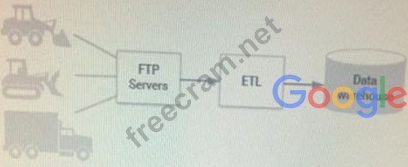
TerramEarth's existing architecture is composed of Linux-based systems that reside in a data center. These systems gzip CSV files from the field and upload via FTP, transform and aggregate them, and place the data in their data warehouse. Because this process takes time, aggregated reports are based on data that is 3 weeks old.
With this data, TerramEarth has been able to preemptively stock replacement parts and reduce unplanned downtime of their vehicles by 60%. However, because the data is stale, some customers are without their vehicles for up to 4 weeks while they wait for replacement parts.
Business Requirements
* Decrease unplanned vehicle downtime to less than 1 week, without increasing the cost of carrying surplus inventory
* Support the dealer network with more data on how their customers use their equipment IP better position new products and services.
* Have the ability to partner with different companies-especially with seed and fertilizer suppliers in the fast-growing agricultural business-to create compelling joint offerings for their customers CEO Statement We have been successful in capitalizing on the trend toward larger vehicles to increase the productivity of our customers. Technological change is occurring rapidly and TerramEarth has taken advantage of connected devices technology to provide our customers with better services, such as our intelligent farming equipment. With this technology, we have been able to increase farmers' yields by 25%, by using past trends to adjust how our vehicles operate. These advances have led to the rapid growth of our agricultural product line, which we expect will generate 50% of our revenues by 2020.
CTO Statement
Our competitive advantage has always been in the manufacturing process with our ability to build better vehicles for tower cost than our competitors. However, new products with different approaches are constantly being developed, and I'm concerned that we lack the skills to undergo the next wave of transformations in our industry. Unfortunately, our CEO doesn't take technology obsolescence seriously and he considers the many new companies in our industry to be niche players. My goals are to build our skills while addressing immediate market needs through incremental innovations.
Company Overview
TerramEarth manufactures heavy equipment for the mining and agricultural industries:
About 80% of their business is from mining and 20% from agriculture. They currently have over 500 dealers and service centers in 100 countries. Their mission is to build products that make their customers more productive.
Company Background
TerramEarth formed in 1946, when several small, family owned companies combined to retool after World War II. The company cares about their employees and customers and considers them to be extended members of their family.
TerramEarth is proud of their ability to innovate on their core products and find new markets as their customers' needs change. For the past 20 years trends in the industry have been largely toward increasing productivity by using larger vehicles with a human operator.
Solution Concept
There are 20 million TerramEarth vehicles in operation that collect 120 fields of data per second. Data is stored locally on the vehicle and can be accessed for analysis when a vehicle is serviced. The data is downloaded via a maintenance port. This same port can be used to adjust operational parameters, allowing the vehicles to be upgraded in the field with new computing modules.
Approximately 200,000 vehicles are connected to a cellular network, allowing TerramEarth to collect data directly. At a rate of 120 fields of data per second, with 22 hours of operation per day. TerramEarth collects a total of about 9 TB/day from these connected vehicles.
Existing Technical Environment
TerramEarth's existing architecture is composed of Linux-based systems that reside in a data center. These systems gzip CSV files from the field and upload via FTP, transform and aggregate them, and place the data in their data warehouse. Because this process takes time, aggregated reports are based on data that is 3 weeks old.
With this data, TerramEarth has been able to preemptively stock replacement parts and reduce unplanned downtime of their vehicles by 60%. However, because the data is stale, some customers are without their vehicles for up to 4 weeks while they wait for replacement parts.
Business Requirements
* Decrease unplanned vehicle downtime to less than 1 week, without increasing the cost of carrying surplus inventory
* Support the dealer network with more data on how their customers use their equipment IP better position new products and services.
* Have the ability to partner with different companies-especially with seed and fertilizer suppliers in the fast-growing agricultural business-to create compelling joint offerings for their customers CEO Statement We have been successful in capitalizing on the trend toward larger vehicles to increase the productivity of our customers. Technological change is occurring rapidly and TerramEarth has taken advantage of connected devices technology to provide our customers with better services, such as our intelligent farming equipment. With this technology, we have been able to increase farmers' yields by 25%, by using past trends to adjust how our vehicles operate. These advances have led to the rapid growth of our agricultural product line, which we expect will generate 50% of our revenues by 2020.
CTO Statement
Our competitive advantage has always been in the manufacturing process with our ability to build better vehicles for tower cost than our competitors. However, new products with different approaches are constantly being developed, and I'm concerned that we lack the skills to undergo the next wave of transformations in our industry. Unfortunately, our CEO doesn't take technology obsolescence seriously and he considers the many new companies in our industry to be niche players. My goals are to build our skills while addressing immediate market needs through incremental innovations.


- Question List (70q)
- 2 commentQuestion 1: For this question, refer to the JencoMart case study. JencoM...
- 6 commentQuestion 2: You want to enable your running Google Container Engine clus...
- 10 commentQuestion 3: Your application needs to process credit card transactions. ...
- 4 commentQuestion 4: For this question refer to the TerramEarth case study Operat...
- 2 commentQuestion 5: For this question, refer to the TerramEarth case study Your ...
- 3 commentQuestion 6: You want to make a copy of a production Linux virtual machin...
- 10 commentQuestion 7: For this question, refer to the Dress4Win case study. As par...
- 6 commentQuestion 8: Your company just finished a rapid lift and shift to Google ...
- 7 commentQuestion 9: Your solution is producing performance bugs in production th...
- 6 commentQuestion 10: Your organization requires that metrics from all application...
- 4 commentQuestion 11: You are creating a solution to remove backup files older tha...
- 2 commentQuestion 12: Your organization has a 3-tier web application deployed in t...
- 7 commentQuestion 13: Your company's test suite is a custom C++ application that r...
- 1 commentQuestion 14: For this question, refer to the TerramEarth case study. Terr...
- 5 commentQuestion 15: A news teed web service has the following code running on Go...
- 10 commentQuestion 16: For this question, refer to the JencoMart case study. JencoM...
- 8 commentQuestion 17: For this question, refer to the Mountkirk Games case study. ...
- 4 commentQuestion 18: A lead engineer wrote a custom tool that deploys virtual mac...
- Question 19: You want to optimize the performance of an accurate, real-ti...
- 5 commentQuestion 20: For this question, refer to the TerramEarth case study. To s...
- 8 commentQuestion 21: You are designing a large distributed application with 30 mi...
- 3 commentQuestion 22: For this question, refer to the JencoMart case study. JencoM...
- Question 23: For this question, refer to the Dress4Win case study. You wa...
- 3 commentQuestion 24: One of your primary business objectives is being able to tru...
- 3 commentQuestion 25: Your company places a high value on being responsive and mee...
- 4 commentQuestion 26: For this question, refer to the Mountkirk Games case study. ...
- 2 commentQuestion 27: Your development team has installed a new Linux kernel modul...
- 2 commentQuestion 28: You have created several preemptible Linux virtual machine i...
- 2 commentQuestion 29: For this question, refer to the Dress4Win case study. Dress4...
- 4 commentQuestion 30: The application reliability team at your company has added a...
- 1 commentQuestion 31: For this question, refer to the Mountkirk Games case study. ...
- 5 commentQuestion 32: For this question, refer to the TerramEarth case study. Terr...
- 6 commentQuestion 33: For this question, refer to the TerramEarth case study. Terr...
- 5 commentQuestion 34: For this question, refer to the Dress4Win case study. Dress4...
- 2 commentQuestion 35: Your company's user-feedback portal comprises a standard LAM...
- Question 36: You need to reduce the number of unplanned rollbacks of erro...
- 1 commentQuestion 37: Your company wants to try out the cloud with low risk. They ...
- 3 commentQuestion 38: For this question, refer to the Dress4Win case study. The Dr...
- 1 commentQuestion 39: Your company plans to migrate a multi-petabyte data set to t...
- 8 commentQuestion 40: For this question, refer to the JencoMart case study A few d...
- 6 commentQuestion 41: A development manager is building a new application He asks ...
- 1 commentQuestion 42: You set up an autoscaling instance group to serve web traffi...
- 13 commentQuestion 43: For this question, refer to the TerramEarth case study. Terr...
- 4 commentQuestion 44: To reduce costs, the Director of Engineering has required al...
- 2 commentQuestion 45: During a high traffic portion of the day, one of your relati...
- 5 commentQuestion 46: Your company runs several databases on a single MySQL instan...
- Question 47: You deploy your custom Java application to Google App Engine...
- 4 commentQuestion 48: The database administration team has asked you to help them ...
- 3 commentQuestion 49: For this question, refer to the JencoMart case study. The Je...
- 6 commentQuestion 50: You write a Python script to connect to Google BigQuery from...
- 7 commentQuestion 51: For this question, refer to the Mountkirk Games case study M...
- Question 52: Your company has successfully migrated to the cloud and want...
- 2 commentQuestion 53: A lead software engineer tells you that his new application ...
- 1 commentQuestion 54: For this question, refer to the Dress4Win case study. As par...
- 2 commentQuestion 55: For this question, refer to the JencoMart case study. JencoM...
- 4 commentQuestion 56: Your customer is receiving reports that their recently updat...
- 10 commentQuestion 57: Your company has decided to build a backup replica of their ...
- Question 58: Your marketing department wants to send out a promotional em...
- Question 59: Your company is forecasting a sharp increase in the number a...
- 8 commentQuestion 60: You have been asked to select the storage system for the cli...
- Question 61: Your company wants to track whether someone is present in a ...
- 3 commentQuestion 62: A small number of API requests to your microservices-based a...
- Question 63: Your company's test suite is a custom C++ application that r...
- 7 commentQuestion 64: You are helping the QA team to roll out a new load-testing t...
- 7 commentQuestion 65: An application development team believes their current loggi...
- 4 commentQuestion 66: For this question, refer to the Mountkirk Games case study. ...
- 5 commentQuestion 67: For this question, refer to the Dress4Win case study. Dress4...
- 5 commentQuestion 68: For this question, refer to the JencoMart case study. The mi...
- 7 commentQuestion 69: One of the developers on your team deployed their applicatio...
- 7 commentQuestion 70: Your customer is moving an existing corporate application to...

[×]
Download PDF File
Enter your email address to download Google.Professional-Cloud-Architect.v2018-04-15.q70.pdf
Recent Comments (The most recent comments are at the top.)
I'd say C is "more" correct.
The answer B is related to quota which may return a 402 or 403 error and not a 503. If the new feature has a "performance issue" it can cause a delay in retrieve data and may cause an error like "backendError" or "backendNotConnected" or even "notReady".
Sample case study is wrong, it should be Mountkirk Games and not TerramEarth.
A = I agree with Tamal if the database was offline, all users would get an error not “many of them”
B = That s it. Among the options, that would be the first thing to be investigated.
C = That s possible, but it wouldn t be the first thing to be investigated.
D = That would be an unbelievable choice. The scenario is the load-testing team indivertibly running some tests in production and causing the response to become slow. That would never be my first investigation.
If we consider that some users are experiencing this error (503) and not all, we can infer that is a disconnection problem to the backend service.
For project quota exceed, in the same documentation article (https://cloud.google.com/billing/v1/errors/core_errors), there's a 403 Forbidden error: dailyLimitExceeded A daily quota limit for the API has been reached.
It's quite vague as usual !
I would say B even if A could be checked as well !
Agree with Salim - Answer B. In case of answer A - all the users would get the error - and also a different error code as the application layer code would catch DB exception issue and fail gracefully.
Answer B
https://cloud.google.com/billing/v1/errors/core_errors
SERVICE_UNAVAILABLE (503)
Error code Description
backendError A backend error occurred.
backendNotConnected The request failed due to a connection error.
notReady The API server is not ready to accept requests
I do agree with Isaac .. It database would have been "offline" then no one would be able to access the service but it's saying "many of them are getting 503 errors" not "all" . It should not be option-"A".
Answer C
I would expect this to be feature code rather than a database being offline. They don't even mention what kind of database and this doesn't even relate to any GCP products whatsoever.