Valid 200-301 Dumps shared by ExamDiscuss.com for Helping Passing 200-301 Exam! ExamDiscuss.com now offer the newest 200-301 exam dumps, the ExamDiscuss.com 200-301 exam questions have been updated and answers have been corrected get the newest ExamDiscuss.com 200-301 dumps with Test Engine here:
Access 200-301 Dumps Premium Version
(1255 Q&As Dumps, 35%OFF Special Discount Code: freecram)
<< Prev Question Next Question >>
Question 61/773
Lab Simulation 49
Guidelines
This is a lab item in which tasks will be performed on virtual devices.
- Refer to the Tasks tab to view the tasks for this lab item.
- Refer to the Topology tab to access the device console(s) and perform the tasks.
- Console access is available for all required devices by clicking the device icon or using the tab(s) above the console window.
- All necessary preconfigurations have been applied.
- Do not change the enable password or hostname for any device.
- Save your configurations to NVRAM before moving to the next item.
- Click Next at the bottom of the screen to submit this lab and move to the next question.
- When Next is clicked, the lab doses and cannot be reopened.
Topology
Tasks
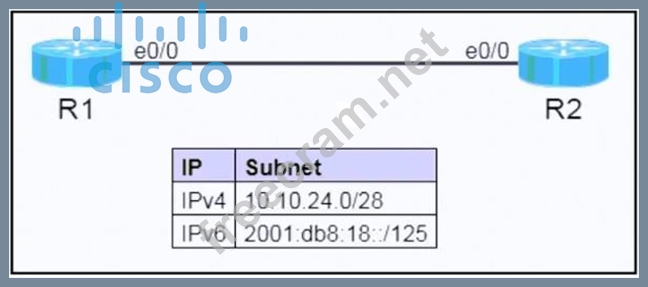
Reference Topology Diagram and table. Configure IPv4 and IPv6 between the two routers.
Task 1:
- Configure R1 with the first usable host IP address in the IPv4 network.
- Configure R2 with the last usable host IP address in the IPv4 network.
- Verify connectivity using ping.
Task 2:
- Do not assign the subnet router anycast address to either router.
- Configure R1 with the first usable host IP address in the IPv6 network.
- Configure R2 with the last usable host IP address in the IPv6 network.
- Verify connectivity using ping.
Guidelines
This is a lab item in which tasks will be performed on virtual devices.
- Refer to the Tasks tab to view the tasks for this lab item.
- Refer to the Topology tab to access the device console(s) and perform the tasks.
- Console access is available for all required devices by clicking the device icon or using the tab(s) above the console window.
- All necessary preconfigurations have been applied.
- Do not change the enable password or hostname for any device.
- Save your configurations to NVRAM before moving to the next item.
- Click Next at the bottom of the screen to submit this lab and move to the next question.
- When Next is clicked, the lab doses and cannot be reopened.
Topology
Tasks
Reference Topology Diagram and table. Configure IPv4 and IPv6 between the two routers.
Task 1:
- Configure R1 with the first usable host IP address in the IPv4 network.
- Configure R2 with the last usable host IP address in the IPv4 network.
- Verify connectivity using ping.
Task 2:
- Do not assign the subnet router anycast address to either router.
- Configure R1 with the first usable host IP address in the IPv6 network.
- Configure R2 with the last usable host IP address in the IPv6 network.
- Verify connectivity using ping.
Correct Answer:
See the below explanation
Explanation:
Task 1: Configure IPv4
1. IPv4 Subnet Analysis:
Subnet: 10.10.24.0/28

Subnet Mask: 255.255.255.240
Usable IP Range: 10.10.24.1 to 10.10.24.14 (first usable: 10.10.24.1, last usable: 10.10.24.14)
Broadcast Address: 10.10.24.15
2. Configuration on R1:
R1> enable
R1# configure terminal
R1(config)# interface e0/0
R1(config-if)# ip address 10.10.24.1 255.255.255.240
R1(config-if)# no shutdown
3. Configuration on R2:
R2> enable
R2# configure terminal
R2(config)# interface e0/0
R2(config-if)# ip address 10.10.24.14 255.255.255.240
R2(config-if)# no shutdown
3. Verify IPv4 Connectivity:
From R1:
R1# ping 10.10.24.14
From R2:
R2# ping 10.10.24.1
Task 2: Configure IPv6
1. IPv6 Subnet Analysis:
Subnet: 2001:db8:18::/125
Usable Range: 2001:db8:18::1 to 2001:db8:18::6 (first usable: 2001:db8:18::1, last usable:
2001:db8:18::6)
Do not assign 2001:db8:18:: (subnet router anycast address).
2. Configuration on R1:
R1> enable
R1# configure terminal
R1(config)# interface e0/0
R1(config-if)# ipv6 address 2001:db8:18::1/125
R1(config-if)# no shutdown
3. Configuration on R2:
R2> enable
R2# configure terminal
R2(config)# interface e0/0
R2(config-if)# ipv6 address 2001:db8:18::6/125
R2(config-if)# no shutdown
4. Verify IPv6 Connectivity:
From R1:
R1# ping 2001:db8:18::6
From R2:
R2# ping 2001:db8:18::1
Final Steps:
1. Save configurations on both routers:
R1# write memory
R2# write memory
2. Verify connectivity and interface status using:
show ip interface brief
show ipv6 interface brief
Explanation:
Task 1: Configure IPv4
1. IPv4 Subnet Analysis:
Subnet: 10.10.24.0/28
Subnet Mask: 255.255.255.240
Usable IP Range: 10.10.24.1 to 10.10.24.14 (first usable: 10.10.24.1, last usable: 10.10.24.14)
Broadcast Address: 10.10.24.15
2. Configuration on R1:
R1> enable
R1# configure terminal
R1(config)# interface e0/0
R1(config-if)# ip address 10.10.24.1 255.255.255.240
R1(config-if)# no shutdown
3. Configuration on R2:
R2> enable
R2# configure terminal
R2(config)# interface e0/0
R2(config-if)# ip address 10.10.24.14 255.255.255.240
R2(config-if)# no shutdown
3. Verify IPv4 Connectivity:
From R1:
R1# ping 10.10.24.14
From R2:
R2# ping 10.10.24.1
Task 2: Configure IPv6
1. IPv6 Subnet Analysis:
Subnet: 2001:db8:18::/125
Usable Range: 2001:db8:18::1 to 2001:db8:18::6 (first usable: 2001:db8:18::1, last usable:
2001:db8:18::6)
Do not assign 2001:db8:18:: (subnet router anycast address).
2. Configuration on R1:
R1> enable
R1# configure terminal
R1(config)# interface e0/0
R1(config-if)# ipv6 address 2001:db8:18::1/125
R1(config-if)# no shutdown
3. Configuration on R2:
R2> enable
R2# configure terminal
R2(config)# interface e0/0
R2(config-if)# ipv6 address 2001:db8:18::6/125
R2(config-if)# no shutdown
4. Verify IPv6 Connectivity:
From R1:
R1# ping 2001:db8:18::6
From R2:
R2# ping 2001:db8:18::1
Final Steps:
1. Save configurations on both routers:
R1# write memory
R2# write memory
2. Verify connectivity and interface status using:
show ip interface brief
show ipv6 interface brief


- Question List (773q)
- Question 1: Drag and Drop Question Drag and drop the RF terms from the l...
- Question 2: What are two benefits of private IPv4 IP addresses? (Choose ...
- Question 3: Which virtualization technology requires a base OS installat...
- Question 4: Lab Simulation 40 Guidelines This is a lab item in which tas...
- Question 5: Which NTP command configures the local devices as an NTP ref...
- Question 6: Why do large OSPF networks use a hierarchical design? (Choos...
- Question 7: Lab Simulation 41 Guidelines This is a lab item in which tas...
- Question 8: Refer to the exhibit. Which routes are configured with their...
- Question 9: Refer to the exhibit. How much OSPF be configured on the Gig...
- Question 10: Refer to the exhibit. Routers R1 and R2 have been configured...
- Question 11: Which two TCP messages use a 32-bit number as part of the in...
- Question 12: Which two protocols are supported on service-port interfaces...
- Question 13: What are two reasons to implement IPv4 private addressing on...
- Question 14: Lab Simulation 46 Guidelines This is a lab item in which tas...
- Question 15: Which IOS troubleshooting tool should you use to direct syst...
- Question 16: Drag and Drop Question Drag and drop the HTTP verbs from the...
- Question 17: A network administrator is troubleshooting the OSPF configur...
- Question 18: A network engineer must migrate a router loopback interface ...
- Question 19: Refer to the exhibit. An extended ACL has been configured an...
- Question 20: Refer to the exhibit. Clients on the WLAN are required to us...
- Question 21: An engineering team asks an implementer to configure syslog ...
- Question 22: The service password-encryption command is entered on a rout...
- Question 23: Which communication interaction takes place when a southboun...
- Question 24: Lab Simulation 62 Please use the "Tasks" and "Topology" tabs...
- Question 25: Lab Simulation 48 Guidelines This is a lab item in which tas...
- Question 26: What does traffic shaping do to reduce congestion in a netwo...
- Question 27: Which type of address is shared by routers in a HSRP impleme...
- Question 28: What is an appropriate use for private IPv4 addressing?...
- Question 29: Refer to the exhibit. Which prefix does Router1 use for traf...
- Question 30: Refer to the exhibit. When router R1 is sending traffic to I...
- Question 31: Refer to the exhibit. Which network prefix was learned via E...
- Question 32: Refer to the exhibit. Users on existing VLAN 100 can reach s...
- Question 33: Lab Simulation 65 Please use the "Tasks" and "Topology" tabs...
- Question 34: Refer to the exhibit. If OSPF Is running on this network, ho...
- Question 35: Which two WAN architecture options help a business scalabili...
- Question 36: Which IPv6 address type provides communication between subne...
- Question 37: Refer to the exhibit. An engineer executed the script and ad...
- Question 38: Which feature when used on a WLC allows it to bundle its dis...
- Question 39: Which two statements about DNS lookup operations are true? (...
- Question 40: Which PoE mode enables powered-devices detection and guarant...
- Question 41: Refer to the exhibit. A packet is being sent across router R...
- Question 42: What are two southbound APIs? (Choose two )...
- Question 43: Refer to the exhibit. What are the two steps an engineer mus...
- Question 44: Which interface condition is occurring in this output? (Exhi...
- Question 45: Lab Simulation 15 Guidelines This is a lab item in which tas...
- Question 46: in Which way does a spine and-leaf architecture allow for sc...
- Question 47: What are two roles of the Dynamic Host Configuration Protoco...
- Question 48: What is the functionality of the Cisco DNA Center?...
- Question 49: Which statement describes virtual machines?...
- Question 50: Refer to the exhibit. A packet sourced from 10.10.10.1 is de...
- Question 51: How are the switches in a spine-and-leaf topology interconne...
- Question 52: Refer to the exhibit. What is the value of the administrativ...
- Question 53: Which switch port configuration must be configured when conn...
- Question 54: What are the alert message generated by SNMP agents called? ...
- Question 55: What is a characteristic of an SSID in wireless networks?...
- Question 56: Which three encapsulation layers in the OSI model are combin...
- Question 57: Refer to the exhibit. Given the output for this command, if ...
- Question 58: When an access point is seeking to join wireless LAN control...
- Question 59: Lab Simulation 7 Guidelines This is a lab item in which task...
- Question 60: What is a functionality of the control plane in the network?...
- Question 61: Lab Simulation 49 Guidelines This is a lab item in which tas...
- Question 62: Which two VLAN IDs indicate a default VLAN? (Choose two.)...
- Question 63: What is represented by the word "LB20" within this JSON sche...
- Question 64: Refer to the exhibit. What is the subnet mask of the route t...
- Question 65: What is the recommended switch load-balancing mode for Cisco...
- Question 66: Which IPv6 address range is suitable for anycast addresses f...
- Question 67: Refer to the exhibit. A network engineer configures the CCNA...
- Question 68: Which mode must be used to configure EtherChannel between tw...
- Question 69: Refer to the exhibit. What data structure do the square brac...
- Question 70: Which command enables a router to become a DHCP client?...
- Question 71: Drag and Drop Question Drag and drop the characteristic from...
- Question 72: Refer to the exhibit. What is a reason for poor performance ...
- Question 73: Refer to the exhibit. Which configuration is needed to confi...
- Question 74: What is a characteristic of private IPv4 addressing?...
- Question 75: Which statement describes the effect of the overload keyword...
- Question 76: What differentiates the Cisco OfficeExtend AP mode from the ...
- Question 77: What is a function performed by a web server?...
- Question 78: Which statement about snmpv2 is true?...
- Question 79: Drag and Drop Question Drag and drop the threat-mitigation t...
- Question 80: Lab Simulation 39 Guidelines This is a lab item in which tas...
- Question 81: R1 has learned route 10.10.10.0/24 via numerous routing prot...
- Question 82: Which network plane is centralized and manages routing decis...
- Question 83: Which protocol does a REST API use to communicate?...
- Question 84: Refer to the exhibit. How many objects keys, and JSON list v...
- Question 85: Refer to the exhibit. A static route must be configured on R...
- Question 86: Which interface is used to send traffic to the destination n...
- Question 87: Which file transfer protocol omits a username or password re...
- Question 88: Refer to the exhibit. Which type of JSON data is shown? (Exh...
- Question 89: An engineer is updating the configuration on a switch. To me...
- Question 90: Which implementation provides the strongest encryption combi...
- Question 91: Refer to the exhibit. A network engineer is in the process o...
- Question 92: Drag and Drop Question Drag and drop the descriptions of sec...
- Question 93: Refer to the exhibit. If R1 receives a packet destined to 17...
- Question 94: What is represented in line 2 within this JSON schema? (Exhi...
- Question 95: What is a benefit of using private IPv4 addressing?...
- Question 96: In which circumstance would a network architect decide to im...
- Question 97: What must be considered for a locally switched FlexConnect A...
- Question 98: Refer to the exhibit. An engineer deploys a topology in whic...
- Question 99: Which mode must be set for Aps to communicate to a Wireless ...
- Question 100: Refer to the exhibit. Company A wants to use a RADIUS server...
- Question 101: Which WLC interface provides out-of-band management in the C...
- Question 102: Refer to the exhibit. Configurations for the switch and PCs ...
- Question 103: Refer to the exhibit. Which tasks must be performed on the D...
- Question 104: Which IPv6 address type provides communication between subne...
- Question 105: A Cisco engineer at a new branch office is configuring a wir...
- Question 106: When a WLAN with WPA2 PSK is configured in the Wireless LAN ...
- Question 107: Two switches are connected and using Cisco Dynamic Trunking ...
- Question 108: Refer to the exhibit. Which settings must be verified on wor...
- Question 109: Which statement identifies the functionality of virtual mach...
- Question 110: Which AP feature provides a captive portal for users to auth...
- Question 111: Which command can you enter to verify that a router is synce...
- Question 112: Which technology must be implemented to configure network de...
- Question 113: Assuming a subnet mask of 255.255.248.0, three of the follow...
- Question 114: Drag and Drop Question Drag and drop the functions of SNMP f...
- Question 115: Lab Simulation 53 Please use the "Tasks" and "Topology" tabs...
- Question 116: Why are API keys used to enforce rate limiting?...
- Question 117: How does CAPWAP communicate between an access point in local...
- Question 118: Refer to the exhibit. Which switch becomes the root of the s...
- Question 119: Which two statements about TACACS+ are true? (Choose two.)...
- Question 120: Which two characteristics are representative of virtual mach...
- Question 121: What is the function of a DNS forwarder?...
- Question 122: What is a characteristic of private IPv4 addressing?...
- Question 123: An engineer is configuring switch SW1 to act an NTP server w...
- Question 124: Which layer of the TCP/IP model manages the transmission of ...
- Question 125: What is the primary purpose of a recursive query in DNS?...
- Question 126: Which two practices are recommended for an acceptable securi...
- Question 127: Refer to the exhibit. An engineer is updating the management...
- Question 128: Refer to the exhibit. An engineer configured NAT translation...
- Question 129: What is a characteristic of private IPv4 addressing?...
- Question 130: Drag and Drop Question Refer to the exhibit. Drag and drop t...
- Question 131: Which alternative to password authentication is implemented ...
- Question 132: Drag and Drop Question Drag the IPv6 DNS record types from t...
- Question 133: Refer to the exhibit. IPv6 must be implemented on R1 to the ...
- Question 134: What describes a northbound REST API for SDN?...
- Question 135: Which value is used to determine the active router in an HSR...
- Question 136: Lab Simulation 56 Please use the "Tasks" and "Topology" tabs...
- Question 137: OSPF must be configured between routers R1 and R2. Which OSP...
- Question 138: What is the purpose of an ESSID?...
- Question 139: What is a service that is provided by a wireless controller?...
- Question 140: Drag and Drop Question Drag and drop the statements about de...
- Question 141: Refer to the exhibit. How many objects are present in the gi...
- Question 142: A network analyst is tasked with configuring the date and ti...
- Question 143: Drag and Drop Question Drag and drop the TCP or UDP details ...
- Question 144: Refer to the exhibit. According to the output, which paramet...
- Question 145: Refer to the exhibit. Which command must be issued to enable...
- Question 146: What layer of the OSI Model is included in TCP/IP Model's IN...
- Question 147: How does MAC learning function on a switch?...
- Question 148: Refer to the exhibit. A network engineer must configure the ...
- Question 149: What are two purposes of HSRP? (Choose two.)...
- Question 150: Which role does machine learning play in identifying network...
- Question 151: Which fact must the engineer consider when implementing IPse...
- Question 152: What OSPF command, when configured, will include all interfa...
- Question 153: Refer to the exhibit. Local access for R4 must be establishe...
- Question 154: Which interface condition is occurring in this output? (Exhi...
- Question 155: Drag and Drop Question Drag and drop the characteristic from...
- Question 156: Which benefit does automation provide in network management?...
- Question 157: What is the purpose of configuring different levels of syslo...
- Question 158: What is the default interface for in-band wireless network m...
- Question 159: What are two reasons to configure PortFast on a switch port ...
- Question 160: Which command can you enter to configure an IPV6 floating st...
- Question 161: Refer to the exhibit, you determine that Computer A cannot p...
- Question 162: Which option about JSON is true?...
- Question 163: An engineer must configure a WLAN using the strongest encryp...
- Question 164: What are two characteristics of a public cloud implementatio...
- Question 165: What is a characteristic of private IPv4 addressing?...
- Question 166: A Cisco engineer is configuring a WLC interface to handle RA...
- Question 167: Which signal frequency appears 60 times per minute?...
- Question 168: How will Link Aggregation be implemented on a Cisco Wireless...
- Question 169: Which IPsec mode provides encapsulation and encryption of th...
- Question 170: Which of the following protocols are used to auto negotiate ...
- Question 171: Lab Simulation 52 Please use the "Tasks" and "Topology" tabs...
- Question 172: Which option best describes an API?...
- Question 173: Refer to the exhibit. After the configuration is applied, th...
- Question 174: Which type of encryption does WPA1 use for data protection?...
- Question 175: Refer to the exhibit. An engineer must translate the PC1 IP ...
- Question 176: Refer to the exhibit. What is represented by "R1" and "SW1" ...
- Question 177: Refer to the exhibit. If RTR01 is configured as shown, which...
- Question 178: What are two reasons to deploy private addressing on a netwo...
- Question 179: What is the default behavior of a Layer 2 switch when a fram...
- Question 180: Which default condition must be considered when an encrypted...
- Question 181: What is a function of a northbound API in a network architec...
- Question 182: An engineer must establish a trunk link between two switches...
- Question 183: What is a characteristic of encryption in wireless networks?...
- Question 184: Which protocol supports sharing the VLAN configuration betwe...
- Question 185: What does a router do when configured with the default DNS l...
- Question 186: Drag and Drop Question Drag and drop the TCP and UDP charact...
- Question 187: Which type of DNS record is used to specify the mail server ...
- Question 188: What is represented beginning with line 1 and ending with li...
- Question 189: An engineer observes high usage on the 2.4GHz channels and l...
- Question 190: Lab Simulation 24 Guidelines This is a lab item in which tas...
- Question 191: Refer to the exhibit. An OSPF neighbor relationship must be ...
- Question 192: Which command prevents passwords from being stored in the co...
- Question 193: What is a characteristic of frame switching?...
- Question 194: Refer to the exhibit. What is the next-hop IP address for R2...
- Question 195: Refer to the exhibit. An engineer is asked to insert the new...
- Question 196: Which statement about RADIUS security is true?...
- Question 197: What is a similarity between 1000BASE-LX and 1000BASE-T stan...
- Question 198: Refer to the exhibit. Which change to the configuration on S...
- Question 199: Drag and Drop Question Refer to the exhibit. Drag and drop t...
- Question 200: Refer to the exhibit. Which IP route command created the bes...
- Question 201: When configuring a WLAN with WPA2 PSK in the Cisco Wireless ...
- Question 202: Which name describes an IPV6 host-enable tunneling technique...
- Question 203: What is a characteristic of encryption in wireless networks?...
- Question 204: Drag and Drop Question Drag and drop the RF terms from the l...
- Question 205: A wireless administrator has configured a WLAN; however, the...
- Question 206: Which two statements distinguish authentication from account...
- Question 207: What is a characteristic of private IPv4 addressing?...
- Question 208: What are two differences between WPA2 and WPA3 wireless secu...
- Question 209: Which port security violation mode drops traffic from unknow...
- Question 210: Drag and Drop Question Refer to the exhibit. OSPF is running...
- Question 211: Drag and Drop Question Drag and drop the descriptions of fil...
- Question 212: Router R1 must send all traffic without a matching routing-t...
- Question 213: Drag and Drop Question Drag and drop the IPv6 address types ...
- Question 214: Which RFC was created to alleviate the depletion of IPv4 pub...
- Question 215: Refer to the exhibit. A network engineer is adding another p...
- Question 216: What are two protocols within the IPsec suite? (Choose two.)...
- Question 217: Under which condition is TCP preferred over UDP?...
- Question 218: Which component of a routing table entry represents the subn...
- Question 219: Refer to the exhibit. Which functionalities will this SSID h...
- Question 220: Which architecture supports centralized firmware updates and...
- Question 221: Refer to the exhibit. PC Y is communicating with another dev...
- Question 222: Which 802.11 management frame type is sent when a client roa...
- Question 223: What is the function of a controller in controller-based net...
- Question 224: Which two server types support domain name to IP address res...
- Question 225: What is a benefit of a point-to-point leased line?...
- Question 226: Which protocol uses the SSL?
- Question 227: SIMULATION 72 Please use the "Tasks" and "Topology" tabs to ...
- Question 228: Refer to the exhibit. Which VLAN ID is associated with the d...
- Question 229: What is a purpose of traffic shaping?...
- Question 230: What is a valid IPv6 address record in DNS?...
- Question 231: In software-defined architectures, which plane is distribute...
- Question 232: Which two primary drivers support the need for network autom...
- Question 233: Which statement correctly compares traditional networks and ...
- Question 234: What is one reason to implement LAG on a Cisco WLC?...
- Question 235: Which protocol requires authentication to transfer a backup ...
- Question 236: What is a similarity between OM3 and OM4 fiber optic cable?...
- Question 237: Refer to the exhibit. The link between PC1 and the switch is...
- Question 238: How is noise defined in Wi-Fi?
- Question 239: Which role does AI play in monitoring network data flow?...
- Question 240: What is the role of nonoverlapping channels in a wireless en...
- Question 241: Refer to the exhibit. Which address will the client contact ...
- Question 242: Which command must be entered to configure a DHCP relay?...
- Question 243: Lab Simulation 31 Guidelines This is a lab item in which tas...
- Question 244: A network engineer is Installing an IPv6-only capable device...
- Question 245: Refer to the exhibit. How should the configuration be update...
- Question 246: Drag and Drop Question Drag and drop the characteristic from...
- Question 247: Lab Simulation 50 Guidelines This is a lab item in which tas...
- Question 248: Refer to the exhibit. Which switch becomes the root bridge? ...
- Question 249: Which design element is a best practice when deploying an 80...
- Question 250: Refer to the exhibit. An IPv6 address must be obtained autom...
- Question 251: What does the implementation of a first-hop redundancy proto...
- Question 252: Refer to the exhibit. Four load-balancing servers are reacha...
- Question 253: Refer to the exhibit. Wireless LAN access must be set up to ...
- Question 254: Drag and Drop Question Drag and drop the transport layer req...
- Question 255: Which additional component does Digest Authentication use wi...
- Question 256: What is the authoritative source for an address lookup?...
- Question 257: Refer to the exhibit. With a reference bandwidth of 100 Gb o...
- Question 258: Which NAT function can map multiple inside addresses to a si...
- Question 259: Which action is taken by a switch port enabled for PoE power...
- Question 260: Which network action occurs within the data plane?...
- Question 261: Which output displays a JSON data representation?...
- Question 262: A switch is forwarding a frame out of all interfaces except ...
- Question 263: Which security element uses a combination of one-time passwo...
- Question 264: What are two differences between optical-fiber cabling and c...
- Question 265: Where does the configuration reside when a helper address is...
- Question 266: After a recent security breach and a RADIUS failure, an engi...
- Question 267: Refer to the exhibit. Connections must be blocked from PC2 t...
- Question 268: Which SNMP message type is reliable and precedes an acknowle...
- Question 269: What is a feature of TFTP?
- Question 270: How does frame switching function on a switch?...
- Question 271: What are two characteristics of SSH? (Choose two.)...
- Question 272: How does machine learning improve the detection of unauthori...
- Question 273: Refer to the exhibit. A network administrator assumes a task...
- Question 274: Refer to the exhibit. A packet sourced from 10.10.10.1 is de...
- Question 275: Drag and Drop Question Drag and drop the characteristic from...
- Question 276: Lab Simulation 54 Please use the "Tasks" and "Topology" tabs...
- Question 277: Where are the real-time control functions processed in a spl...
- Question 278: Refer to the exhibit. A network engineer must block access f...
- Question 279: What is an advantage of Cisco DNA Center versus traditional ...
- Question 280: Which command must you use to test DNS connectivity?...
- Question 281: Lab Simulation 9 Guidelines This is a lab item in which task...
- Question 282: Refer to the exhibit. Router R1 must be configured to reach ...
- Question 283: Drag and Drop Question Drag and drop the characteristics fro...
- Question 284: Drag and Drop Question Drag and drop the IPv6 address from t...
- Question 285: Which three are the components of SNMP? (Choose three)...
- Question 286: What is the RFC 4627 default encoding for JSON text?...
- Question 287: Refer to the exhibit. A guest WLAN must be created that prom...
- Question 288: Refer to the exhibit. A packet sourced from 10.10.10.32 is d...
- Question 289: Refer to the exhibit. If the default gateway is the first us...
- Question 290: Refer to the exhibit. Users in your office are complaining t...
- Question 291: What is a role of access points in an enterprise network?...
- Question 292: An engineer needs to add an old switch back into a network. ...
- Question 293: Drag and Drop Question Drag and drop the characteristic from...
- Question 294: R1 as an NTP server must have: - NTP authentication enabled ...
- Question 295: Refer to the exhibit. Which IPv6 configuration is required f...
- Question 296: Refer to the exhibit. Which command configures OSPF on the p...
- Question 297: How does the dynamically-learned MAC address feature functio...
- Question 298: A router has two static routes to the same destination netwo...
- Question 299: Refer to the exhibit. The loopback1 interface of the Atlanta...
- Question 300: What is represented by the word "fe5/42" within this JSON sc...
- Question 301: What is the path for traffic sent from one user workstation ...
- Question 302: How does a Cisco IP phone handle untagged traffic that it re...
- Question 303: Refer to the exhibit. An engineer configures interface fa0/1...
- Question 304: Refer to the exhibit. Which two commands when used together ...
- Question 305: Drag and Drop Question Drag drop the descriptions from the l...
- Question 306: SIMULATION 75 Please use the "Tasks" and "Topology" tabs to ...
- Question 307: A project objective is to minimize the association time to t...
- Question 308: Refer to the exhibit. Users at a branch office are experienc...
- Question 309: Which sequence begins a unique local IPv6 address in binary ...
- Question 310: Refer to the exhibit. When PC 1 sends a packet to PC2,the pa...
- Question 311: What is represented in line 2 within this JSON schema? (Exhi...
- Question 312: Refer to the exhibit. A network administrator configures an ...
- Question 313: Which Rapid PVST+ port state does a port operate in without ...
- Question 314: which type of IP address of ipv6 that also exist in IPv4 but...
- Question 315: Which two statements about IPv4 multicast traffic are true? ...
- Question 316: Refer to the exhibit. All interfaces are configured with dup...
- Question 317: Which attribute does a router use to select the best path wh...
- Question 318: Which Rapid PVST+ feature should be configured on a switch p...
- Question 319: Lab Simulation 22 Guidelines This is a lab item in which tas...
- Question 320: Which two goals reasons to implement private IPv4 addressing...
- Question 321: How many bits represent network id in a IPv6 address?...
- Question 322: Which value is the unique identifier that an access point us...
- Question 323: What is an Ansible inventory?
- Question 324: Which IPsec encryption mode is used for site-to-site VPNs?...
- Question 325: A security administrator wants to profile endpoints and gain...
- Question 326: What is the main difference between traditional networks and...
- Question 327: Refer to the exhibit. What is the administrative distance fo...
- Question 328: Refer to the exhibit. A Cisco engineer is asked to update th...
- Question 329: Refer to the exhibit. Which two statements about the interfa...
- Question 330: What are network endpoints?
- Question 331: How does network automation help reduce network downtime?...
- Question 332: Refer to the exhibit. In which structure does the word "warn...
- Question 333: How does a hub handle a frame traveling to a known destinati...
- Question 334: Drag and Drop Question Drag and drop the Wi-Fi terms from th...
- Question 335: Drag and Drop Question Drag and drop the statements about ne...
- Question 336: Which is a fact related to FTP?...
- Question 337: Which connection type is used when an engineer connects to a...
- Question 338: How does TFTP operate in a network?...
- Question 339: Refer to the exhibit. The iPv6 address for the LAN segment o...
- Question 340: Refer to the exhibit. Packets received by the router from BG...
- Question 341: Refer to the exhibit. An architect is managing a wireless ne...
- Question 342: Which subnet address is for the IP address 172.19.20.23/28?...
- Question 343: When a router undergoes the exchange protocol within OSPF, i...
- Question 344: Refer to the exhibit. A network engineer must provide config...
- Question 345: Which interface is used to send traffic to the destination n...
- Question 346: What prevents a workstation from receiving a DHCP address?...
- Question 347: An administrator must use the password complexity not manufa...
- Question 348: Refer to the exhibit. A network administrator is configuring...
- Question 349: Refer to the exhibit. Which Command do you enter so that R1 ...
- Question 350: Drag and Drop Question Drag and drop the statements about ne...
- Question 351: Which two statements about VTP are true? (Choose two.)...
- Question 352: Which interface is used to send traffic to the destination n...
- Question 353: Refer to the exhibit. Which routing protocol has the best ad...
- Question 354: When a switch receives a frame from an unknown source MAC ad...
- Question 355: Drag and Drop Question Drag and drop the DHCP snooping terms...
- Question 356: What is a function of Wireless LAN Controller?...
- Question 357: Which command can you enter to determine the addresses that ...
- Question 358: Refer to the exhibit. A newly configured PC fails to connect...
- Question 359: Which Cisco IOS command will indicate that interface Gigabit...
- Question 360: The SW1 interface g0/1 is in the down/down state. What are t...
- Question 361: What is a function of MAC address learning?...
- Question 362: Which command must be configured to enable port security wit...
- Question 363: Refer to the exhibit. The network engineer is configuring a ...
- Question 364: When a client and server are not on the same physical networ...
- Question 365: An engineer is installing a new wireless printer with a stat...
- Question 366: Drag and Drop Question Drag and drop the IPv6 address detail...
- Question 367: When configuring an EtherChannel bundle, which mode enables ...
- Question 368: What is a function of Cisco Advanced Malware Protection for ...
- Question 369: Which set of conditions comprises a successful ping attempt ...
- Question 370: What is the default VLAN on an access port?...
- Question 371: Refer to the exhibit. Which switch in this configuration wil...
- Question 372: Drag and Drop Question Drag and drop the network topology ar...
- Question 373: Which two statements correctly describe RADIUS? (Choose two)...
- Question 374: An engineer must update the configuration on two PCs in two ...
- Question 375: Drag and Drop Question Drag and drop the networking paramete...
- Question 376: What is a benefit of using a Cisco Wireless LAN Controller?...
- Question 377: Drag and Drop Question Drag and drop the characteristic from...
- Question 378: Which characteristic differentiates the concept of authentic...
- Question 379: Refer to the exhibit. Router R14 is in the process of being ...
- Question 380: A network engineer must configure the router R1 GigabitEther...
- Question 381: Which type of port is used to connect the wired network when...
- Question 382: In what way does a network supervisor reduce maintenance cos...
- Question 383: Refer to the exhibit. Switch A is newly configured. All VLAN...
- Question 384: Refer to the exhibit. What is the cause of poor performance ...
- Question 385: Why is TCP desired over UDP for applications that require ex...
- Question 386: Drag and Drop Question Drag and drop the functions from the ...
- Question 387: What is the collapsed layer in collapsed core architectures?...
- Question 388: By default, how does EIGRP determine the metric of a route f...
- Question 389: Drag and Drop Question Refer to the exhibit. Drag and drop t...
- Question 390: A Cisco engineer notices that two OSPF neighbors are connect...
- Question 391: What does physical access control regulate?...
- Question 392: Refer to the exhibit. An engineer ts building a new Layer 2 ...
- Question 393: When is the PUT method used within HTTP?...
- Question 394: Refer to the exhibit. An administrator must configure interf...
- Question 395: Which two circumstances can prevent two routers from establi...
- Question 396: What are two reasons for an engineer to configure a floating...
- Question 397: The OSPF Hello protocol performs which of the following task...
- Question 398: An engineer needs to configure LLDP to send the port descrip...
- Question 399: Which QoS feature drops traffic that exceeds the committed a...
- Question 400: Refer to the exhibit. User traffic originating within site B...
- Question 401: What is a reason to implement IPv4 private addressing?...
- Question 402: Refer to the exhibit. Routers R1, R2, and R3 use a protocol ...
- Question 403: Which function dose the range of private IPv4 addresses perf...
- Question 404: Refer to the exhibit. A network engineer configures the Cisc...
- Question 405: Refer to the exhibit. An engineer booted a new switch and ap...
- Question 406: Lab Simulation 30 Guidelines This is a lab item in which tas...
- Question 407: How does frame switching function on a switch?...
- Question 408: Which command is used to verify the DHCP relay agent address...
- Question 409: Refer to the exhibit. Which switch in this configuration wil...
- Question 410: Drag and Drop Question Drag and drop the common functions fr...
- Question 411: Which AP mode wirelessly connects two separate network segme...
- Question 412: Drag and Drop Question Drag and drop the characteristic from...
- Question 413: Drag and Drop Question Drag and drop the SNMP components fro...
- Question 414: Which cipher is supported for wireless encryption only with ...
- Question 415: Drag and Drop Question Drag and drop the AAA features from t...
- Question 416: Refer to the exhibit. C-router is to be used as a "router-on...
- Question 417: An engineer is configuring a switch port that is connected t...
- Question 418: Drag and Drop Question Drag and drop the characteristic from...
- Question 419: Which technology can prevent client devices from arbitrarily...
- Question 420: Which statement best describes the IPsec site-to-site VPN?...
- Question 421: Refer to the exhibit. Which two commands must be added to up...
- Question 422: What must be considered when using 802:11 ta?...
- Question 423: Lab Simulation 47 Guidelines This is a lab item in which tas...
- Question 424: What should a network administrator consider when deciding t...
- Question 425: Drag and Drop Question Drag and drop the statements about AA...
- Question 426: Refer to the exhibit. Which command provides this output? (E...
- Question 427: Which type of traffic Is sent with pure iPsec?...
- Question 428: What is represented beginning with line 1 and ending with li...
- Question 429: What is used as a solution for protecting an individual netw...
- Question 430: What is a characteristic of RSA?...
- Question 431: Which feature or protocol determines whether the QOS on the ...
- Question 432: When is the most appropriate time to escalate an issue that ...
- Question 433: If primary and secondary root switches with priority 16384 b...
- Question 434: Refer to the exhibit. A network engineer is configuring a wi...
- Question 435: Which configuration ensures that the switch is always the ro...
- Question 436: Refer to the exhibit. A VTY password has been set to Labtest...
- Question 437: What is a function of a southbound API?...
- Question 438: Refer to the exhibit. A network engineer is verifying the se...
- Question 439: Lab Simulation 45 Guidelines This is a lab item in which tas...
- Question 440: Which switch technology establishes a network connection imm...
- Question 441: Which command can you enter to display the hits counter for ...
- Question 442: Which command creates a static NAT binding for a PC address ...
- Question 443: Which two capabilities of Cisco DNA Center make it more exte...
- Question 444: Refer to the exhibit. Which command configures a floating st...
- Question 445: What is a feature of WPA?
- Question 446: How does MAC learning function on a switch?...
- Question 447: Lab Simulation 57 Please use the "Tasks" and "Topology" tabs...
- Question 448: Refer to the exhibit. When router R1 receives a packet with ...
- Question 449: Drag and Drop Question Drag and drop the protocol characteri...
- Question 450: Refer to exhibit. Which statement explains the configuration...
- Question 451: Which of the following is the JSON encoding of a dictionary ...
- Question 452: How does AI contribute to network traffic analysis?...
- Question 453: Refer to the exhibit. A network administrator must permit SS...
- Question 454: What is the root port in STP?
- Question 455: Refer to the exhibit. Based on the LACP neighbor status, in ...
- Question 456: Refer to the exhibit. Which switch in this configuration wil...
- Question 457: Which two command sequences must be configured on a switch t...
- Question 458: Which three describe the reasons large OSPF networks use a h...
- Question 459: Which technology supports the stateless assignment of IPv6 a...
- Question 460: Which type of IPv6 address is similar to a unicast address b...
- Question 461: Drag and Drop Question Drag and drop the characteristic from...
- Question 462: What are two reasons to implement DHCP in a network? (Choose...
- Question 463: Drag and Drop Question Drag and drop the IPv6 address from t...
- Question 464: Which mode allows access points to be managed by Cisco Wirel...
- Question 465: What is the role of syslog level 7 in network device health ...
- Question 466: How do generative models support network design testing?...
- Question 467: Which command must be entered to configure a DHCP relay?...
- Question 468: Which information is used to install the best route to a des...
- Question 469: Refer to the exhibit. On R1 which routing protocol is in use...
- Question 470: Lab Simulation 66 Please use the "Tasks" and "Topology" tabs...
- Question 471: Which two statements about firewalls are true ?...
- Question 472: Drag and Drop Question Drag and drop the IPv6 address type c...
- Question 473: Refer to the exhibit. What two conclusions should be made ab...
- Question 474: Which port type supports the spanning-tree portfast command ...
- Question 475: Refer to the exhibit. Switch AccSw1 has just been added to t...
- Question 476: Refer to the exhibit. Router R1 is running three different r...
- Question 477: An administrator must secure the WLC from receiving spoofed ...
- Question 478: If a router has four interfaces and each interface is connec...
- Question 479: How does STP prevent forwarding loops at OSI Layer 2?...
- Question 480: Lab Simulation 23 Guidelines This is a lab item in which tas...
- Question 481: What is represented by the word "switch" within this JSON sc...
- Question 482: What are two benefits of private IPv4 addressing? (Choose tw...
- Question 483: Which three features are added in SNMPv3 over SNMPv2?...
- Question 484: Which version of SNMP first allowed user-based access?...
- Question 485: Drag and Drop Question Drag and drop the AAA terms from the ...
- Question 486: Refer to the exhibit. What is preventing host A from reachin...
- Question 487: Refer to the exhibit. Which two commands were used to create...
- Question 488: Drag and Drop Question Drag and drop the characteristic from...
- Question 489: Refer to the exhibit. An engineer is configuring a Layer 3 p...
- Question 490: Which two statements are true about the command ip route 172...
- Question 491: Which two principles must be considered when using per-hop b...
- Question 492: Drag and Drop Question Drag and drop the QoS terms from the ...
- Question 493: What is represented in line 3 within this JSON schema? (Exhi...
- Question 494: What is a characteristic of private IPv4 addressing?...
- Question 495: Refer to the exhibit. The static routes were implemented on ...
- Question 496: Refer to the exhibit. A network engineer started to change d...
- Question 497: What is a characteristic of encryption in wireless networks?...
- Question 498: What is a characteristic of a Layer 2 switch?...
- Question 499: Refer to the exhibit. Which VLAN ID is associated with the n...
- Question 500: How does MAC learning function on a switch?...
- Question 501: Refer to the exhibit. Routers R1 and R2 are configured with ...
- Question 502: A network administrator enabled port security on a switch in...
- Question 503: Which interface condition is occurring in this output? (Exhi...
- Question 504: What is a link-local all-nodes IPv6 multicast address?...
- Question 505: What is the benefit of using FHRP (First Hop Redundancy Prot...
- Question 506: Which statement about Cisco Discovery Protocol is true?...
- Question 507: What is an expected outcome when network management automati...
- Question 508: What is the role of disaggregation in controller-based netwo...
- Question 509: Refer to the exhibit. Which entry is the longest prefix matc...
- Question 510: Drag and Drop Question Drag and drop the attack-mitigation t...
- Question 511: Refer to the exhibit. Which switch becomes the root bridge? ...
- Question 512: Which technology allows a large number of private IP address...
- Question 513: R1 has learned route 192.168.12.0/24 via IS-IS, OSPF, RIP an...
- Question 514: Refer to the exhibit. The network administrator wants VLAN 6...
- Question 515: Drag and Drop Question Drag and drop the Rapid PVST+ forward...
- Question 516: Refer to the exhibit. An engineer is configuring an EtherCha...
- Question 517: Which two of these functions do routers perform on packets? ...
- Question 518: Which type of wireless encryption is used for WPA2 in pre-sh...
- Question 519: Refer to the exhibit. Which format matches the Modified EUI-...
- Question 520: What is a characteristic of frame switching?...
- Question 521: Why would a network administrator choose to implement automa...
- Question 522: Refer to the exhibit SW_1 and SW_12 represent two companies ...
- Question 523: Which protocol does an access point use to draw power from a...
- Question 524: Refer to the exhibit. Only four switches are participating i...
- Question 525: Which interface is used to send traffic to the destination n...
- Question 526: Refer to the exhibit. The router has been configured with a ...
- Question 527: Refer to the exhibit. Which next-hop IP address does Router1...
- Question 528: Which capability does TFTP provide?...
- Question 529: What is a function of the core and distribution layers in a ...
- Question 530: What is the role of community strings in SNMP operations?...
- Question 531: How does IPsec provide secure networking for applications wi...
- Question 532: Which device segregates a network into separate zones that h...
- Question 533: Refer to the exhibit. What is the effect of the given config...
- Question 534: An engineer is configuring router R1 with an IPv6 static rou...
- Question 535: Refer to the exhibit. Which configuration enables an EtherCh...
- Question 536: Which feature or protocol is required for an IP SLA to measu...
- Question 537: An engineer must configure a /30 subnet between two routers....
- Question 538: Drag and Drop Question Drag and drop the characteristic from...
- Question 539: What is the difference between the TCP and UDP protocols?...
- Question 540: A DHCP pool has been created with the name NOCC. The pool is...
- Question 541: What is represented in line 2 within this JSON schema? (Exhi...
- Question 542: What is a characteristic of private IPv4 addressing?...
- Question 543: Which type of organization should use a collapsed-core archi...
- Question 544: Which interface condition is occurring in this output? (Exhi...
- Question 545: What is represented by the word "firewall" within this JSON ...
- Question 546: What is a functionality of HSRP?...
- Question 547: Drag and Drop Question Drag and drop the statements about AA...
- Question 548: Refer to the exhibit. Which action by the router when a pack...
- Question 549: Drag and Drop Question Drag and drop the Cisco IOS attack mi...
- Question 550: By default, which port is the following telnet command going...
- Question 551: Refer to the exhibit. How does router R1 handle traffic to t...
- Question 552: Which REST method updates an object in the Cisco DNA Center ...
- Question 553: What does traffic shaping do?
- Question 554: Drag and Drop Question Drag and drop the statements about ac...
- Question 555: Refer to the exhibit. The IPv6 address for the LAN segment o...
- Question 556: What is the difference between the TCP and UDP protocols?...
- Question 557: Which additional configuration step is necessary in order to...
- Question 558: What is a function of an endpoint on a network?...
- Question 559: Which port-security violation mode drops traffic from unknow...
- Question 560: Which two actions are performed by the Weighted Random Early...
- Question 561: Refer to the exhibit. An engineer was asked to update a wire...
- Question 562: Refer to the exhibit A new VLAN and switch are added to the ...
- Question 563: Drag and Drop Question Drag and drop the traffic types from ...
- Question 564: A device detects two stations transmitting frames at the sam...
- Question 565: Refer to the exhibit. Router R1 resides in OSPF Area 0. Afte...
- Question 566: An engineer must configure a core router with a floating sta...
- Question 567: Refer to the exhibit. What action establishes the OSPF neigh...
- Question 568: How does WPA3 improve security?...
- Question 569: How does MAC learning function?...
- Question 570: An engineer must configure R1 for a new user account. The ac...
- Question 571: What is a function spine-and-leaf architecture?...
- Question 572: Which two components comprise part of a PKI? (Choose two.)...
- Question 573: Which interface is used by an administrator to access the WL...
- Question 574: What are two characteristics of a controller-based network? ...
- Question 575: When deploying syslog, which severity level logs information...
- Question 576: When deploying a new network that includes both Cisco and th...
- Question 577: Drag and Drop Question Drag and drop the DNS lookup commands...
- Question 578: Refer to the exhibit. When PC-A sends traffic to PC-B, which...
- Question 579: When the LAG configuration is updated on a Cisco WLC, which ...
- Question 580: How do UTP and STP cables compare?...
- Question 581: Which action protects a network from VLAN hopping attacks?...
- Question 582: Refer to the exhibit. The loopback IP of R3 has been learned...
- Question 583: Which interface configuration type is needed for a FlexConne...
- Question 584: Which statement about LLDP is true?...
- Question 585: Which two encoding methods are supported by REST APIs? (Choo...
- Question 586: What is a function of store-and forward switching?...
- Question 587: Drag and Drop Question Drag and drop the IPv6 address from t...
- Question 588: Which syslog message logging level displays interface line p...
- Question 589: Refer to the exhibit. An administrator received a call from ...
- Question 590: What occurs to frames during the process of frame flooding?...
- Question 591: Refer to the exhibit. A secondary route is required on route...
- Question 592: Which two statements about data VLANs on access ports are tr...
- Question 593: Refer to the exhibit. Which two values does router R1 use to...
- Question 594: When the active router in an HSRP group fails, which router ...
- Question 595: A wireless access point is needed and must meet these requir...
- Question 596: Which configuration command can you apply to a HSRP router s...
- Question 597: Which command configures the Cisco WLC to prevent a serial s...
- Question 598: When configuring IPv6 on an interface, which two IPv6 multic...
- Question 599: Refer to the exhibit. A network engineer must configure rout...
- Question 600: Which technology allows multiple operating systems to run a ...
- Question 601: Why would VRRP be implemented when configuring a new subnet ...
- Question 602: Refer to the exhibit. This ACL is configured to allow client...
- Question 603: Which IEEE mechanism is responsible for the authentication o...
- Question 604: What is a requirement for nonoverlapping Wi-Fi channels?...
- Question 605: Why would a network administrator implement the HSRP protoco...
- Question 606: Refer to the exhibit. Which interface does a packet take to ...
- Question 607: What is a characteristic of frame switching?...
- Question 608: Lab Simulation 59 Please use the "Tasks" and "Topology" tabs...
- Question 609: When a switch receives a frame for an unknown destination MA...
- Question 610: Which type does a port become when it receives the best BPDU...
- Question 611: Which feature on the Cisco Wireless LAN Controller when enab...
- Question 612: What is the expected outcome when an EUI-64 address is gener...
- Question 613: How does MAC learning function?...
- Question 614: Drag and Drop Question Refer to the exhibit. Drag and drop t...
- Question 615: What are two reasons a network administrator would use CDP? ...
- Question 616: Which two descriptions of TACACS+ are true? (Choose two.)...
- Question 617: Which components are contained within a virtual machine?...
- Question 618: What is the benefit of using private IPv4 addressing?...
- Question 619: Which two cable types must be used to connect an access poin...
- Question 620: Which interface is used to send traffic to the destination n...
- Question 621: Which AP mode is used in a wireless mesh deployment?...
- Question 622: Which element of a virtualization solution manages virtualiz...
- Question 623: Which command is necessary to permit SSH or Telnet access to...
- Question 624: What is the purpose of the ip address dhcp command?...
- Question 625: Refer to the exhibit. Which two commands, when configured on...
- Question 626: Which WPA3 enhancement protects against hackers viewing traf...
- Question 627: Refer to the exhibit. An engineer is configuring a new Cisco...
- Question 628: What are the two functions of SSIDs? (Choose two.)...
- Question 629: Which two statements about wireless LAN controllers are true...
- Question 630: Refer to the exhibit. How many JSON objects are represented?...
- Question 631: What is the temporary state that switch ports always enter i...
- Question 632: Which technique can you use to route IPv6 traffic over an IP...
- Question 633: How does a network administrator securely manage an AP in li...
- Question 634: Which two VPN technologies are recommended by Cisco for mult...
- Question 635: A manager asks a network engineer to advise which cloud serv...
- Question 636: When you enable PortFast on a switch port, the port immediat...
- Question 637: Lab Simulation 10 Guidelines This is a lab item in which tas...
- Question 638: Which two VLAN IDs indicate a default VLAN? (Choose two.)...
- Question 639: What is a function of a remote access VPN?...
- Question 640: Which device tracks the state of active connections in order...
- Question 641: A network engineer must implement an IPv6 configuration on t...
- Question 642: A network architect is considering whether to implement Cisc...
- Question 643: Which three statements are typical characteristics of VLAN a...
- Question 644: Drag and Drop Question Drag and drop the characteristics of ...
- Question 645: What is a function of a Next-Generation IPS?...
- Question 646: Router A learns the same route from two different neighbors,...
- Question 647: Refer to the exhibit. The default-information originate comm...
- Question 648: Refer to the exhibit. All routers in the network are configu...
- Question 649: Lab Simulation 67 Please use the "Tasks" and "Topology" tabs...
- Question 650: Which two statements about exterior routing protocols are tr...
- Question 651: If router R1 knows a static route to a destination network a...
- Question 652: Which technology can enable multiple VLANs to communicate wi...
- Question 653: Which two features introduced in SNMPv2 provides the ability...
- Question 654: Which command can you enter to assign an interface to the de...
- Question 655: What is a characteristic of an SSID in wireless networks?...
- Question 656: Refer to the exhibit. Inter-VLAN routing is configured on SW...
- Question 657: Refer to the exhibit. Which two statements are true about th...
- Question 658: What differentiates device management enabled by Cisco DNA C...
- Question 659: Refer to the exhibit. What does apple represent within the J...
- Question 660: Which two components are needed to create an Ansible script ...
- Question 661: What is the correct routing match to reach 172.16.1.5/32?...
- Question 662: Which two transport layer protocols carry syslog messages? (...
- Question 663: Why would VRRP be implemented when configuring a new subnet ...
- Question 664: Refer to the exhibit. What is the correct next hop for route...
- Question 665: Refer to the exhibit. Which command would you use to configu...
- Question 666: A switch receives a frame with the destination MAC address 3...
- Question 667: Lab Simulation 51 Please use the "Tasks" and "Topology" tabs...
- Question 668: Refer to the exhibit. The IPv6 address for the LAN segment o...
- Question 669: What are two characteristics of a small office / home office...
- Question 670: Refer to the exhibit. The user has connectivity to devices o...
- Question 671: Which command can you enter in a network switch configuratio...
- Question 672: An email user has been lured into clicking a link in an emai...
- Question 673: Drag and Drop Question Drag and drop the SNMP components fro...
- Question 674: Drag and Drop Question Refer to the exhibit. Drag and drop t...
- Question 675: Refer to the exhibit. Which address and mask combination rep...
- Question 676: Refer to the exhibit. Router-WAN1 has a new connection via G...
- Question 677: What uses HTTP messages to transfer data to applications res...
- Question 678: An engineer is configuring NAT to translate the source subne...
- Question 679: An engineer must configure traffic for a VLAN that is untagg...
- Question 680: What is a reason to configure a trunk port that connects to ...
- Question 681: Which two protocols are used by an administrator for authent...
- Question 682: What role does a hypervisor provide for each virtual machine...
- Question 683: Drag and Drop Question Drag and drop the IPv6 address descri...
- Question 684: Which command should you enter to configure an LLDP delay ti...
- Question 685: What is the advantage of separating the control plane from t...
- Question 686: Refer to the exhibit. Which rule does the DHCP server use wh...
- Question 687: Refer to the exhibit. Of the routes learned with dynamic rou...
- Question 688: What is the purpose of a CNAME record?...
- Question 689: Drag and Drop Question Drag and drop the characteristic from...
- Question 690: What is the difference in data transmission delivery and rel...
- Question 691: Refer to the exhibit. An engineer is creating a secure presh...
- Question 692: Refer to the exhibit. A network engineer updates the existin...
- Question 693: Which two statements correctly describe distance-vector rout...
- Question 694: Which Layer 2 switch function encapsulates packets for diffe...
- Question 695: What is a reason why an administrator would choose to implem...
- Question 696: If Port-channel1 is the uplink interface of the access-layer...
- Question 697: Which type of address is the public IP address of a NAT devi...
- Question 698: Which interface is used to send traffic to the destination n...
- Question 699: For which two protocols can PortFast alleviate potential hos...
- Question 700: Drag and Drop Question Drag and drop the IPv4 network subnet...
- Question 701: Refer to the exhibit. The EtherChannel is configured with a ...
- Question 702: Which component of an Ethernet frame is used to notify a hos...
- Question 703: Which IPsec encryption mode is appropriate when the destinat...
- Question 704: Refer to the exhibit. What configuration on RTR-1 denies SSH...
- Question 705: What does a switch use to build its MAC address table?...
- Question 706: Refer to the exhibit. A network engineer must update the con...
- Question 707: SIMULATION 77 Please use the "Tasks" and "Topology" tabs to ...
- Question 708: What is the purpose of a southbound API in a control based n...
- Question 709: When more than one AP-Manager interface is provisioned on a ...
- Question 710: Drag and Drop Question Drag and drop the characteristic from...
- Question 711: How does a DNS server improve network efficiency when resolv...
- Question 712: What is the function of generative AI in network operations?...
- Question 713: How does MAC learning function?...
- Question 714: According to security best practices, which two actions must...
- Question 715: Which feature or protocol must you enable so that the output...
- Question 716: Refer to the exhibit. Which prefix did router R1 learn from ...
- Question 717: What is represented by the word "R29" within this JSON schem...
- Question 718: A network engineer is upgrading a small data center to host ...
- Question 719: Refer to the exhibit. The IPv6 address for the LAN segment o...
- Question 720: Which three statements about link-state routing are true? (C...
- Question 721: How does Cisco DNA Center gather data from the network?...
- Question 722: Drag and Drop Question Drag and drop the characteristic from...
- Question 723: Drag and Drop Question Drag and drop the IPv6 addresses from...
- Question 724: Drag and Drop Question Drag and drop the characteristic from...
- Question 725: What is the MAC address used with VRRP as a virtual address?...
- Question 726: In which way does generative AI aid network simulations?...
- Question 727: Which type of attack can be mitigated by dynamic ARP inspect...
- Question 728: Which device protects an internal network from the Internet?...
- Question 729: What is a characteristics of a collapsed-core network topolo...
- Question 730: Under the CRUD model, which two HTTP methods support the UPD...
- Question 731: Which guideline helps to create a secure password policy?...
- Question 732: Which two benefits of implementing a full-mesh WAN topology ...
- Question 733: What is a function of spine-and-leaf architecture?...
- Question 734: How are API keys used to enforce rate limiting?...
- Question 735: Which two pieces of information can you determine from the o...
- Question 736: Which part of the HTTP request is used in REST API basic aut...
- Question 737: How do AAA operations compare regarding user identification,...
- Question 738: An on-site service desk technician must verify the IP addres...
- Question 739: Which security method is used to prevent man-in-the-middle a...
- Question 740: What is the primary purpose of a console port on a Cisco WLC...
- Question 741: Which technology is appropriate for communication between an...
- Question 742: Refer to the exhibit. An engineer configured the New York ro...
- Question 743: When should an engineer implement a collapsed-core architect...
- Question 744: Which two host addresses are reserved for private use within...
- Question 745: Refer to the exhibit. Which configuration must be applied to...
- Question 746: What is represented by the word "firewall" within this JSON ...
- Question 747: Refer to the exhibit. Router R4 is dynamically learning the ...
- Question 748: What provides connection redundancy, increased bandwidth, an...
- Question 749: Which type of device can be replaced by the use of subinterf...
- Question 750: What is the role of nonoverlapping channels in a wireless en...
- Question 751: In a cloud-computing environment what is rapid elasticity?...
- Question 752: Lab Simulation 18 Guidelines This is a lab item in which tas...
- Question 753: Which type of network attack overwhelms the target server by...
- Question 754: Which two services can be provided by a wireless controller?...
- Question 755: Refer to the exhibit. Which action is expected from SW1 when...
- Question 756: Refer to the exhibit. The New York router is configured with...
- Question 757: Which interface condition is occurring in this output? (Exhi...
- Question 758: Refer to the exhibit. The P2P Blocking Action option is disa...
- Question 759: Refer to the exhibit. The router R1 is in the process of bei...
- Question 760: An administrator has connected devices to a switch and, for ...
- Question 761: Refer to the exhibit. What is missing from this output for i...
- Question 762: SIMULATION 74 Please use the "Tasks" and "Topology" tabs to ...
- Question 763: With REST API, which standard HTTP header tells a server whi...
- Question 764: What is the primary effect of the spanning-tree port fast co...
- Question 765: What is the total number of users permitted to simultaneousl...
- Question 766: Which two statements are true for multicast MAC address dire...
- Question 767: A network engineer must configure two new subnets using the ...
- Question 768: Using direct sequence spread spectrum, which three 2.4-GHz c...
- Question 769: Refer to the exhibit. The ntp server 192.168.0.3 command has...
- Question 770: Which type of information resides on a DHCP server?...
- Question 771: Which action implements physical access control as part of t...
- Question 772: Refer to the exhibit. Which two configurations must the engi...
- Question 773: How does QoS optimize voice traffic?...
