<< Prev Question Next Question >>
Question 8/26
You have an Azure SQL database that contains a table named knowledgebase, knowledgebase stores human resources (HR) policy documents and contains columns named title, content, category, and embedding.
You have an application named App1. App1 queries two relational tables named employee_pnofiles and benefits_enrollnent that contain HR data. App1 hosts a chatbot that calls a large language model (LLM) directly.
Users report that the chatbot answers general HR questions correctly but provides outdated or incorrect answers when policies change. The chatbot also fails to answer questions that reference internal policy documents by title or category.
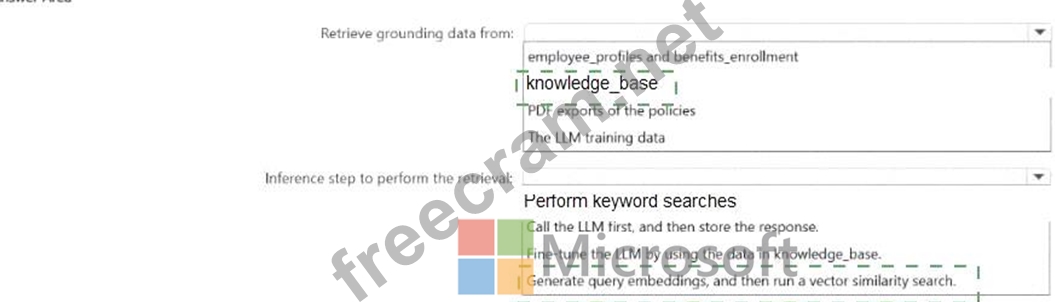
You need to recommend a Retrieval Augmented Generation (RAG) solution to resolve the chatbot issues.
What should you recommend? To answer, select the appropriate options in the answer area.
NOTE: Each correct selection is worth one point.
You have an application named App1. App1 queries two relational tables named employee_pnofiles and benefits_enrollnent that contain HR data. App1 hosts a chatbot that calls a large language model (LLM) directly.
Users report that the chatbot answers general HR questions correctly but provides outdated or incorrect answers when policies change. The chatbot also fails to answer questions that reference internal policy documents by title or category.
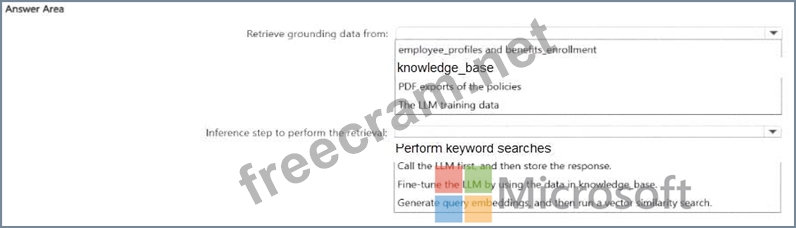
You need to recommend a Retrieval Augmented Generation (RAG) solution to resolve the chatbot issues.
What should you recommend? To answer, select the appropriate options in the answer area.
NOTE: Each correct selection is worth one point.