Valid AZ-104 Dumps shared by ExamDiscuss.com for Helping Passing AZ-104 Exam! ExamDiscuss.com now offer the newest AZ-104 exam dumps, the ExamDiscuss.com AZ-104 exam questions have been updated and answers have been corrected get the newest ExamDiscuss.com AZ-104 dumps with Test Engine here:
Access AZ-104 Dumps Premium Version
(428 Q&As Dumps, 35%OFF Special Discount Code: freecram)
<< Prev Question Next Question >>
Question 28/108
Which blade should you instruct the finance department auditors to use?
Correct Answer: C
Explanation
Cost analysis: Correct Option
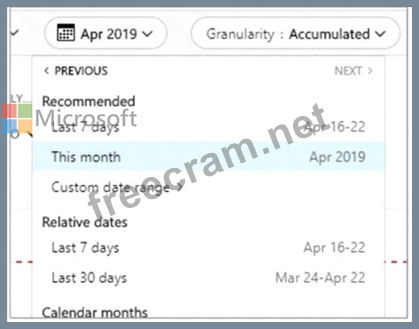
In cost analysis blade of Azure, you can see all the detail for custom time span. You can use this to determine expenditure of last few day, weeks, and month. Below options are available in Cost analysis blade for filtering information by time span: last 7 days, last 30 days, and custom date range. Choosing the first option (last 7 days) auditors can view the costs by time span.
Cost analysis shows data for the current month by default. Use the date selector to switch to common date ranges quickly. Examples include the last seven days, the last month, the current year, or a custom date range.
Pay-as-you-go subscriptions also include date ranges based on your billing period, which isn't bound to the calendar month, like the current billing period or last invoice. Use the <PREVIOUS and NEXT> links at the top of the menu to jump to the previous or next period, respectively. For example, <PREVIOUS will switch from the Last 7 days to 8-14 days ago or 15-21 days ago.
A screenshot of a calendar Description automatically generated
Invoice: Incorrect Option
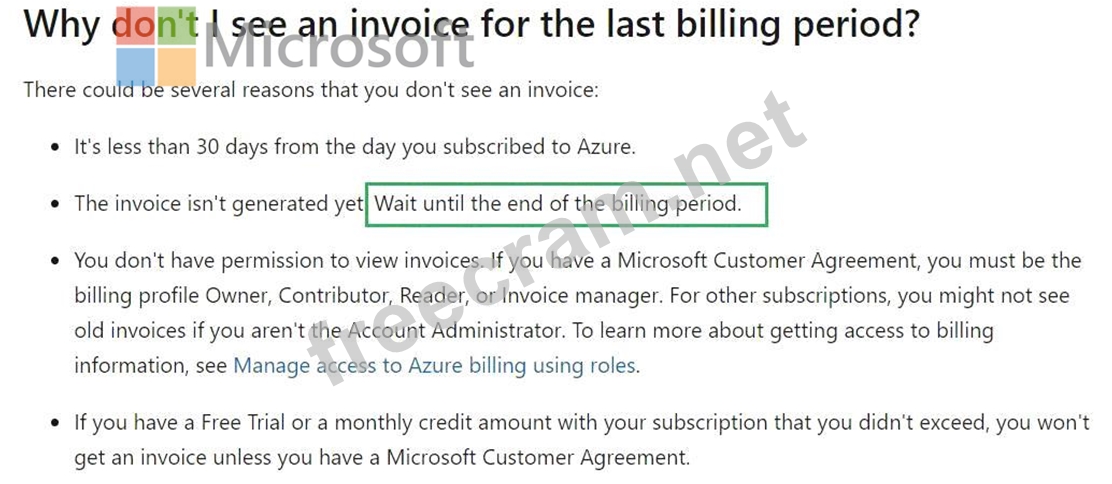
Invoices can only be used for past billing periods not for current billing period, i.e. if your requirement is to know the last week's cost then that also not filled by invoices because Azure generates invoice at the end of the month. Even though Invoices have custom timespan, but when you put in dates for a week, the pane would be empty. Below is from Microsoft document:
A screenshot of a computer screen Description automatically generated
Resource Provider: Incorrect Option
When deploying resources, you frequently need to retrieve information about the resource providers and types.
For example, if you want to store keys and secrets, you work with the Microsoft.KeyVault resource provider.
This resource provider offers a resource type called vaults for creating the key vault. This is not useful for reviewing all Azure costs from the past week which is required for audit.
Payment method: Incorrect Option
Payment methods is not useful for reviewing all Azure costs from the past week which is required for audit.
Reference:
https://docs.microsoft.com/en-us/azure/cost-management-billing/costs/quick-acm-cost-analysis
https://docs.microsoft.com/en-us/azure/cost-management-billing/manage/download-azure-invoice-daily-usage-da
Topic 2, Litware, inc.
Overview
Litware, Ltd. is a consulting company that has a main office in Montreal and two branch offices in Seattle and New York.
The Montreal office has 2,000 employees. The Seattle office has 1,000 employees. The New York office has
200 employees.
All the resources used by Litware are hosted on-premises.
Litware creates a new Azure subscription. The Azure Active Directory (Azure AD) tenant uses a domain named Litware.onmicrosoft.com. The tenant uses the P1 pricing tier.
Existing Environment
The network contains an Active Directory forest named Litware.com. All domain controllers are configured as DNS servers and host the Litware.com DNS zone.
Litware has finance, human resources, sales, research, and information technology departments. Each department has an organizational unit (OU) that contains all the accounts of that respective department. All the user accounts have the department attribute set to their respective department. New users are added frequently.
Litware.com contains a user named User1.
All the offices connect by using private links.
Litware has data centers in the Montreal and Seattle offices. Each data center has a firewall that can be configured as a VPN device.
All infrastructure servers are virtualized. The virtualization environment contains the servers in the following table.

Litware uses two web applications named App1 and App2. Each instance on each web application requires
1GB of memory.
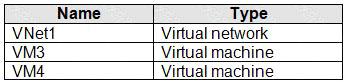
The Azure subscription contains the resources in the following table.
The network security team implements several network security groups (NSGs).
Planned Changes
Litware plans to implement the following changes:
* Deploy Azure ExpressRoute to the Montreal office.
* Migrate the virtual machines hosted on Server1 and Server2 to Azure.
* Synchronize on-premises Active Directory to Azure Active Directory (Azure AD).
* Migrate App1 and App2 to two Azure web apps named webApp1 and WebApp2.
Technical requirements
Litware must meet the following technical requirements:
* Ensure that WebApp1 can adjust the number of instances automatically based on the load and can scale up to five instance*.
* Ensure that VM3 can establish outbound connections over TCP port 8080 to the applications servers in the Montreal office.
* Ensure that routing information is exchanged automatically between Azure and the routers in the Montreal office.
* Enable Azure Multi-Factor Authentication (MFA) for the users in the finance department only.
* Ensure that webapp2.azurewebsites.net can be accessed by using the name app2.Litware.com.
* Connect the New Your office to VNet1 over the Internet by using an encrypted connection.
* Create a workflow to send an email message when the settings of VM4 are modified.
* Create a custom Azure role named Role1 that is based on the Reader role.
* Minimize costs whenever possible.
Cost analysis: Correct Option
In cost analysis blade of Azure, you can see all the detail for custom time span. You can use this to determine expenditure of last few day, weeks, and month. Below options are available in Cost analysis blade for filtering information by time span: last 7 days, last 30 days, and custom date range. Choosing the first option (last 7 days) auditors can view the costs by time span.
Cost analysis shows data for the current month by default. Use the date selector to switch to common date ranges quickly. Examples include the last seven days, the last month, the current year, or a custom date range.
Pay-as-you-go subscriptions also include date ranges based on your billing period, which isn't bound to the calendar month, like the current billing period or last invoice. Use the <PREVIOUS and NEXT> links at the top of the menu to jump to the previous or next period, respectively. For example, <PREVIOUS will switch from the Last 7 days to 8-14 days ago or 15-21 days ago.
A screenshot of a calendar Description automatically generated
Invoice: Incorrect Option
Invoices can only be used for past billing periods not for current billing period, i.e. if your requirement is to know the last week's cost then that also not filled by invoices because Azure generates invoice at the end of the month. Even though Invoices have custom timespan, but when you put in dates for a week, the pane would be empty. Below is from Microsoft document:
A screenshot of a computer screen Description automatically generated
Resource Provider: Incorrect Option
When deploying resources, you frequently need to retrieve information about the resource providers and types.
For example, if you want to store keys and secrets, you work with the Microsoft.KeyVault resource provider.
This resource provider offers a resource type called vaults for creating the key vault. This is not useful for reviewing all Azure costs from the past week which is required for audit.
Payment method: Incorrect Option
Payment methods is not useful for reviewing all Azure costs from the past week which is required for audit.
Reference:
https://docs.microsoft.com/en-us/azure/cost-management-billing/costs/quick-acm-cost-analysis
https://docs.microsoft.com/en-us/azure/cost-management-billing/manage/download-azure-invoice-daily-usage-da
Topic 2, Litware, inc.
Overview
Litware, Ltd. is a consulting company that has a main office in Montreal and two branch offices in Seattle and New York.
The Montreal office has 2,000 employees. The Seattle office has 1,000 employees. The New York office has
200 employees.
All the resources used by Litware are hosted on-premises.
Litware creates a new Azure subscription. The Azure Active Directory (Azure AD) tenant uses a domain named Litware.onmicrosoft.com. The tenant uses the P1 pricing tier.
Existing Environment
The network contains an Active Directory forest named Litware.com. All domain controllers are configured as DNS servers and host the Litware.com DNS zone.
Litware has finance, human resources, sales, research, and information technology departments. Each department has an organizational unit (OU) that contains all the accounts of that respective department. All the user accounts have the department attribute set to their respective department. New users are added frequently.
Litware.com contains a user named User1.
All the offices connect by using private links.
Litware has data centers in the Montreal and Seattle offices. Each data center has a firewall that can be configured as a VPN device.
All infrastructure servers are virtualized. The virtualization environment contains the servers in the following table.
Litware uses two web applications named App1 and App2. Each instance on each web application requires
1GB of memory.
The Azure subscription contains the resources in the following table.
The network security team implements several network security groups (NSGs).
Planned Changes
Litware plans to implement the following changes:
* Deploy Azure ExpressRoute to the Montreal office.
* Migrate the virtual machines hosted on Server1 and Server2 to Azure.
* Synchronize on-premises Active Directory to Azure Active Directory (Azure AD).
* Migrate App1 and App2 to two Azure web apps named webApp1 and WebApp2.
Technical requirements
Litware must meet the following technical requirements:
* Ensure that WebApp1 can adjust the number of instances automatically based on the load and can scale up to five instance*.
* Ensure that VM3 can establish outbound connections over TCP port 8080 to the applications servers in the Montreal office.
* Ensure that routing information is exchanged automatically between Azure and the routers in the Montreal office.
* Enable Azure Multi-Factor Authentication (MFA) for the users in the finance department only.
* Ensure that webapp2.azurewebsites.net can be accessed by using the name app2.Litware.com.
* Connect the New Your office to VNet1 over the Internet by using an encrypted connection.
* Create a workflow to send an email message when the settings of VM4 are modified.
* Create a custom Azure role named Role1 that is based on the Reader role.
* Minimize costs whenever possible.


- Question List (108q)
- Question 1: You deploy an Azure Kubernetes Service (AKS) cluster that ha...
- Question 2: Note: This question is part of a series of questions that pr...
- Question 3: You have an Azure subscription that contains an Azure Direct...
- Question 4: You are evaluating the connectivity between the virtual mach...
- Question 5: You deploy Azure virtual machines to three Azure regions. Ea...
- Question 6: You have an Azure subscription that contains multiple virtua...
- 1 commentQuestion 7: You have an Azure subscription that contains the resources s...
- Question 8: Your company has an Azure subscription named Subscription1. ...
- 1 commentQuestion 9: You have an Azure subscription. You plan to deploy a storage...
- Question 10: Note: This question is part of a series of questions that pr...
- Question 11: You have an Azure Active Directory (Azure AD) tenant named c...
- Question 12: You need to add VM1 and VM2 to the backend poo! of LB1. What...
- Question 13: You need to ensure that you can grant Group4 Azure RBAC read...
- Question 14: You have an Azure subscription named Subscroption1. In Subsc...
- Question 15: You need to meet the technical requirement for VM4. What sho...
- 1 commentQuestion 16: You have the following custom role-based access control (RBA...
- Question 17: Which blade should you instruct the finance department audit...
- Question 18: You have an Azure subscription that contains the virtual mac...
- Question 19: You need to configure the alerts for VM1 and VM2 to meet the...
- Question 20: You need to prepare the environment to meet the authenticati...
- Question 21: You have an Azure Resource Manager that is used to deploy an...
- Question 22: You have an Azure subscription. You plan to migrate 50 virtu...
- Question 23: Peering for VNET2 is configured as shown in the following ex...
- Question 24: You are planning the move of App1 to Azure. You create a net...
- Question 25: You plan to deploy five virtual machines to a virtual networ...
- Question 26: You have an Azure subscription that contains The storage acc...
- 1 commentQuestion 27: You have an Azure subscription that contains the virtual net...
- Question 28: Which blade should you instruct the finance department audit...
- Question 29: You have a hybrid deployment of Azure AD that contains the u...
- Question 30: You have an Azure subscription that contains a virtual netwo...
- 1 commentQuestion 31: You have Azure subscriptions named Subscription1 and Subscri...
- Question 32: You have an Azure subscription that contains the resources i...
- Question 33: You have two Azure virtual machines named VM1 and VM2 that r...
- Question 34: You have an Azure subscription. You need to deploy a virtual...
- 2 commentQuestion 35: You have an Azure subscription that contains the hierarchy s...
- Question 36: You need to meet the user requirement for Admin1. What shoul...
- Question 37: You have an Azure DNS zone named adatum.com. You need to del...
- Question 38: You plan to create an Azure virtual machine named VM1 that w...
- 1 commentQuestion 39: You need to ensure that VM1 can communicate with VM4. The so...
- Question 40: You have an Azure subscription that contains a storage accou...
- Question 41: You need to define a custom domain name for Azure AD to supp...
- Question 42: You need to configure the Device settings to meet the techni...
- Question 43: You implement the planned changes for NSG1 and NSG2. For eac...
- Question 44: You have two subscriptions named Subscription1 and Subscript...
- 1 commentQuestion 45: You have two Azure virtual machines as shown in the followin...
- Question 46: You have an Azure subscription that contains a web app named...
- Question 47: Note: This question is part of a series of questions that pr...
- Question 48: You have an Azure subscription that contains a storage accou...
- Question 49: Your on-premises network contains an SMB share named Share1....
- Question 50: Note: This question is part of a series of questions that pr...
- Question 51: Note: This question is part of a series of questions that pr...
- Question 52: You have an Azure subscription named Subscription1 that has ...
- Question 53: You need to prepare the environment to meet the authenticati...
- Question 54: You have an Azure Active Directory (Azure AD) tenant named c...
- Question 55: You plan to create an Azure Storage account in the Azure reg...
- Question 56: You have an Azure subscription that contains the storage acc...
- Question 57: You have an Azure subscription named Subscription1 that cont...
- Question 58: You need to create container1 and share1. Which storage acco...
- Question 59: You plan to deploy an Azure container instance by using the ...
- Question 60: You have an Azure subscription that contains a virtual machi...
- Question 61: You have an Azure Storage account named storage1. You plan t...
- 1 commentQuestion 62: You have an Azure App Service app named WebApp1 that contain...
- Question 63: You have an Azure subscription named Sub1 that contains the ...
- Question 64: You have an Azure subscription that contains an Azure virtua...
- Question 65: You have an Azure subscription named Subscription1 that cont...
- Question 66: You need to recommend an identify solution that meets the te...
- Question 67: You have an Azure subscription that hat Traffic Analytics co...
- Question 68: Note: This question is part of a series of questions that pr...
- Question 69: You have an Azure subscription named Subscription1 that cont...
- Question 70: You have an Azure subscription that contains the public load...
- Question 71: You need to resolve the licensing issue before you attempt t...
- 1 commentQuestion 72: You have an Azure subscription that contains two virtual mac...
- Question 73: You have an Azure subscription that contains the storage acc...
- 1 commentQuestion 74: You have an Azure subscription that contains a storage accou...
- Question 75: You have an Azure virtual machine named VM1 that connects to...
- Question 76: You have an Azure subscription You plan to deploy a new stor...
- Question 77: You have an Azure subscription named Subscription1 that cont...
- Question 78: Note: This question is part of a series of questions that pr...
- 1 commentQuestion 79: You have an Azure Storage account named storage1 that contai...
- Question 80: You have an Azure subscription that contains an Azure Availa...
- Question 81: You discover that VM3 does NOT meet the technical requiremen...
- 1 commentQuestion 82: You have an Azure subscription that contains the resources s...
- Question 83: You have an Azure subscription named Subscription1. You have...
- Question 84: You need to ensure that User1 can create initiative definiti...
- Question 85: You have an Azure subscription named Subscription1 that is u...
- Question 86: You have an Azure subscription. You deploy a virtual machine...
- Question 87: You have an Azure subscription. The subscription contains vi...
- Question 88: You have an Azure subscription named Subscription1 that cont...
- Question 89: You have an Azure subscription that contains the Azure virtu...
- Question 90: You need to prepare the environment to ensure that the web a...
- Question 91: You need to implement Role1. Which command should you run be...
- Question 92: You have an Azure App Services web app named App1. You plan ...
- Question 93: Note: This question is part of a series of questions that pr...
- Question 94: You download an Azure Resource Manager template based on an ...
- Question 95: You have an Azure subscription that contains a virtual netwo...
- Question 96: Note: This question is part of a series of questions that pr...
- Question 97: You have an on-premises server that contains a folder named ...
- Question 98: You have an Azure subscription that contains the virtual net...
- Question 99: You have an Azure subscription that contains a storage accou...
- Question 100: You are evaluating the name resolution for the virtual machi...
- 1 commentQuestion 101: You have two Azure subscriptions named Sub1 and Sub2. Sub1 i...
- Question 102: You create an Azure Storage account named Contoso storage. Y...
- Question 103: You have an Azure Linux virtual machine that is protected by...
- Question 104: You have an Azure Storage account named storage1 that stores...
- Question 105: You have a virtual network named VNet1 that has the configur...
- Question 106: You have an Azure subscription that contains a storage accou...
- Question 107: You have an Azure subscription named Subscription1. Subscrip...
- Question 108: Note: This question is part of a series of questions that pr...
