<< Prev Question Next Question >>
Question 13/26
Scenario
Vision Media is an international media organization, operating various lines of business including:
Film Production

Television (production and delivery of their own channel in the United States VisionOne)
Print media (including newspapers in 15 countries)
Online Advertising
The organization has recently been restructured, and now is comprised of the following companies and departments:
Vision Films (production of movies and television shows)
VisionOne (television channel)
VisionNews (coordinates all of the sub-companies involved in the delivery of printed newspapers, as
well as being the centralized source of news information for all company owned media outlets) VisionNet (managing the online and internet businesses)
Legal Services
Finance and Administration
Human Resources
Information Technology
The organization is also actively pursuing growth in the online market, and is currently holding discussions with the leading online news provider about the possible acquisition of their company. This would increase the overall size of Vision Media by around 15%.
The Information Technology department acts as a Shared Service Unit, providing IT Services to all of sub- companies and departments, which complement some of the Internal Service Providers that also exist.
The director of Information Technology has realized the need to improve the quality of services offered by implementing ITIL, and has decided to do so using a phased approach. Some of the Service Design and Service Transition processes have already been implemented, and they are now planning the implementation of Service Operation.
While the IT director does have tentative support from the other directors and CEO, budgets for implementing the Service Operation processes have not been finalized, and still require a business case to be formally submitted.
Refer to the exhibit.
Sally Robbins, who had previously managed the IT department's Service Desk, has now been assigned the role of Incident Manager. To assist in the implementation of the process, Sally has conducted a number of meetings with IT staff, customers, external suppliers and other relevant stakeholders to identify their requirements. Based on these discussions, Sally has created following impact definitions, which will be used in conjunction to the given urgency to determine the appropriate timescales and effort applied for response and resolution to recorded incidents.
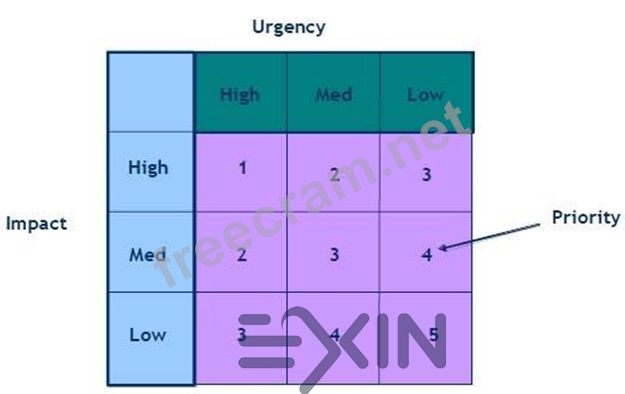
Impact Definition:
Low Impact
Affects a single user, preventing them from performing normal work functions
A single, non-critical device or peripheral is unavailable
Medium Impact
Multiple users are affected, preventing them from performing normal work functions
A regular business function is unavailable to part of a or organizational unit department
High Impact
A vital business function is unavailable to an entire department or company owned organization
Major Incident
A vital business function is unavailable to all Vision
Media departments and company owned organizations
Example Incidents:
I. The IT manager of Vision Films detects that their dedicated Virtual Private Network linking them to Vision Media's corporate IT systems has failed. This has prevented users from accessing or modifying any file, document or system maintained by the centralized IT department of Vision Media.
II. The vice-president of the Finance and Administration department reports that her laptop keeps rebooting. She has an important report to complete for the Chief Executive Officer.
III. The president of Vision TV is unable to stream high-definition video from a regional office. He requires the regional office's WAN connection to be upgraded to a 14.4 M/bit wireless mobile network.
IV. A IT staff member is alerted to the failure of systems provided by Human Resources to all other departments and sub companies to manage payments and leave for Vision Media employees (and those employed by organizations fully owned by Vision Media) Which of the following responses provides the correct assignment of impact to the above incidents?
Vision Media is an international media organization, operating various lines of business including:
Film Production
Television (production and delivery of their own channel in the United States VisionOne)
Print media (including newspapers in 15 countries)
Online Advertising
The organization has recently been restructured, and now is comprised of the following companies and departments:
Vision Films (production of movies and television shows)
VisionOne (television channel)
VisionNews (coordinates all of the sub-companies involved in the delivery of printed newspapers, as
well as being the centralized source of news information for all company owned media outlets) VisionNet (managing the online and internet businesses)
Legal Services
Finance and Administration
Human Resources
Information Technology
The organization is also actively pursuing growth in the online market, and is currently holding discussions with the leading online news provider about the possible acquisition of their company. This would increase the overall size of Vision Media by around 15%.
The Information Technology department acts as a Shared Service Unit, providing IT Services to all of sub- companies and departments, which complement some of the Internal Service Providers that also exist.
The director of Information Technology has realized the need to improve the quality of services offered by implementing ITIL, and has decided to do so using a phased approach. Some of the Service Design and Service Transition processes have already been implemented, and they are now planning the implementation of Service Operation.
While the IT director does have tentative support from the other directors and CEO, budgets for implementing the Service Operation processes have not been finalized, and still require a business case to be formally submitted.
Refer to the exhibit.
Sally Robbins, who had previously managed the IT department's Service Desk, has now been assigned the role of Incident Manager. To assist in the implementation of the process, Sally has conducted a number of meetings with IT staff, customers, external suppliers and other relevant stakeholders to identify their requirements. Based on these discussions, Sally has created following impact definitions, which will be used in conjunction to the given urgency to determine the appropriate timescales and effort applied for response and resolution to recorded incidents.
Impact Definition:
Low Impact
Affects a single user, preventing them from performing normal work functions
A single, non-critical device or peripheral is unavailable
Medium Impact
Multiple users are affected, preventing them from performing normal work functions
A regular business function is unavailable to part of a or organizational unit department
High Impact
A vital business function is unavailable to an entire department or company owned organization
Major Incident
A vital business function is unavailable to all Vision
Media departments and company owned organizations
Example Incidents:
I. The IT manager of Vision Films detects that their dedicated Virtual Private Network linking them to Vision Media's corporate IT systems has failed. This has prevented users from accessing or modifying any file, document or system maintained by the centralized IT department of Vision Media.
II. The vice-president of the Finance and Administration department reports that her laptop keeps rebooting. She has an important report to complete for the Chief Executive Officer.
III. The president of Vision TV is unable to stream high-definition video from a regional office. He requires the regional office's WAN connection to be upgraded to a 14.4 M/bit wireless mobile network.
IV. A IT staff member is alerted to the failure of systems provided by Human Resources to all other departments and sub companies to manage payments and leave for Vision Media employees (and those employed by organizations fully owned by Vision Media) Which of the following responses provides the correct assignment of impact to the above incidents?


