- Home
- Cisco
- Conducting Forensic Analysis & Incident Response Using Cisco Technologies for CyberOps
- Cisco.300-215.v2026-01-17.q56
- Question 47
Valid 300-215 Dumps shared by ExamDiscuss.com for Helping Passing 300-215 Exam! ExamDiscuss.com now offer the newest 300-215 exam dumps, the ExamDiscuss.com 300-215 exam questions have been updated and answers have been corrected get the newest ExamDiscuss.com 300-215 dumps with Test Engine here:
Access 300-215 Dumps Premium Version
(118 Q&As Dumps, 35%OFF Special Discount Code: freecram)
<< Prev Question Next Question >>
Question 47/56
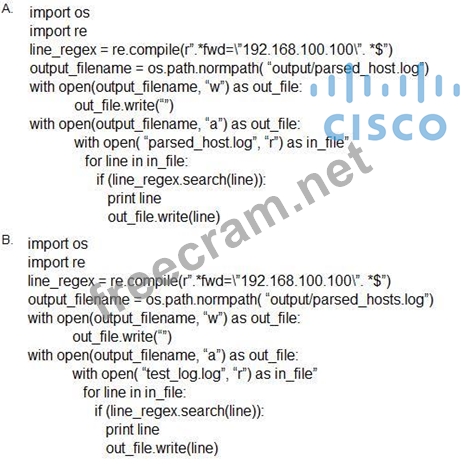
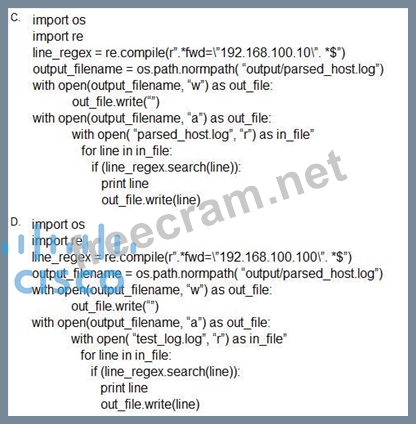
Which scripts will search a log file for the IP address of 192.168.100.100 and create an output file named parsed_host.log while printing results to the console?
Correct Answer: B
To determine the correct script, we evaluate the following requirements:
* The script must search for the IP address 192.168.100.100.
* The output should be written to a file named parsed_host.log.
* The matching lines should be printed to the console.
Analysis of the options:
* Option A: Correct IP regex used and correct output filename, but reads from parsed_host.log instead of a source log file like test_log.log (not ideal for initial parsing).
* Option C: The IP address used is 192.168.100.101 instead of 192.168.100.100 - incorrect.
* Option D: Same IP address and logic as Option B, but uses print statement without parentheses, which is not valid in Python 3 unless using Python 2 - not ideal.
#Option B:
* Uses correct IP: "192.168.100.100"
* Reads from test_log.log (presumably the source log file).
* Writes to output/parsed_host.log.
* Prints each matching line and writes to output file - satisfying all conditions.
Reference:CyberOps Technologies (CBRFIR) 300-215 study guide, Chapter on "Investigating Host-Based Evidence and Logs" emphasizes scripting log parsing tasks using Python's regex and file I/O for filtering artifacts like IP addresses. Scripts should ensure proper source log input, pattern matching, result redirection, and optional output logging for forensics analysis.
ChatGPT said:
* The script must search for the IP address 192.168.100.100.
* The output should be written to a file named parsed_host.log.
* The matching lines should be printed to the console.
Analysis of the options:
* Option A: Correct IP regex used and correct output filename, but reads from parsed_host.log instead of a source log file like test_log.log (not ideal for initial parsing).
* Option C: The IP address used is 192.168.100.101 instead of 192.168.100.100 - incorrect.
* Option D: Same IP address and logic as Option B, but uses print statement without parentheses, which is not valid in Python 3 unless using Python 2 - not ideal.
#Option B:
* Uses correct IP: "192.168.100.100"
* Reads from test_log.log (presumably the source log file).
* Writes to output/parsed_host.log.
* Prints each matching line and writes to output file - satisfying all conditions.
Reference:CyberOps Technologies (CBRFIR) 300-215 study guide, Chapter on "Investigating Host-Based Evidence and Logs" emphasizes scripting log parsing tasks using Python's regex and file I/O for filtering artifacts like IP addresses. Scripts should ensure proper source log input, pattern matching, result redirection, and optional output logging for forensics analysis.
ChatGPT said:


- Question List (56q)
- Question 1: An attacker embedded a macro within a word processing file o...
- Question 2: An insider scattered multiple USB flash drives with zero-day...
- Question 3: A cybersecurity analyst is examining a complex dataset of th...
- Question 4: Which magic byte indicates that an analyzed file is a pdf fi...
- Question 5: An organization uses a Windows 7 workstation for access trac...
- Question 6: A threat actor attempts to avoid detection by turning data i...
- Question 7: A threat intelligence report identifies an outbreak of a new...
- Question 8: An incident response team is recommending changes after anal...
- Question 9: An organization experienced a sophisticated phishing attack ...
- Question 10: Which tool is used for reverse engineering malware?...
- Question 11: A new zero-day vulnerability is discovered in the web applic...
- Question 12: A threat intelligence report identifies an outbreak of a new...
- Question 13: A malware outbreak revealed that a firewall was misconfigure...
- Question 14: Refer to the exhibit. (Exhibit) What does the exhibit indica...
- Question 15: An incident response analyst is preparing to scan memory usi...
- Question 16: Data has been exfiltrated and advertised for sale on the dar...
- Question 17: Refer to the exhibit. (Exhibit) An alert came with a potenti...
- Question 18: An engineer is analyzing a DoS attack and notices that the p...
- Question 19: Over the last year, an organization's HR department has acce...
- Question 20: In a secure government communication network, an automated a...
- Question 21: Drag and drop the capabilities on the left onto the Cisco se...
- Question 22: A network host is infected with malware by an attacker who u...
- Question 23: An investigator is analyzing an attack in which malicious fi...
- Question 24: A cybersecurity analyst must identify an unknown service cau...
- Question 25: An engineer received a report of a suspicious email from an ...
- Question 26: An organization recovered from a recent ransomware outbreak ...
- Question 27: Refer to the exhibit. (Exhibit) According to the Wireshark o...
- Question 28: Refer to the exhibit. (Exhibit) The application x-dosexec wi...
- Question 29: An engineer must advise on how YARA rules can enhance detect...
- Question 30: (Exhibit)
- Question 31: A security team is notified from a Cisco ESA solution that a...
- Question 32: Drag and drop the steps from the left into the order to perf...
- Question 33: Which two tools conduct network traffic analysis in the abse...
- Question 34: Refer to the exhibit. (Exhibit) According to the SNORT alert...
- Question 35: A threat actor has successfully attacked an organization and...
- Question 36: Refer to the exhibit. (Exhibit) What do these artifacts indi...
- Question 37: A cybersecurity analyst is analyzing a complex set of threat...
- Question 38: A cybersecurity analyst detects fileless malware activity on...
- Question 39: (Exhibit) Refer to the exhibit. A network administrator crea...
- Question 40: A security team received an alert of suspicious activity on ...
- Question 41: Refer to the exhibit. (Exhibit) An engineer is analyzing a T...
- Question 42: (Exhibit) Refer to the exhibit. A security analyst notices t...
- Question 43: A security team needs to prevent a remote code execution vul...
- Question 44: What is an issue with digital forensics in cloud environment...
- Question 45: An organization fell victim to a ransomware attack that succ...
- Question 46: Refer to the exhibit. (Exhibit) A company that uses only the...
- Question 47: Which scripts will search a log file for the IP address of 1...
- Question 48: What is the steganography anti-forensics technique?...
- Question 49: A security team detected an above-average amount of inbound ...
- Question 50: A workstation uploads encrypted traffic to a known clean dom...
- Question 51: An employee receives an email from a "trusted" person contai...
- Question 52: A security team is discussing lessons learned and suggesting...
- Question 53: A company had a recent data leak incident. A security engine...
- Question 54: Refer to the exhibit. (Exhibit) What is occurring within the...
- Question 55: Refer to the exhibit. (Exhibit) What should be determined fr...
- Question 56: What is the goal of an incident response plan?...
