- Home
- Snowflake
- SnowPro® Specialty: Gen AI Certification Exam
- Snowflake.GES-C01.v2025-10-06.q171
- Question 58
Valid GES-C01 Dumps shared by EduDump.com for Helping Passing GES-C01 Exam! EduDump.com now offer the newest GES-C01 exam dumps, the EduDump.com GES-C01 exam questions have been updated and answers have been corrected get the newest EduDump.com GES-C01 dumps with Test Engine here:
Access GES-C01 Dumps Premium Version
(351 Q&As Dumps, 35%OFF Special Discount Code: freecram)
<< Prev Question Next Question >>
Question 58/171
A data governance team is concerned about the consistency and compliance of SQL queries generated by Cortex Analyst for sensitive financial reporting. They need to ensure that all generated SQL for a specific semantic model always includes a 'WHERE' clause that filters data for 'region = 'EMEA" and adheres to 'ISO 8601' date formatting for all date columns, regardless of the user's natural language input. Which of the following approaches is the MOST effective for implementing these strict, overarching requirements within Cortex Analyst's semantic model?
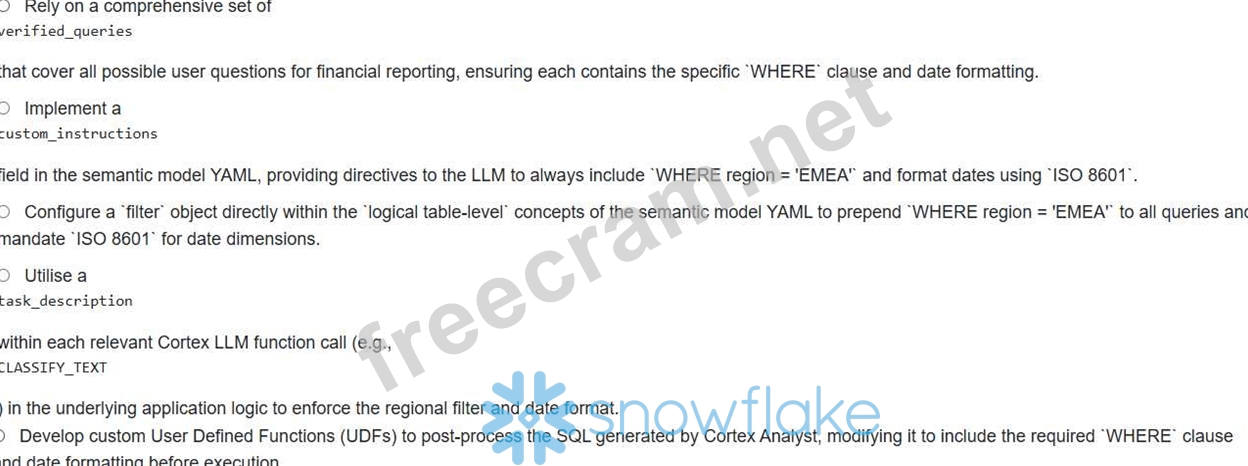
Correct Answer: B
To enforce overarching, consistent behavior in SQL query generation regardless of user input, the 'custom_instructions' field in the semantic model YAML is the most appropriate mechanism. It allows providing unique business context and directives directly to the LLM that Cortex Analyst uses, enabling greater control over the generated SQL. Option A (verified queries) is good for specific questions but would require an exhaustive and potentially unmanageable list to cover *all* user inputs for general rules. Option C (logical table-level filters) can apply 'WHERES' clauses but doesn't inherently enforce a specific date format across all date columns consistently without further explicit definition for each time dimension, and the source doesn't detail a filter mechanism for global date format enforcement. Option D ('task_description' in "CLASSIFY _ TEXT) is for task-specific classification and not for controlling SQL generation by Cortex Analyst. Option E (custom UDFs for post- processing) is an external step to Cortex Analyst's core text-to-SQL generation and adds unnecessary complexity, losing the benefit of Cortex Analyst's managed nature, and is not a direct configuration *within* Cortex Analyst to influence SQL generation.


- Question List (171q)
- Question 1: A legal department uses Snowflake to manage and review large...
- Question 2: An organization relies on Snowflake Cortex LLM functions and...
- Question 3: A Gen AI developer is implementing a Cortex Search Service f...
- Question 4: A development team is implementing a suite of generative AI ...
- Question 5: A team of data application developers is leveraging Snowflak...
- Question 6: A Streamlit application developer wants to use AI_COMPLETE (...
- Question 7: A data scientist is tasked with improving the accuracy of an...
- Question 8: A data scientist has developed a Hugging Face sentence trans...
- Question 9: A Gen AI specialist is preparing to upload a large volume of...
- Question 10: A data engineer is reviewing the purpose of AI Observability...
- Question 11: A data engineering team is designing a pipeline in Snowflake...
- Question 12: A Snowflake administrator needs to configure Snowflake Copil...
- Question 13: A financial institution uses Snowflake Cortex Analyst with s...
- Question 14: A security audit is being conducted for a financial institut...
- Question 15: A development team is building a conversational application ...
- Question 16: A Gen AI Specialist is tasked with implementing a data pipel...
- Question 17: A data scientist is tasked with improving the accuracy of an...
- Question 18: A data engineering team is setting up a pipeline to automati...
- Question 19: A data engineer is tasked with establishing a robust MLOps p...
- Question 20: A Gen AI Specialist is leveraging Snowflake Document AI to e...
- Question 21: A marketing analyst wants to quickly gauge the overall senti...
- Question 22: A compliance officer is reviewing the usage of Snowflake Cor...
- Question 23: An enterprise is deploying a new RAG application using Snowf...
- Question 24: An ML engineer is deploying a custom PyTorch-based image cla...
- Question 25: A data application developer is building a Streamlit chat ap...
- Question 26: A new Gen AI specialist is setting up Document AI. They have...
- Question 27: A multi-national corporation uses Snowflake across several A...
- Question 28: A team is developing a Retrieval Augmented Generation (RAG) ...
- Question 29: A data engineering team is designing a scalable data pipelin...
- Question 30: An operations team at a company is implementing a robust gov...
- Question 31: An AI developer is testing a new RAG application in Snowflak...
- Question 32: A data engineering team has developed a Python-based generat...
- Question 33: A data architect is integrating Snowflake Cortex LLM functio...
- Question 34: A data engineer is setting up a Document AI pipeline to extr...
- Question 35: An operations manager is tasked with monitoring the cost and...
- Question 36: An administrator has configured the 'CORTEX_MODELS_ALLOWLIST...
- Question 37: A development team is preparing to deploy a new Retrieval-Au...
- Question 38: An ML engineer has developed a custom PyCaret classification...
- Question 39: A team is planning the implementation of a new Document AI s...
- Question 40: A developer is building an interactive chat application in S...
- Question 41: A Streamlit application developer wants to use AI_COMPLETE (...
- Question 42: A Gen AI Specialist in Snowflake Cortex aims to fine-tune an...
- Question 43: A development team is creating a new search application usin...
- Question 44: A data engineering team is deploying Snowflake Cortex Analys...
- Question 45: A software development team is building a conversational AI ...
- Question 46: A team is developing a critical business intelligence applic...
- Question 47: (Exhibit) Which of the following is a 'direct cause' of this...
- Question 48: An ML Engineer has developed a custom PyTorch model for GPU-...
- Question 49: A developer is building a client application that interacts ...
- Question 50: A security architect is configuring access controls for a ne...
- Question 51: A data engineering team is building an automated pipeline in...
- Question 52: A data engineering team needs to implement a highly accurate...
- Question 53: An organization is building a new knowledge base system with...
- Question 54: A team is designing a complex Gen AI application in Snowflak...
- Question 55: A data application developer is building a Streamlit chat ap...
- Question 56: (Exhibit) After resolving this, they try to process a batch ...
- Question 57: A developer is refining a Document AI extraction process usi...
- Question 58: A data governance team is concerned about the consistency an...
- Question 59: A new ML Engineer, 'data_scientist_role' , has been assigned...
- Question 60: A data engineering team is tasked with creating vector embed...
- Question 61: A machine learning team is leveraging the Snowflake Model Re...
- Question 62: A business analyst is using a Cortex Analyst-powered convers...
- Question 63: An administrator has configured the 'CORTEX MODELS ALLOWLIST...
- Question 64: A security-conscious data scientist in an Azure East US 2 (V...
- Question 65: A financial services company uses Snowflake Cortex's AI_COMP...
- Question 66: A developer has successfully created a Cortex Search Service...
- Question 67: An organization has implemented a strict governance policy w...
- Question 68: A data application developer is tasked with building a multi...
- Question 69: A data scientist, 'Dl DEV', has been granted the (Exhibit) D...
- Question 70: A data scientist is leveraging various Snowflake Cortex LLM ...
- Question 71: A data engineer is designing a new feature for a Retrieval A...
- Question 72: A Gen AI developer is implementing a Document AI solution to...
- Question 73: A Snowflake developer is tasked with enhancing a daily data ...
- Question 74: A global marketing team uses Snowflake to manage customer fe...
- Question 75: A financial analytics team is using to extract specific fina...
- Question 76: A data team is refining their Cortex Analyst semantic model ...
- Question 77: A Data Scientist has a pre-trained PyCaret model and wants t...
- Question 78: A business team using a Snowflake Cortex Analyst-powered cha...
- Question 79: A data pipeline processes thousands of scanned legal contrac...
- Question 80: A data platform architect is integrating 'SNOWFLAKE.CORTEX.E...
- Question 81: A development team is constructing a Gen AI application usin...
- Question 82: A data engineering team is planning to build a real-time dat...
- Question 83: A development team plans to utilize Snowpark Container Servi...
- Question 84: A data science team is developing an internal LLM to classif...
- Question 85: A Snowflake administrator needs to implement a granular acce...
- Question 86: A company is planning to process a large volume of legal doc...
- Question 87: A SnowPro-certified engineer is tasked with setting up AI Ob...
- Question 88: An ML engineer is preparing a Docker image for a custom LLM ...
- Question 89: A data engineering team is building an automated pipeline in...
- Question 90: A development team is preparing to deploy a new Retrieval-Au...
- Question 91: A data analytics team is building a self-service analytics a...
- Question 92: A development team is building an AI-powered data pipeline i...
- Question 93: An enterprise is deploying a new RAG application using Snowf...
- Question 94: A data scientist is tasked with improving the accuracy of an...
- Question 95: (Exhibit)
- Question 96: A business intelligence team wants to enable non-technical u...
- Question 97: A global enterprise has Snowflake accounts in various region...
- Question 98: A data engineer is constructing a Retrieval Augmented Genera...
- Question 99: A data engineer is tasked with defining a semantic model for...
- Question 100: A data engineer is designing an automated data pipeline in S...
- Question 101: A data analyst is tasked with identifying customers who purc...
- Question 102: A data scientist needs to fine-tune a 'mistral-7b' LLM using...
- Question 103: A data scientist is tasked with improving the accuracy of an...
- Question 104: (Exhibit)
- Question 105: A data science team is deploying a custom real-time inferenc...
- Question 106: A financial institution is deploying a sentiment analysis ap...
- Question 107: A data application developer is using the Snowflake Cortex C...
- Question 108: (Exhibit)
- Question 109: A data analyst is setting up a new Cortex Analyst-powered co...
- Question 110: A global enterprise has Snowflake accounts in various region...
- Question 111: A data scientist has successfully deployed a Hugging Face se...
- Question 112: An ML engineer is developing a RAG application in Python and...
- Question 113: A security auditor needs to access and analyze logs generate...
- Question 114: A data science team is fine-tuning a Snowflake Document AI m...
- Question 115: A data scientist is preparing to log a custom PyCaret classi...
- Question 116: A Snowflake administrator is tasked with ensuring that a spe...
- Question 117: A business intelligence team wants to enable non-technical u...
- Question 118: (Exhibit) database role. Which of the following 'privileges ...
- Question 119: A financial analyst is concerned about the rising costs of t...
- Question 120: An ML engineer is planning a fine-tuning project for a llama...
- Question 121: A data engineering team is implementing a solution using Sno...
- Question 122: A financial institution wants to automate the extraction of ...
- Question 123: An ML Engineer deploys a custom fine-tuned LLM on Snowpark C...
- Question 124: An 'ACCOUNTADMIN' has configured the 'CORTEX MODELS ALLOWLIS...
- Question 125: A machine learning engineering team is evaluating two differ...
- Question 126: A data application developer is tasked with creating a multi...
- Question 127: A Gen AI Specialist needs to extract the 'invoice number' an...
- Question 128: A data engineer is building an AI data pipeline to automatic...
- Question 129: A financial institution uses Snowflake Cortex Analyst with s...
- Question 130: A data application developer is tasked with building a multi...
- Question 131: A data engineering team is building a pipeline to process le...
- Question 132: A development team is preparing to deploy a new Retrieval-Au...
- Question 133: A company is developing a RAG application to provide concise...
- Question 134: A data engineer is tasked with establishing AI Observability...
- Question 135: A data engineering manager needs to audit Cortex LLM functio...
- Question 136: A data processing team is using Snowflake Document AI to ext...
- Question 137: An ML engineer is designing a Cortex Agent to provide highly...
- Question 138: A financial analytics team is using AI_COMPLETE to extract s...
- Question 139: An ML Engineer is logging a custom PyCaret model to the Snow...
- Question 140: A machine learning engineer is building a product recommenda...
- Question 141: A financial institution wants to leverage Snowflake Cortex A...
- Question 142: A data scientist is optimising a Cortex Analyst application ...
- Question 143: A data engineering team is setting up a Retrieval Augmented ...
- Question 144: A Data Engineer is responsible for deploying machine learnin...
- Question 145: A financial analytics team is developing an application to e...
- Question 146: A data science team is planning to implement a new RAG (Retr...
- Question 147: An ML engineer is deploying a custom PyTorch-based image cla...
- Question 148: A Snowflake account administrator in an Azure East US 2 regi...
- Question 149: A data operations team is attempting to scale up their Docum...
- Question 150: A Snowflake team observes consistently high token costs from...
- Question 151: (Exhibit)
- Question 152: An organization is implementing a two-tier LLM access contro...
- Question 153: A data science team is using SNOWFLAKE. CORTEX. CLASSIFY_TEX...
- Question 154: A data engineering team needs to establish an automated pipe...
- Question 155: An administrator has configured the 'CORTEX MODELS ALLOWLIST...
- Question 156: An ML engineer is working on a Snowflake project that requir...
- Question 157: A financial institution is fine-tuning a llama3.1-70b model ...
- Question 158: A developer is integrating a Cortex Fine-tuning pipeline int...
- Question 159: A data engineer is building a Snowflake data pipeline to ing...
- Question 160: A Streamlit application developer wants to use AI_COMPLETE (...
- Question 161: A data engineering manager needs to audit Cortex LLM functio...
- Question 162: A Gen AI specialist is preparing to upload a large volume of...
- Question 163: A data engineering team needs to configure their Snowflake e...
- Question 164: A development team is implementing a document retrieval syst...
- Question 165: A data engineering team is setting up a Retrieval Augmented ...
- Question 166: A data engineer is working with Snowflake Cortex Analyst to ...
- Question 167: An operations team at a company is implementing a robust gov...
- Question 168: A machine learning team has fine-tuned a llama3.1-70b model ...
- Question 169: A data engineering team is preparing a large corpus of unstr...
- Question 170: A data science team is fine-tuning a mistral-lb model within...
- Question 171: (Exhibit) Which 'combination of missing schema-level privile...
