<< Prev Question Next Question >>

Question 10/35

A Mule application contains an ActiveMQ JMS dependency. The Mule application was developed in Anypoint Studio and runs successfully in Anypoint Studio.
The Mule application must now be exported from Anypoint Studio and shared with another developer.
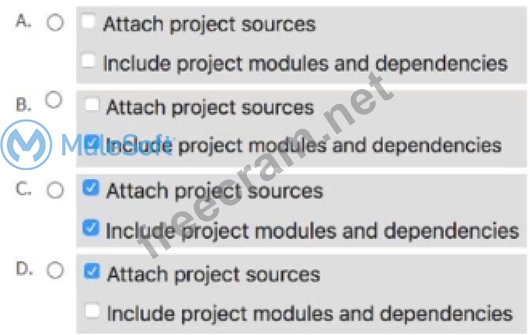
What export options create the smallest JAR file that can be imported into the other developer's Anypoint Studio and run successfully?

Recent Comments (The most recent comments are at the top.)

JP. - Jun 10, 2022

It is the letter A that claims to be option B.

Beware of this issue.

JP. - Jun 10, 2022

B is correct.

Saravanan Devadass - Feb 24, 2022

Option B is correct.

Since the Mule app has a dependency, it is necessary to include project modules and dependencies to make sure the app will run successfully on the runtime on any other machine.

Source code of the component that the Mule app is dependent of does not need to be included in the exported JAR file, because the source code is not being used while executing an app. Compiled code is being used instead.
James - Jan 04, 2022

B is correcta

James - Jan 04, 2022

B is correct

LEAVE A REPLY

Your email address will not be published. Required fields are marked *

Question List (35q)
Question 1: Refer to the exhibit. (Exhibit) What is the response to a we...
2 commentQuestion 2: A Mule application contains two HTTP Listeners, each configu...
Question 3: By default, what happens to a file after it is read using an...
1 commentQuestion 4: Refer to the exhibit. (Exhibit) The main flow is configured ...
Question 5: A RAML specification is defined to manage customers with a u...
Question 6: Refer to the exhibit. (Exhibit) What expression correctly sp...
1 commentQuestion 7: Refer to the exhibits. (Exhibit) The input array of strings ...
Question 8: Refer to the exhibits. (Exhibit) The orders.csv file is read...
Question 9: An SLA based policy has been enabled in API Manager. What is...
5 commentQuestion 10: A Mule application contains an ActiveMQ JMS dependency. The ...
2 commentQuestion 11: A Database On Table Row listener retrieves data from a CUSTO...
Question 12: Refer to the exhibit. (Exhibit) This RAML specification incl...
2 commentQuestion 13: Refer to the exhibit. (Exhibit) What is a valid expression f...
2 commentQuestion 14: Refer to the exhibits. (Exhibit) What payload and quantity a...
Question 15: An API specification is designed using RAML. What is the nex...
Question 16: Refer to the exhibit. The error occurs when a project is run...
3 commentQuestion 17: What is the correct syntax for a Logger component to output ...
Question 18: A web client submits a request to http://localhost:8081/book...
Question 19: Why would a Mule application use the ${http.port} property p...
2 commentQuestion 20: Refer to the exhibits. A web client sends a POST request to ...
Question 21: Refer to the exhibits. (Exhibit) What payload and quantity a...
1 commentQuestion 22: Refer to the exhibits. (Exhibit) A JSON payload is set in th...
Question 23: Refer to the exhibit. The input array of strings is passed t...
Question 24: Refer to the exhibits. (Exhibit) A web client submits a requ...
Question 25: Refer to the exhibits. (Exhibit) A web client submits a requ...
Question 26: What payload is returned by a Database SELECT operation that...
Question 27: Refer to the exhibits. (Exhibit) A web client submits a requ...
4 commentQuestion 28: A Utility.dwl file is located in a Mule project at src/main/...
Question 29: Refer to the exhibit. In the execution of the Scatter-Gather...
Question 30: An HTTP Request operation sends an HTTP request with a non-e...
1 commentQuestion 31: Refer to the exhibits. What payload is logged at the end of ...
Question 32: Refer to the exhibits. (Exhibit) The Validation component in...
Question 33: What is the output type of the DataWeave map operator?...
Question 34: What DataWeave expression transforms the example XML input t...
Question 35: Refer to the exhibit. (Exhibit) What Database expression tra...