- Home
- Microsoft
- Administering Relational Databases on Microsoft Azure
- Microsoft.DP-300.v2022-04-28.q107
- Question 33
Valid DP-300 Dumps shared by ExamDiscuss.com for Helping Passing DP-300 Exam! ExamDiscuss.com now offer the newest DP-300 exam dumps, the ExamDiscuss.com DP-300 exam questions have been updated and answers have been corrected get the newest ExamDiscuss.com DP-300 dumps with Test Engine here:
Access DP-300 Dumps Premium Version
(464 Q&As Dumps, 35%OFF Special Discount Code: freecram)
<< Prev Question Next Question >>
Question 33/107
HOTSPOT
You need to recommend a configuration for ManufacturingSQLDb1 after the migration to Azure. The solution
must meet the business requirements.
What should you include in the recommendation? To answer, select the appropriate options in the answer area.
NOTE: Each correct selection is worth one point.
Hot Area:

You need to recommend a configuration for ManufacturingSQLDb1 after the migration to Azure. The solution
must meet the business requirements.
What should you include in the recommendation? To answer, select the appropriate options in the answer area.
NOTE: Each correct selection is worth one point.
Hot Area:
Correct Answer:
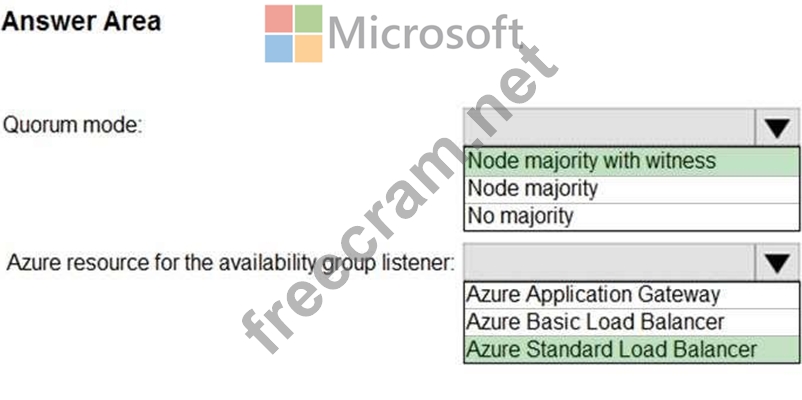
Section: [none]
Explanation:
Box 1: Node majority with witness
As a general rule when you configure a quorum, the voting elements in the cluster should be an odd number.
Therefore, if the cluster contains an even number of voting nodes, you should configure a disk witness or a file
share witness.
Note: Mode: Node majority with witness (disk or file share)
Nodes have votes. In addition, a quorum witness has a vote. The cluster quorum is the majority of voting nodes
in the active cluster membership plus a witness vote. A quorum witness can be a designated disk witness or a
designated file share witness.
Box 2: Azure Standard Load Balancer
Microsoft guarantees that a Load Balanced Endpoint using Azure Standard Load Balancer, serving two or more
Healthy Virtual Machine Instances, will be available 99.99% of the time.
Scenario: Business Requirements
Litware identifies business requirements include: meet an SLA of 99.99% availability for all Azure deployments.
Incorrect Aswers:
Basic Balancer: No SLA is provided for Basic Load Balancer.
Note: There are two main options for setting up your listener: external (public) or internal. The external (public)
listener uses an internet facing load balancer and is associated with a public Virtual IP (VIP) that is accessible
over the internet. An internal listener uses an internal load balancer and only supports clients within the same
Virtual Network.
Reference:
https://technet.microsoft.com/windows-server-docs/failover-clustering/deploy-cloud-witness
https://azure.microsoft.com/en-us/support/legal/sla/load-balancer/v1_0/


- Question List (107q)
- Question 1: DRAG DROP You have SQL Server on an Azure virtual machine na...
- Question 2: You have an Azure SQL database named DB3. You need to provid...
- Question 3: DRAG DROP You have an Azure SQL Database instance named Data...
- Question 4: Note: This question is part of a series of questions that pr...
- Question 5: Note: This question is part of a series of questions that pr...
- Question 6: You need to apply 20 built-in Azure Policy definitions to al...
- Question 7: You have an Azure SQL database. You identify a long running ...
- Question 8: Based on the PaaS prototype, which Azure SQL Database comput...
- Question 9: You have an Azure Synapse Analytics Apache Spark pool named ...
- Question 10: You have SQL Server on an Azure virtual machine. You review ...
- Question 11: You manage an enterprise data warehouse in Azure Synapse Ana...
- Question 12: You are building a database in an Azure Synapse Analytics se...
- Question 13: You have an Azure virtual machine named VM1 on a virtual net...
- Question 14: You need to recommend a configuration for ManufacturingSQLDb...
- Question 15: You configure version control for an Azure Data Factory inst...
- Question 16: You receive numerous alerts from Azure Monitor for an Azure ...
- Question 17: You have 20 Azure SQL databases provisioned by using the vCo...
- Question 18: You have an Azure SQL database. The database contains a tabl...
- Question 19: You have SQL Server on an Azure virtual machine that contain...
- Question 20: You need to recommend the appropriate purchasing model and d...
- Question 21: You need to recommend a solution to ensure that the customer...
- Question 22: You are planning the migration of the SERVER1 databases. The...
- Question 23: You have an Azure virtual machine named VM1 on a virtual net...
- Question 24: You need to recommend the appropriate purchasing model and d...
- Question 25: You have a version-8.0 Azure Database for MySQL database. Yo...
- Question 26: You are designing a star schema for a dataset that contains ...
- Question 27: You have an Azure SQL Database managed instance named SQLMI1...
- Question 28: You have an Azure SQL database that contains a table named f...
- Question 29: You need to configure user authentication for the SERVER1 da...
- Question 30: DRAG DROP You have a new Azure SQL database named DB1 on an ...
- Question 31: You have several Azure SQL databases on the same Azure SQL D...
- Question 32: DRAG DROP You need to implement statistics maintenance for S...
- Question 33: HOTSPOT You need to recommend a configuration for Manufactur...
- Question 34: Note: This question is part of a series of questions that pr...
- Question 35: You need to identify the cause of the performance issues on ...
- Question 36: HOTSPOT You plan to develop a dataset named Purchases by usi...
- Question 37: You plan to build a structured streaming solution in Azure D...
- Question 38: You have an on-premises app named App1 that stores data in a...
- Question 39: HOTSPOT You are planning the migration of the SERVER1 databa...
- Question 40: You need to recommend a configuration for ManufacturingSQLDb...
- Question 41: Which audit log destination should you use to meet the monit...
- Question 42: You are building a database in an Azure Synapse Analytics se...
- Question 43: You have an Azure SQL managed instance named SQLMI1 that hos...
- Question 44: You have SQL Server on an Azure virtual machine that contain...
- Question 45: HOTSPOT You have an Azure SQL database named DB1 that contai...
- Question 46: You plan to perform batch processing in Azure Databricks onc...
- Question 47: You have SQL Server on an Azure virtual machine named SQL1. ...
- Question 48: Note: This question is part of a series of questions that pr...
- Question 49: You have a resource group named App1Dev that contains an Azu...
- Question 50: You have an Azure Data Lake Storage Gen2 container. Data is ...
- Question 51: You have an Azure SQL database named DB1 that contains two t...
- Question 52: HOTSPOT You have an Azure SQL database named db1. You need t...
- Question 53: DRAG DROP You are creating a managed data warehouse solution...
- Question 54: You have SQL Server 2019 on an Azure virtual machine that co...
- Question 55: What should you do after a failover of SalesSQLDb1 to ensure...
- Question 56: DRAG DROP You have a resource group named App1Dev that conta...
- Question 57: You have an Azure SQL database that contains a table named E...
- Question 58: You are creating a new notebook in Azure Databricks that wil...
- Question 59: You need to implement the monitoring of SalesSQLDb1. The sol...
- Question 60: You need to identify the cause of the performance issues on ...
- Question 61: You have an Azure subscription that is linked to a hybrid Az...
- Question 62: Based on the PaaS prototype, which Azure SQL Database comput...
- Question 63: HOTSPOT You have an Azure Data Factory instance named ADF1 a...
- Question 64: You need to implement the monitoring of SalesSQLDb1. The sol...
- Question 65: You are designing a star schema for a dataset that contains ...
- Question 66: Note: This question is part of a series of questions that pr...
- Question 67: You have an Azure SQL database named sqldb1. You need to min...
- Question 68: Note: This question is part of a series of questions that pr...
- Question 69: You are designing an enterprise data warehouse in Azure Syna...
- Question 70: You are planning a solution that will use Azure SQL Database...
- Question 71: You have an Azure SQL database named db1 on a server named s...
- Question 72: HOTSPOT You have an Azure data factory that has two pipeline...
- Question 73: You deploy a database to an Azure SQL Database managed insta...
- Question 74: You need to implement statistics maintenance for SalesSQLDb1...
- Question 75: You have SQL Server on an Azure virtual machine that contain...
- Question 76: You are creating a managed data warehouse solution on Micros...
- Question 77: Note: This question is part of a series of questions that pr...
- Question 78: You have 20 Azure SQL databases provisioned by using the vCo...
- Question 79: You create all of the tables and views for ResearchDB1. You ...
- Question 80: HOTSPOT You need to recommend a configuration for Manufactur...
- Question 81: You have a Microsoft SQL Server 2019 instance in an on-premi...
- Question 82: DRAG DROP You need to configure user authentication for the ...
- Question 83: DRAG DROP You need to configure user authentication for the ...
- Question 84: You have an Azure SQL database. You have a query and the ass...
- Question 85: HOTSPOT You need to recommend the appropriate purchasing mod...
- Question 86: You have an Azure Active Directory (Azure AD) tenant named c...
- Question 87: You have SQL Server on an Azure virtual machine that contain...
- Question 88: You are designing an enterprise data warehouse in Azure Syna...
- Question 89: You have an Azure Synapse Analytics dedicated SQL pool named...
- Question 90: You have SQL Server on an Azure virtual machine that contain...
- Question 91: You have an Azure SQL database named DB1. You need to ensure...
- Question 92: From a website analytics system, you receive data extracts a...
- Question 93: You have SQL Server on an Azure virtual machine that contain...
- Question 94: You have SQL Server 2019 on an Azure virtual machine that ru...
- Question 95: HOTSPOT You configure version control for an Azure Data Fact...
- Question 96: You have an Azure SQL database named DB1. You need to displa...
- Question 97: HOTSPOT You are performing exploratory analysis of bus fare ...
- Question 98: You are designing a streaming data solution that will ingest...
- Question 99: You have an Azure SQL database named DB1. You need to ensure...
- Question 100: You have an Azure SQL managed instance named SQL1 and two Az...
- Question 101: DRAG DROP You have SQL Server 2019 on an Azure virtual machi...
- Question 102: DRAG DROP You have a resource group named App1Dev that conta...
- Question 103: You have SQL Server on an Azure virtual machine that contain...
- Question 104: DRAG DROP You have SQL Server on an Azure virtual machine th...
- Question 105: You are building an Azure virtual machine. You allocate two ...
- Question 106: You deploy a database to an Azure SQL Database managed insta...
- Question 107: HOTSPOT You have an on-premises Microsoft SQL Server 2016 se...
