<< Prev Question Next Question >>
Question 7/38
You have two Azure virtual networks named Vnet1 and Vnet2 in an Azure region that has three availability zones.
You deploy 12 virtual machines to each virtual network, deploying four virtual machines per zone. The virtual machines in Vnet1 host an app named App1. The virtual machines in Vnet2 host an app named App2.
You plan to use Azure Virtual Network NAT to implement outbound connectivity for App1 and App2.
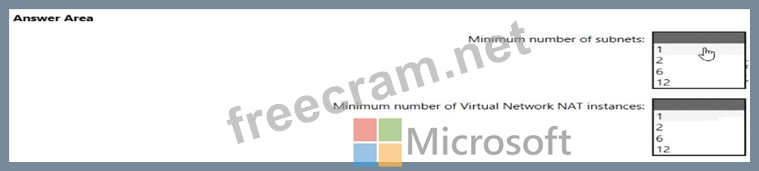
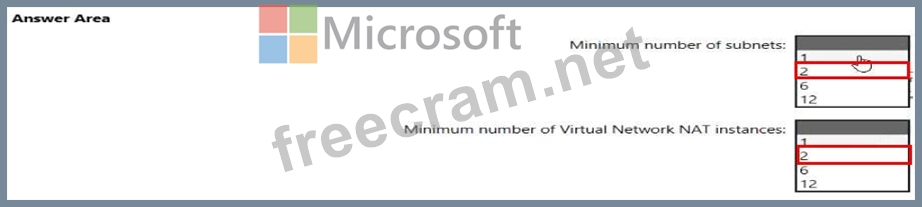
You need to identify the minimum number of subnets and Virtual Network NAT instances required to meet the following requirements:
* A failure of two zones must NOT affect the availability of either App1 or App2.
* A failure of two zones must NOT affect the outbound connectivity of either App1 or App2.
What should you identify? To answer, select the appropriate options in the answer are
a.
NOTE: Each correct selection is worth one point.
You deploy 12 virtual machines to each virtual network, deploying four virtual machines per zone. The virtual machines in Vnet1 host an app named App1. The virtual machines in Vnet2 host an app named App2.
You plan to use Azure Virtual Network NAT to implement outbound connectivity for App1 and App2.
You need to identify the minimum number of subnets and Virtual Network NAT instances required to meet the following requirements:
* A failure of two zones must NOT affect the availability of either App1 or App2.
* A failure of two zones must NOT affect the outbound connectivity of either App1 or App2.
What should you identify? To answer, select the appropriate options in the answer are
a.
NOTE: Each correct selection is worth one point.


Recent Comments (The most recent comments are at the top.)
i think: To meet the requirements of ensuring that a failure of two zones does not affect the availability of either App1 or App2, and that outbound connectivity is maintained for both applications, the minimum number of subnets and Virtual Network NAT instances required would be as follows: Minimum number of subnets: 6 (3 subnets in Vnet1 + 3 subnets in Vnet2) Minimum number of Virtual Network NAT instances: 6 (1 NAT instance per subnet to ensure outbound connectivity for each application) Therefore, the correct options to select are:
Minimum number of subnets: 6
Min number of Virtual Network NAT instances: 6