<< Prev Question Next Question >>
Question 7/43
You need to implement outbound connectivity for VMScaleSet1. The solution must meet the virtual networking requirements and the business requirements.
Which three actions should you perform in sequence? To answer, move the appropriate actions from the list of actions to the answer area and arrange them in the correct order.
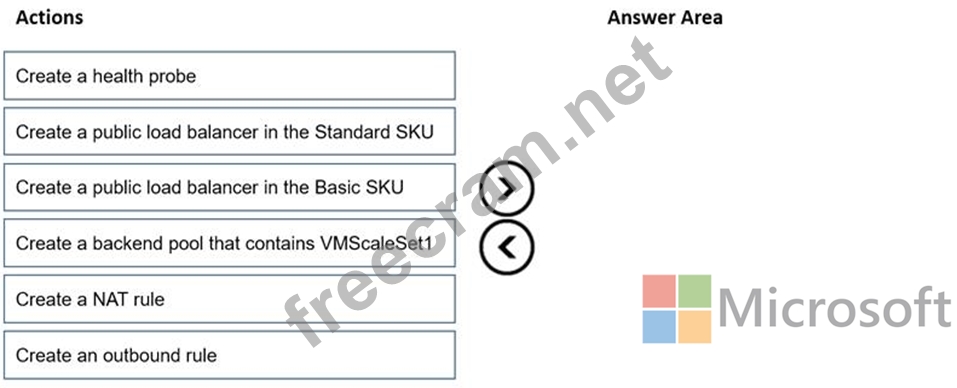
Which three actions should you perform in sequence? To answer, move the appropriate actions from the list of actions to the answer area and arrange them in the correct order.


Recent Comments (The most recent comments are at the top.)
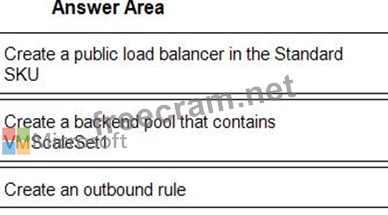
given answer is correct. explanation:To implement outbound connectivity for VMScaleSet1 while meeting the virtual networking requirements and business requirements, the following three actions should be performed in sequence:
Create a public load balancer in the Standard SKU
Create a backend pool that contains VMScaleSet1
Create an outbound rule
In the context of Azure networking, a health probe is typically used in load balancers to monitor the health of backend instances and ensure that traffic is directed only to healthy instances. In the scenario of implementing outbound connectivity for VMScaleSet1, the health probe is not a prerequisite before creating an outbound rule because outbound rules are primarily used to define how traffic should be routed from the virtual network to external destinations. Creating an outbound rule allows you to control and secure outbound traffic from your virtual network, specifying which resources can initiate outbound connections. Once the outbound rule is defined, it governs how traffic flows out of the virtual network. On the other hand, a health probe is more relevant in scenarios where load balancing and monitoring the health of backend instances are crucial, which is not directly related to defining outbound connectivity rules. Therefore, in the sequence of actions for implementing outbound connectivity for VMScaleSet1, creating an outbound rule would logically come before setting up a health probe as it directly addresses how outbound traffic is managed without requiring health monitoring of backend instances....