- Home
- Microsoft
- Designing and Implementing Microsoft DevOps Solutions
- Microsoft.AZ-400.v2021-11-12.q113
- Question 1
Valid AZ-400 Dumps shared by EduDump.com for Helping Passing AZ-400 Exam! EduDump.com now offer the newest AZ-400 exam dumps, the EduDump.com AZ-400 exam questions have been updated and answers have been corrected get the newest EduDump.com AZ-400 dumps with Test Engine here:
Access AZ-400 Dumps Premium Version
(625 Q&As Dumps, 35%OFF Special Discount Code: freecram)
Next Question >>
Question 1/113
You need to implement the code flow strategy for Project2 in Azure DevOps.
Which three actions should you perform in sequence? To answer, move the appropriate actions from the list of actions to the answer area and arrange in the correct order.
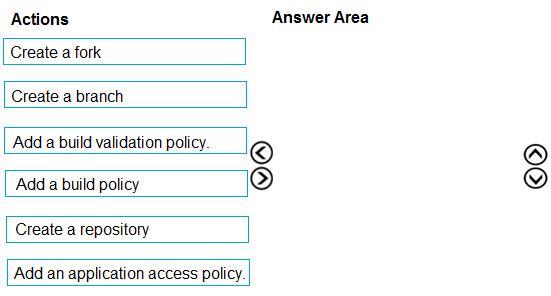
Which three actions should you perform in sequence? To answer, move the appropriate actions from the list of actions to the answer area and arrange in the correct order.
Correct Answer:
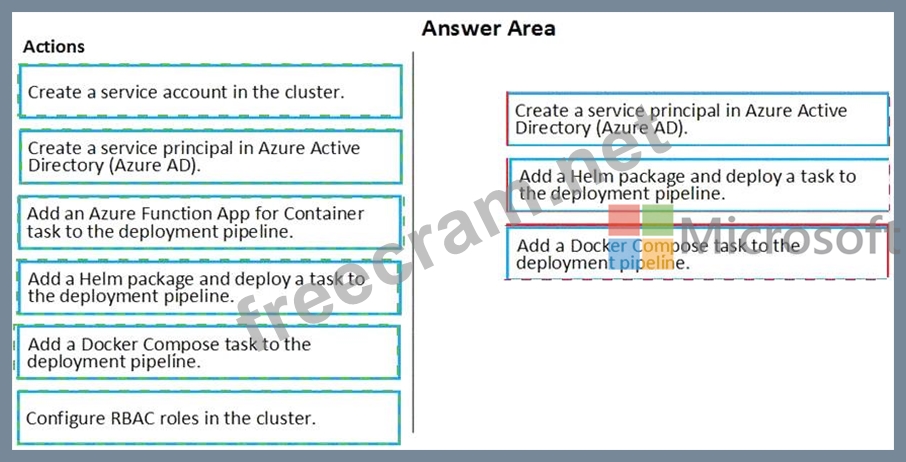
Explanation
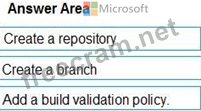
Step 1: Create a repository
A Git repository, or repo, is a folder that you've told Git to help you track file changes in. You can have any number of repos on your computer, each stored in their own folder.
Step 2: Create a branch
Branch policies help teams protect their important branches of development. Policies enforce your team's code quality and change management standards.
Step 3: Add a build validation policy
When a build validation policy is enabled, a new build is queued when a new pull request is created or when changes are pushed to an existing pull request targeting this branch. The build policy then evaluates the results of the build to determine whether the pull request can be completed.
Scenario:
Implement a code flow strategy for Project2 that will:
Enable Team2 to submit pull requests for Project2.
Enable Team2 to work independently on changes to a copy of Project2.
Ensure that any intermediary changes performed by Team2 on a copy of Project2 will be subject to the same restrictions as the ones defined in the build policy of Project2.

References: https://docs.microsoft.com/en-us/azure/devops/repos/git/manage-your-branches
Topic 3, Woodgrove bank
This is a case study. Case studies are not timed separately. You can use as much exam time as you would like to complete each case. However, there may be additional case studies and sections on this exam. You must manage your time to ensure that you are able to complete all questions included on this exam in the time provided.
To answer the questions included in a case study, you will need to reference information that is provided in the case study. Case studies might contain exhibits and other resources that provide more information about the scenario that is described in the case study. Each question is independent of the other questions in this case study.
At the end of this case study, a review screen will appear. This screen allows you to review your answers and to make changes before you move to the next section of the exam. After you begin a new section, you cannot return to this section.
To start the case study
To display the first question in this case study, click the button. Use the buttons in the left pane to explore the content of the case study before you answer the questions. Clicking these buttons displays information such as business requirements, existing environment, and problem statements. If the case study has an All Information tab, note that the information displayed is identical to the information displayed on the subsequent tabs. When you are ready to answer a question, click the button to return to the question.
Overview
General Overview
Woodgrove Bank is a financial services company that has a main office in the United Kingdom.
Technical Requirements and Planned Changes
Planned Changes
Woodgrove Bank plans to implement the following project management changes:
* Implement Azure DevOps for project tracking.
* Centralize source code control in private GitHub repositories.
* Implement Azure Pipelines for build pipelines and release pipelines.
Woodgrove Bank plans to implement the following changes to the identity environment:
* Deploy an Azure AD tenant named woodgrovebank.com.
* Sync the Active Directory domain to Azure AD.
* Configure App1 to use a service principal.
* Integrate GitHub with Azure AD.
Woodgrove Bank plans to implement the following changes to the core apps:
* Migrate App1 to ASP.NET Core.
* Integrate Azure Pipelines and the third-party build tool used to develop App2.
Woodgrove Bank plans to implement the following changes to the DevOps environment:
* Deploy App1 to Azure App Service.
* Implement source control for the DB1 schema.
* Migrate all the source code from TFS1 to GitHub.
* Deploy App2 to an Azure virtual machine named VM1.
* Merge the POC branch into the GitHub default branch.
* Implement an Azure DevOps dashboard for stakeholders to monitor development progress.
Technical Requirements
Woodgrove Bank identifies the following technical requirements:
* The initial databases for new environments must contain both schema and reference data.
* An Azure Monitor alert for VM1 must be configured to meet the following requirements:
* Be triggered when average CPU usage exceeds 80 percent for 15 minutes.
* Calculate CPU usage averages once every minute.
* The commit history of the POC branch must replace the history of the default branch.
* The Azure DevOps dashboard must display the metrics shown in the following table.

* Access to Azure DevOps must be restricted to specific IP addresses.
* Page load times for App1 must be captured and monitored.
* Administrative effort must be minimized.


- Question List (113q)
- Question 1: You need to implement the code flow strategy for Project2 in...
- Question 2: You manage an Azure web app that supports an e-commerce webs...
- Question 3: Your company is building a mobile app that targets Android a...
- Question 4: You need to prepare a network security group (NSG) named az4...
- Question 5: You use Azure Pipelines to manage project builds and deploym...
- Question 6: You use WhiteSource Bolt to scan a Node.js application. The ...
- Question 7: You are monitoring the health and performance of an Azure we...
- Question 8: Note: This question is part of a series of questions that pr...
- Question 9: You are creating a container for an ASP.NET Core app. You ne...
- Question 10: Your company wants to use Azure Application Insights to unde...
- Question 11: You have a GitHub repository. You create a new repository in...
- Question 12: Your company plans to use an agile approach to software deve...
- Question 13: You are developing a full Microsoft .NET Framework solution ...
- Question 14: You have a project Azure DevOps. You plan to create a build ...
- Question 15: You are deploying a server application that will run on a Se...
- Question 16: You have an Azure web app named Webapp1. You need to use an ...
- Question 17: You have a web app that connects to an Azure SQL Database na...
- Question 18: You need to increase the security of your team's development...
- Question 19: Note: This question is part of a series of questions that pr...
- Question 20: You use Azure Pipelines lo manage the build and deployment o...
- Question 21: You have an Azure DevOps organization named Contoso and an A...
- Question 22: You manage the Git repository for a large enterprise applica...
- Question 23: During a code review, you discover quality issues in a Java ...
- Question 24: You are implementing a package management solution for a Nod...
- Question 25: Your company has an Azure subscription named Subscription1. ...
- Question 26: Your company has an Azure DevOps project, The source code fo...
- Question 27: You need to find and isolate shared code. The shared code wi...
- Question 28: You need to create an instance of Azure Application Insights...
- Question 29: Your company hosts a web application in Azure. The company u...
- Question 30: Note: This question is part of a series of questions that pr...
- Question 31: You have a web app hosted on Azure App Service. The web app ...
- Question 32: You have a protect in Azure DevOps. You need to associate an...
- Question 33: You are configuring a release pipeline in Azure DevOps as sh...
- Question 34: You need to recommend project metrics for dashboards in Azur...
- Question 35: As part of your application build process, you need to deplo...
- Question 36: (Exhibit) You have an Azure Kubernetes Service (AKS) pod. Yo...
- Question 37: You need to ensure that the https://contoso.com/statushook w...
- Question 38: You have the following Azure policy. (Exhibit) You assign th...
- Question 39: SIMULATION You need to create and configure an Azure Storage...
- Question 40: Your company is concerned that when developers introduce ope...
- Question 41: To resolve the current technical issue, what should you do t...
- Question 42: Note: This question is part of a series of questions that pr...
- Question 43: After you answer a question in this section, you will NOT be...
- Question 44: You have a private distribution group that contains provisio...
- Question 45: You have an Azure function hosted in an App Service plan nam...
- Question 46: You are designing the development process for your company. ...
- Question 47: You plan to create an image that will contain a .NET Core ap...
- Question 48: You use Azure Pipelines to manage build pipelines. GitHub to...
- Question 49: You plan to use a NuGet package in a project in Azure DevOps...
- Question 50: (Exhibit) Your company wants to use Azure Application Insigh...
- Question 51: You provision an Azure Kubernetes Service (AKS) cluster that...
- Question 52: You need to recommend a solution for deploying charts by usi...
- Question 53: Your company is building a new solution in Java. The company...
- Question 54: Note: This question is part of a series of questions that pr...
- Question 55: You have an Azure Kubernetes Service (AKS) pod. You need to ...
- Question 56: Note: This question is part of a series of questions that pr...
- Question 57: You are developing a multi-tier application. The application...
- Question 58: You use Azure DevOps to manage the build and deployment of a...
- Question 59: You are automating the testing process for your company. You...
- Question 60: You need to ensure that Microsoft Visual Studio 2017 can rem...
- Question 61: You use Azure Artifacts to host NuGet packages that you crea...
- Question 62: Note: This question is part of a series of questions that pr...
- Question 63: Your company uses a Git repository in Azure Repos lo manage ...
- Question 64: Your company plans to deploy an application to the following...
- Question 65: You are developing an iOS application by using Azure DevOps....
- Question 66: You have an Azure DevOps project named Project1 and an Azure...
- Question 67: You need to implement Project6. Which three actions should y...
- Question 68: Your company has a project in Azure DevOps. You need to ensu...
- Question 69: You are integrating Azure Pipelines and Microsoft Teams. You...
- Question 70: You are creating a NuGet package. You plan to distribute the...
- Question 71: This question is part of a series of questions that present ...
- Question 72: You manage build pipelines and deployment pipelines by using...
- Question 73: You have multi-tier application that ha an Azure Web Apps fr...
- Question 74: You have an application that consists of several Azure App S...
- Question 75: Your company creates a new Azure DevOps team. D18912E1457D5D...
- Question 76: Note: This question is part of a series of questions that pr...
- Question 77: You have Azure Pipelines and GitHub integrated as a source c...
- Question 78: Your company has 60 developers who are assigned to four team...
- Question 79: Note: This question is part of a series of questions that pr...
- Question 80: You plan to deploy a runbook that will create Azure AD user ...
- Question 81: You have a project in Azure DevOps. You have an Azure Resour...
- Question 82: How should you configure the filters for the Project5 trigge...
- Question 83: You need to create a notification if the peak average respon...
- Question 84: You need to execute inline testing of an Azure DevOps pipeli...
- Question 85: You need to recommend a Docker container build strategy that...
- Question 86: You have an Azure DevOps project named Project1 and an Azure...
- Question 87: Note: This question is part of a series of questions that pr...
- Question 88: You have a private distribution group that contains provisio...
- Question 89: You are finalizing a release in GitHub. You need to apply th...
- Question 90: You create an alert rule in Azure Monitor as shown in the fo...
- Question 91: You need to deploy Internet Information Services (IIS) to an...
- Question 92: You have an Azure DevOps organization named Contoso and an A...
- Question 93: unique solution that might meet the stated goals. Some quest...
- Question 94: You are implementing an Azure DevOps strategy for mobile dev...
- Question 95: You need to use Azure Automation Sure Configuration to manag...
- Question 96: You company uses Azure DevOps to deploy infrastructures to A...
- Question 97: Your company has a project in Azure DevOps. You plan to crea...
- Question 98: You plan to create alerts that will be triggered based on th...
- Question 99: After you answer a question in this section, you will NOT be...
- Question 100: Your company a concerned that when developers introduce open...
- Question 101: You have an application named App1 that has a custom domain ...
- Question 102: You need to create an instance of Azure Application Insights...
- Question 103: You have a project in Azure DevOps named Project1. Project1 ...
- Question 104: You need to create and configure an Azure Storage account na...
- Question 105: You have an Azure DevOps organization that contains a projec...
- Question 106: You need to configure GitHub to use Azure Active Directory (...
- Question 107: Your company builds a multi tier web application. >You us...
- Question 108: You have a project in Azure DevOps named Project1. Project! ...
- Question 109: You add the virtual machines as managed nodes in Azure Autom...
- Question 110: Note: This question is part of a series of questions that pr...
- Question 111: Your company uses Git as a source code control system for a ...
- Question 112: Your company uses cloud-hosted Jenkins for builds. You need ...
- Question 113: You use GitHub for source control. A file that contains sens...
