- Home
- Microsoft
- Developing Solutions for Microsoft Azure
- Microsoft.AZ-204.v2026-07-02.q212
- Question 182
Valid AZ-204 Dumps shared by EduDump.com for Helping Passing AZ-204 Exam! EduDump.com now offer the newest AZ-204 exam dumps, the EduDump.com AZ-204 exam questions have been updated and answers have been corrected get the newest EduDump.com AZ-204 dumps with Test Engine here:
Access AZ-204 Dumps Premium Version
(655 Q&As Dumps, 35%OFF Special Discount Code: freecram)
<< Prev Question Next Question >>
Question 182/212
Contoso, Ltd. provides an API to customers by using Azure API Management (APIM). The API authorizes users with a JWT token.
You must implement response caching for the APIM gateway. The caching mechanism must detect the user ID of the client that accesses data for a given location and cache the response for that user ID.
You need to add the following policies to the policies file:
* a set-variable policy to store the detected user identity
* a cache-lookup-value policy
* a cache-store-value policy
* a find-and-replace policy to update the response body with the user profile information To which policy section should you add the policies? To answer, drag the appropriate sections to the correct policies. Each section may be used once, more than once, or not at all. You may need to drag the split bar between panes or scroll to view content NOTE: Each correct selection is worth one point

You must implement response caching for the APIM gateway. The caching mechanism must detect the user ID of the client that accesses data for a given location and cache the response for that user ID.
You need to add the following policies to the policies file:
* a set-variable policy to store the detected user identity
* a cache-lookup-value policy
* a cache-store-value policy
* a find-and-replace policy to update the response body with the user profile information To which policy section should you add the policies? To answer, drag the appropriate sections to the correct policies. Each section may be used once, more than once, or not at all. You may need to drag the split bar between panes or scroll to view content NOTE: Each correct selection is worth one point
Correct Answer:

Explanation:
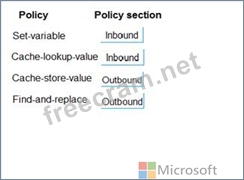
Box 1: Inbound.
A set-variable policy to store the detected user identity.
Example:
< policies >
< inbound >
< !-- How you determine user identity is application dependent -- >
< set-variable
name= " enduserid "
value= " @(context.Request.Headers.GetValueOrDefault( " Authorization " , " " ).Split( ' ' )[1].AsJwt()?.
Subject) " / >
Box 2: Inbound
A cache-lookup-value policy
Example:
< inbound >
< base / >
< cache-lookup vary-by-developer= " true | false " vary-by-developer-groups= " true | false " downstream- caching-type= " none | private | public " must-revalidate= " true | false " >
< vary-by-query-parameter > parameter name < /vary-by-query-parameter > < !-- optional, can repeated several times -- >
< /cache-lookup >
< /inbound >
Box 3: Outbound
A cache-store-value policy.
Example:
< outbound >
< base / >
< cache-store duration= " 3600 " / >
< /outbound >
Box 4: Outbound
A find-and-replace policy to update the response body with the user profile information.
Example:
< outbound >
< !-- Update response body with user profile-- >
< find-and-replace
from= ' " $userprofile$ " '
to= " @((string)context.Variables[ " userprofile " ]) " / >
< base / >
< /outbound >
Reference:
https://docs.microsoft.com/en-us/azure/api-management/api-management-caching-policies
https://docs.microsoft.com/en-us/azure/api-management/api-management-sample-cache-by-key


- Question List (212q)
- Question 1: The solution must receive and store messages until they can ...
- Question 2: Note: This question is part of a series of questions that pr...
- Question 3: Note: This question is part of a series of questions that pr...
- Question 4: You are developing a medical records document management web...
- Question 5: You need to implement farmer authentication. Which three act...
- Question 6: You need to deploy a new version of the LabelMaker applicati...
- Question 7: Vou are developing a microservice to run on Azure Container ...
- Question 8: You have an application that provides weather forecasting da...
- Question 9: You develop software solutions for a mobile delivery service...
- Question 10: You are developing an ASP.NET Core app hosted in Azure App S...
- Question 11: An organization hosts web apps in Azure. The organization us...
- Question 12: You need to investigate the http server log output to resolv...
- Question 13: Note: This question is part of a series of questions that pr...
- Question 14: You are developing a .Net web application that stores data i...
- Question 15: Note: This question is part of a series of questions that pr...
- Question 16: An organization plans to deploy Azure storage services. You ...
- Question 17: You are developing a set of RESTful APIs that will be consum...
- Question 18: You develop a web app that interacts with Azure Active Direc...
- Question 19: You are developing a mobile app that uses an API which store...
- Question 20: You are developing a .NET Core model-view controller (MVC) a...
- Question 21: You need to provide internal staff access to the production ...
- Question 22: You create the following PowerShell script: (Exhibit) For ea...
- Question 23: Note: This question is part of a series of questions that pr...
- Question 24: You need to implement the Azure Function for delivery driver...
- Question 25: You are developing an application to store information about...
- Question 26: You are preparing to deploy a medical records application to...
- Question 27: You are developing a mobile instant messaging app for a comp...
- Question 28: You need to ensure that all messages from Azure Event Grid a...
- Question 29: You need to ensure that PolicyLib requirements are met. How ...
- Question 30: You develop an Azure web app. You monitor performance of the...
- Question 31: You need to implement the Log policy. How should you complet...
- Question 32: you need to reduce read latency for the retail store solutio...
- Question 33: You are developing a Docker/Go using Azure App Service Web A...
- Question 34: You develop a solution that uses an Azure SQL Database to st...
- Question 35: You need to resolve the capacity issue. What should you do?...
- Question 36: A company is developing a gaming platform. Users can join te...
- Question 37: You are developing a back-end Azure App Service that scales ...
- Question 38: You have an Azure App Service plan named APSPIanl set to the...
- Question 39: You need to add code at line EG15 in EventGridController.cs ...
- Question 40: You are developing a Java application that uses Cassandra to...
- Question 41: You have a workspace-based Azure Application Insights resour...
- Question 42: You are updating an application that stores data on Azure an...
- Question 43: You manage an Azure subscription associated with a Microsoft...
- Question 44: You have an app that stores player scores for an online game...
- Question 45: You have 100 Azure virtual machines (VMs) with the system-as...
- Question 46: You are developing an Azure App Service hosted ASP.NET Core ...
- Question 47: You are developing an application that monitors data added t...
- Question 48: You need to secure the Shipping Function app. How should you...
- Question 49: You need to correct the VM issues. Which tools should you us...
- Question 50: You need to retrieve the database connection string. Which v...
- Question 51: You are building an application that stores sensitive custom...
- Question 52: You need to add code at line PC32 in Processing.cs to implem...
- Question 53: You develop a web app that uses tier D1 app service plan by ...
- Question 54: You are developing a web application that uses the Microsoft...
- Question 55: You need to add markup at line AM04 to implement the Content...
- Question 56: You need to implement the Log policy. How should you complet...
- Question 57: You are developing a complex workflow by using Azure Durable...
- Question 58: You have a workspace-based Azure Application Insights resour...
- Question 59: You have a web service that is used to pay for food deliveri...
- Question 60: You have an Azure Application Insights resource named All. A...
- Question 61: You develop a REST API. You implement a user delegation SAS ...
- Question 62: You need to resolve a notification latency issue. Which two ...
- Question 63: You develop applications that integrate with a Microsoft Ent...
- Question 64: You develop a Python application for image rendering that us...
- Question 65: You are developing an application to retrieve user profile i...
- Question 66: You are developing a web application that makes calls to the...
- Question 67: You need to configure all site configuration settings for th...
- Question 68: You need to implement a solution to resolve the retail store...
- Question 69: You are developing an Azure-hosted e-commerce web applicatio...
- Question 70: You are developing several microservices to run on Azure Con...
- Question 71: You develop a news and blog content app for Windows devices....
- Question 72: You manage an Azure Key Vault named kv1 of Standard SKU. You...
- Question 73: You need to secure the Shipping Logic App. What should you u...
- Question 74: You need to ensure receipt processing occurs correctly. What...
- Question 75: YOU need to reliably identify the delivery driver profile in...
- Question 76: You need to ensure that network security policies are met. H...
- Question 77: Note: This question is part of a series of questions that pr...
- Question 78: You are developing a solution that uses the Azure Storage Cl...
- Question 79: You develop an ASP.NET Core app that uses Azure App Configur...
- Question 80: Note: This question is part of a series of questions that pr...
- Question 81: You have two Azure Container Registry (ACR) instances: ACR01...
- Question 82: You deploy an API to API Management You must secure all oper...
- Question 83: You are building a software-as-a-service (SaaS) application ...
- Question 84: You are developing a solution to store documents in Azure Bl...
- Question 85: You plan to implement an Azure Functions app. The Azure Func...
- Question 86: An organization deploys a Mob storage account. Users take mu...
- Question 87: You develop and deploy an Azure App Service web app. The app...
- Question 88: Note: This question is part of a series of questions that pr...
- Question 89: You are developing an internal website for employees to view...
- Question 90: A company is developing a mobile app for field service emplo...
- Question 91: You use Azure Table storage to store customer information fo...
- Question 92: You are developing a solution for a hospital to support the ...
- Question 93: You plan to create a Docker image that runs an ASP.NET Core ...
- Question 94: Note: This question is part of a series of questions that pr...
- Question 95: You are developing an Azure Function App by using Visual Stu...
- Question 96: You are developing a web application that uses the Microsoft...
- Question 97: A company has multiple warehouse. Each warehouse contains Io...
- Question 98: You are developing an Azure function that connects to an Azu...
- Question 99: You need to authenticate the user to the corporate website a...
- Question 100: You are developing an application to store business-critical...
- Question 101: A development team is creating a new REST API. The API will ...
- Question 102: You have a single page application (SPA) web application tha...
- Question 103: You develop a gateway solution for a public facing news API....
- Question 104: You are a developer building a web site using a web app. The...
- Question 105: You are developing an Azure Function that calls external API...
- Question 106: Note: This question is part of a series of questions that pr...
- Question 107: You are building a web application that uses the Microsoft i...
- Question 108: You are designing a solution that will use two Azure Functio...
- Question 109: You develop and deploy the following staticwebapp.config.jso...
- Question 110: You plan to develop an Azure Functions app with an Azure Blo...
- Question 111: Note: This question is part of a series of questions that pr...
- Question 112: You are developing an application to store and retrieve data...
- Question 113: You are implementing an order processing system. A point of ...
- Question 114: You have an Azure App Service web app named App1. App1 has A...
- Question 115: You have an application that provides weather forecasting da...
- Question 116: Your company is developing an Azure API. You need to impleme...
- Question 117: You develop and deploy a web app to Azure App service. The w...
- Question 118: You are developing an Azure messaging solution. You need to ...
- Question 119: You have a Standard tier instance of Azure Cache for Radis n...
- Question 120: You are developing a user portal for a company. You need to ...
- Question 121: You are developing a Java application to be deployed in Azur...
- Question 122: You are building a website that is used to review restaurant...
- Question 123: You develop software solutions for a mobile delivery service...
- Question 124: You ate developing a web application that uses the Microsoft...
- Question 125: You are developing a microservices-based application that us...
- Question 126: You are developing an application that needs access to an Az...
- Question 127: You are using Azure Front Door Service. You are expecting in...
- Question 128: You develop and deploy a Java RESTful API to Azure App Servi...
- Question 129: You are developing Azure WebJobs. You need to recommend a We...
- Question 130: You develop Azure solutions. A .NET application needs to rec...
- Question 131: You are developing an application that use an Azure blob nam...
- Question 132: Note: This question is part of a series of questions that pr...
- Question 133: You need to test the availability of the corporate website. ...
- Question 134: You are developing an ASP.NET Core web application. You plan...
- Question 135: You are developing an Azure Function app. The app must meet ...
- Question 136: You are developing several microservices to deploy to a Azur...
- Question 137: You are developing an Azure Durable Function to manage an on...
- Question 138: You plan to deploy a web app to App Service on Linux. You cr...
- Question 139: You are developing an Azure Web App. You configure TLS mutua...
- Question 140: You deploy an ASP.NET web app to Azure App Service. You must...
- Question 141: You need to ensure disaster recovery requirements are met. W...
- Question 142: You need to secure the corporate website for users. Which fo...
- Question 143: You need to store inventory item images. Which Azure Blob St...
- Question 144: An organization has web apps hosted in Azure. The organizati...
- Question 145: You are developing an application to store millions of image...
- Question 146: You develop an application. You plan to host the application...
- Question 147: You create and publish a new Azure App Service web app. User...
- Question 148: You are developing several Azure API Management (APIM) hoste...
- Question 149: A company backs up all manufacturing data to Azure Blob Stor...
- Question 150: You are developing an Azure Function App that runs in an App...
- Question 151: A company is developing a Java web app. The web app code is ...
- Question 152: You need to retrieve all order line items from Order.json an...
- Question 153: You need to configure Azure Cosmos DB. Which settings should...
- Question 154: You have an application that uses Azure Blob storage. You ne...
- Question 155: You are developing a data storage solution for a social netw...
- Question 156: You need to implement event routing for retail store locatio...
- Question 157: You are developing applications for a company. You plan to h...
- Question 158: A company maintains multiple web and mobile applications. Ea...
- Question 159: You need to Implement the retail store location Azure Functi...
- Question 160: Your company purchases an Azure subscription and plans to mi...
- Question 161: You have an Azure Queue Storage account that contains a queu...
- Question 162: You develop Azure Durable Functions to manage vehicle loans....
- Question 163: You need to secure the Azure Functions to meet the security ...
- Question 164: You are developing an ASP.NET Core Web API web service. The ...
- Question 165: You plan to deploy a new application to a Linux virtual mach...
- Question 166: A company is implementing a publish-subscribe (Pub/Sub) mess...
- Question 167: You are developing a REST web service. Customers will access...
- Question 168: You are preparing to deploy an Azure virtual machine (VM) ba...
- Question 169: You need to support the requirements for the Shipping Logic ...
- Question 170: You have an Azure Service Bus namespace with a partitioned q...
- Question 171: An organization deploys a blob storage account. Users take m...
- Question 172: You have an Azure App Service plan named APSPIanl set to the...
- Question 173: You have an App Service plan named aspl based on the Free pr...
- Question 174: Note: This question is part of a series of questions that pr...
- Question 175: You need to implement the corporate website. How should you ...
- Question 176: You develop an ASP. Net Core application by integrating the ...
- Question 177: You have a web app named Appl hosted on your on-premises web...
- Question 178: You need to configure App Service to support the corporate w...
- Question 179: You need to correct the errors for farmers and distributors....
- Question 180: A company is implementing a publish-subscribe (Pub/Sub) mess...
- Question 181: You are developing a .NET application that communicates with...
- Question 182: Contoso, Ltd. provides an API to customers by using Azure AP...
- Question 183: You need to ensure the security policies are met. What code ...
- Question 184: You are developing an ASP.NET Core web application, using th...
- Question 185: You are developing an online game that allows players to vot...
- Question 186: You are writing code to create and run an Azure Batch job. Y...
- Question 187: You develop a website. You plan to host the website in Azure...
- Question 188: You develop a gateway solution for a public facing news API....
- Question 189: You are developing a microservices solution. You plan to dep...
- Question 190: Note: This question is part of a series of questions that pr...
- Question 191: Note: This question is part of a series of questions that pr...
- Question 192: You plan to develop an Azure Functions app with an HTTP trig...
- Question 193: You manage several existing Logic Apps. You need to change d...
- Question 194: You are preparing to deploy an ASP.NET Core website to an Az...
- Question 195: You need to ensure that the solution can meet the scaling re...
- Question 196: You develop Azure Web Apps for a commercial diving company. ...
- Question 197: You need to deploy the CheckUserContent Azure function. The ...
- Question 198: You are developing an application. You have an Azure user ac...
- Question 199: You need to configure Azure Service Bus to Event Grid integr...
- Question 200: You have an Azure subscription that hosts an Application Ins...
- Question 201: You are a developer for a Software as a Service (SaaS) compa...
- Question 202: You develop two Python scripts to process data. The Python s...
- Question 203: You are creating an app that will use CosmosDB for data stor...
- Question 204: Note: This question is part of a series of questions that pr...
- Question 205: Note: This question is part of a series of questions that pr...
- Question 206: You need to correct the corporate website error. Which four ...
- Question 207: ASP.NET Core API app by using C#. The API app will allow use...
- Question 208: You need to design network connectivity for a subnet in an A...
- Question 209: You manage an Azure subscription that contains 100 Azure App...
- Question 210: You a web application that provides access to legal document...
- Question 211: D18912E1457D5D1DDCBD40AB3BF70D5D You are building a website ...
- Question 212: You are developing a web app that is protected by Azure Web ...
