Valid AI-900 Dumps shared by EduDump.com for Helping Passing AI-900 Exam! EduDump.com now offer the newest AI-900 exam dumps, the EduDump.com AI-900 exam questions have been updated and answers have been corrected get the newest EduDump.com AI-900 dumps with Test Engine here:
Access AI-900 Dumps Premium Version
(336 Q&As Dumps, 35%OFF Special Discount Code: freecram)
<< Prev Question Next Question >>
Question 78/135
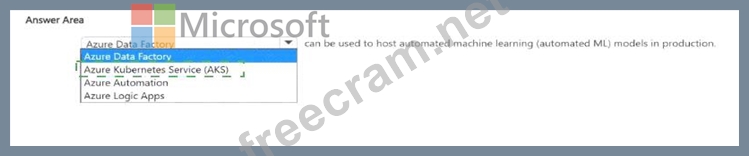
Select the answer that correctly completes the sentence.

Correct Answer:
Explanation:
Azure Kubernetes Service (AKS).
According to the Microsoft Azure AI Fundamentals (AI-900) official study guide and Microsoft Learn documentation on Azure Machine Learning, the Azure Kubernetes Service is commonly used to host and deploy machine learning models, including Automated ML models, into production environments. Once a model is trained using Azure Machine Learning (Azure ML), it must be deployed as a web service endpoint so it can receive data and return predictions.
Azure ML offers two primary options for hosting and deploying models:
* Azure Kubernetes Service (AKS) - for high-scale, production-grade deployments that require fast response times, high availability, and scalability.
* Azure Container Instances (ACI) - for testing or low-scale workloads where cost and simplicity are more important than performance.
AKS provides a managed Kubernetes cluster that allows for automated container orchestration, load balancing, scaling, and monitoring of deployed machine learning models. When you use Automated ML in Azure ML Studio, the generated model can be containerized and deployed directly to AKS, making it accessible as a REST API endpoint. This enables applications, systems, or users to send data and receive predictions in real time.
The other options serve different purposes:
* Azure Data Factory is used for data integration and pipeline orchestration, not model hosting.
* Azure Automation focuses on automating administrative tasks and runbooks, not ML deployment.
* Azure Logic Apps is used to automate workflows and integrate services, not to serve ML models.
Therefore, the correct service to host automated machine learning (AutoML) models in production is Azure Kubernetes Service (AKS), as it provides a reliable, scalable, and secure environment for real-time inference and enterprise AI workloads.


- Question List (135q)
- Question 1: Which service should you use to extract text, key/value pair...
- Question 2: Which feature of the Azure Al Language service should you us...
- Question 3: Select the . (Exhibit)
- Question 4: Select the answer that correctly completes the sentence (Exh...
- Question 5: Select the answer that correctly completes the sentence. (Ex...
- Question 6: To complete the sentence, select the appropriate option in t...
- Question 7: You are developing a conversational AI solution that will co...
- Question 8: Match the computer vision service to the appropriate Al work...
- Question 9: An app that analyzes social media posts to identify their to...
- Question 10: You need to predict the animal population of an area. Which ...
- Question 11: For each of the following statements, select Yes if the stat...
- Question 12: For each of the following statements, select Yes if the stat...
- Question 13: You are evaluating whether to use a basic workspace or an en...
- Question 14: Match the facial recognition tasks to the appropriate questi...
- Question 15: You are developing a solution that uses the Text Analytics s...
- Question 16: You send an image to a Computer Vision API and receive back ...
- Question 17: You deploy the Azure OpenAI service to generate images. You ...
- Question 18: For each of the following statements, select Yes if the stat...
- Question 19: To complete the sentence, select the appropriate option in t...
- Question 20: You have a frequently asked questions (FAQ) PDF file. You ne...
- Question 21: Match the types of machine learning to the appropriate scena...
- Question 22: You have an Azure Machine Learning model that predicts produ...
- Question 23: Match the Al workload to the appropriate task. To answer, dr...
- Question 24: You are developing a natural language processing solution in...
- Question 25: You need to reduce the load on telephone operators by implem...
- Question 26: You use natural language processing to process text from a M...
- Question 27: You plan to use Azure Cognitive Services to develop a voice ...
- Question 28: You are designing a system that will generate insurance quot...
- Question 29: You need to analyze images of vehicles on a highway and meas...
- Question 30: Match the principles of responsible AI to the appropriate de...
- Question 31: Select the answer that correctly completes the sentence. (Ex...
- Question 32: Which two languages can you use to write custom code for Azu...
- Question 33: You are building a chatbot that will use natural language pr...
- Question 34: You need to track multiple versions of a model that was trai...
- Question 35: During the process of Machine Learning, when should you revi...
- Question 36: Select the answer that correctly completes the sentence. (Ex...
- Question 37: Select the answer that correctly completes the sentence. (Ex...
- Question 38: You have the process shown in the following exhibit. (Exhibi...
- Question 39: When training a model, why should you randomly split the row...
- Question 40: Which three actions improve the quality of responses returne...
- Question 41: You have an app that identifies birds in images. The app per...
- Question 42: Select the answer that correctly completes the sentence. (Ex...
- Question 43: For each of the following statements, select Yes if the stat...
- Question 44: You need to convert receipts into transactions in a spreadsh...
- Question 45: To complete the sentence, select the appropriate option in t...
- Question 46: You are authoring a Language Understanding (LUIS) applicatio...
- Question 47: For each of the following statements, select Yes If the stat...
- Question 48: For each of the following statements, select Yes if the stat...
- Question 49: For each of the following statements, select Yes if the stat...
- Question 50: To complete the sentence, select the appropriate option in t...
- Question 51: What is a use case for classification?...
- Question 52: Which OpenAI model does GitHub Copilot use to make suggestio...
- Question 53: Match the Microsoft guiding principles for responsible AI to...
- Question 54: Select the answer that correctly completes the sentence. (Ex...
- Question 55: Select the answer that correctly completes the sentence. (Ex...
- Question 56: For each of the following statements, select Yes if the stat...
- Question 57: You have a dataset that contains experimental data for fuel ...
- Question 58: You need to scan the news for articles about your customers ...
- Question 59: You have a custom question answering solution. You create a ...
- Question 60: You need to develop a chatbot for a website. The chatbot mus...
- Question 61: Match the Azure Cognitive Services to the appropriate Al wor...
- Question 62: Stating the source of the data used to train a model is an e...
- Question 63: You need to use Azure Machine Learning designer to build a m...
- Question 64: You need to create a customer support solution to help custo...
- Question 65: Which term is used to describe uploading your own data to cu...
- Question 66: Extracting relationships between data from large volumes of ...
- Question 67: Select the answer that correctly completes the sentence. (Ex...
- Question 68: For each of the following statements, select Yes if the stat...
- Question 69: A company employs a team of customer service agents to provi...
- Question 70: A smart device that responds to the question. " What is the ...
- Question 71: You have a bot that identifies the brand names of products i...
- Question 72: For each of the following statements, select Yes if the stat...
- Question 73: You have a natural language processing (NIP) model that was ...
- Question 74: Providing contextual information to improve the responses qu...
- Question 75: For each of the following statements, select Yes if the stat...
- Question 76: You have a chatbot that answers technical questions by using...
- Question 77: Select the answer that correctly completes the sentence. (Ex...
- Question 78: Select the answer that correctly completes the sentence. (Ex...
- Question 79: Which two scenarios are examples of a conversational AI work...
- Question 80: You have an Al-based loan approval system. During testing, y...
- Question 81: Which machine learning technique can be used for anomaly det...
- Question 82: Which Azure service can use the prebuilt receipt model in Az...
- Question 83: You plan to deploy an Azure Machine Learning model by using ...
- Question 84: To complete the sentence, select the appropriate option in t...
- Question 85: You need to make the press releases of your company availabl...
- Question 86: Select the answer that correctly completes the sentence. (Ex...
- Question 87: Which two scenarios are examples of a conversational AI work...
- Question 88: Which two resources can you use to analyze code and generate...
- Question 89: For each of the following statements, select Yes if the stat...
- Question 90: You have an app that identifies the coordinates of a product...
- Question 91: You are building a tool that will process images from retail...
- Question 92: What should you use to identify similar faces in a set of im...
- Question 93: What are three Microsoft guiding principles for responsible ...
- Question 94: Select the answer that correctly completes the sentence. (Ex...
- Question 95: Match the principles of responsible AI to appropriate requir...
- Question 96: For each of the following statements, select Yes if the stat...
- Question 97: Which Azure Al Language feature can be used to retrieve data...
- Question 98: When you design an AI system to assess whether loans should ...
- Question 99: Select the answer that correctly completes the sentence. (Ex...
- Question 100: Your company manufactures widgets. You have 1.000 digital ph...
- Question 101: Match the tool to the Azure Machine Learning task. To answer...
- Question 102: Select the answer that correctly completes the sentence. (Ex...
- Question 103: For each of the following statements, select Yes if the stat...
- Question 104: For each of the following statements, select Yes if the stat...
- Question 105: What is an example of a regression model in machine learning...
- Question 106: You need to build an image tagging solution for social media...
- Question 107: You have an Internet of Things (loT) device that monitors en...
- Question 108: You need to create a model that labels a collection of your ...
- Question 109: You have a database that contains a list of employees and th...
- Question 110: In which scenario should you use key phrase extraction?...
- Question 111: For each of the following statements, select Yes if the stat...
- Question 112: Which AI service can you use to interpret the meaning of a u...
- Question 113: Which type of machine learning should you use to identify gr...
- Question 114: For each of the following statements, select Yes if the stat...
- Question 115: Match the types of natural languages processing workloads to...
- Question 116: To complete the sentence, select the appropriate option in t...
- Question 117: You use Azure Machine Learning designer to publish an infere...
- Question 118: You are processing photos of runners in a race. You need to ...
- Question 119: Match the types of computer vision to the appropriate scenar...
- Question 120: Match the Al workload to the appropriate task. To answer, dr...
- Question 121: Select the answer that correctly completes the sentence. (Ex...
- Question 122: Select the answer that correctly completes the sentence. (Ex...
- Question 123: You ate building a Conversational Language Understanding mod...
- Question 124: In which two scenarios can you use the Form Recognizer servi...
- Question 125: Match the machine learning tasks to the appropriate scenario...
- Question 126: You plan to deploy an Azure Machine Learning model as a serv...
- Question 127: Which action can be performed by using the Azure Al Vision s...
- Question 128: Select the answer that correctly completes the sentence. (Ex...
- Question 129: You are building an AI-based app. You need to ensure that th...
- Question 130: For each of the following statements, select Yes if the stat...
- Question 131: You need to provide content for a business chatbot that will...
- Question 132: Select the answer that correctly completes the sentence. (Ex...
- Question 133: Select the answer that correctly completes the sentence. (Ex...
- Question 134: For each of the following statements, select Yes if the stat...
- Question 135: Select the answer that correctly completes the sentence. (Ex...
