- Home
- Microsoft
- Designing and Deploying Microsoft Exchange Server 2016
- Microsoft.70-345.v2018-10-23.q92
- Question 53
Valid 70-345 Dumps shared by ExamDiscuss.com for Helping Passing 70-345 Exam! ExamDiscuss.com now offer the newest 70-345 exam dumps, the ExamDiscuss.com 70-345 exam questions have been updated and answers have been corrected get the newest ExamDiscuss.com 70-345 dumps with Test Engine here:
Access 70-345 Dumps Premium Version
(168 Q&As Dumps, 35%OFF Special Discount Code: freecram)
<< Prev Question Next Question >>
Question 53/92
You need to recommend a load balancing solution that meets the availability requirements.
Which load balancing solution should you recommend?
Which load balancing solution should you recommend?
Correct Answer: A
Explanation/Reference:
Explanation:
From Scenario:
Contoso identifies the following high-availability requirements for the planned deployment:
The network load balancer must be able to probe the health of each workload.
Load balancers that work on the Layer 7 of OSI model are intelligent. Layer 7 load balancer is aware of the type of traffic passing through it. This type of load balancer can inspect the content of the traffic between the clients and the Exchange server. From this inspection, it gets that results and uses this information to make its forwarding decisions. For example, it can route traffic based on the virtual directory to which a client is trying to connect, such as /owa, /ecp or /mapi and it can use a different routing logic, depending on the URL the client is connecting to. When using a Layer 7 load balancer, you can also leverage the capabilities of Exchange Server 2016 Managed Availability feature. This built-in feature of Exchange monitors the critical components and services of Exchange server and based on results it can take actions.
Note: Layer 7 load balancer can use this to detect functionality of critical services, and based on that information decide if it will forward client connections to that node. If the load balancer health check receives a 200 status response from health check web page, then the service or protocol is up and running. If the load balancer receives a 403 status code, then it means that Managed Availability has marked that protocol instance down on the Mailbox server.
Although it might look that load balancer actually performs a simple health check against the server nodes in the pool, health check web page provides an information about workload's health by taking into account multiple internal health check probes performed by Managed Availability.
Incorrect Answers:
D: Load balancers that work on Layer 4 are not aware of the actual traffic content being load balanced.
References: http://dizdarevic.ba/ddamirblog/?p=187
Testlet 1
Case study
Existing Environment
Active Directory
The network contains an Active Directory Domain Services (AD DS) forest named litware.com that has Active Directory Certificate Services (AD CS) deployed. The forest contains a site in Houston and a site in London. All domain controllers run Windows Server 2016.
Exchange Server
Litware has an Exchange Server 2016 organization that uses the namespaces of mail.litware.com and autodiscover.litware.com.
The organization contains the servers configured as shown in the following table.
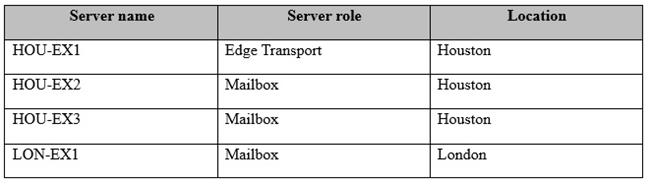
All Internet email is routed through HOU-EX1.
Requirements
Business Goals
Litware has security concerns about the data and messaging content of the research and development department. Preventing information leaks is a priority.
All users must be able to access their corporate email from any device.
Litware plans to minimize the costs associated with changing the Exchange Server environment.
Planned Changes
Litware plans to implement a site resilience solution ensuring that outbound email messages can be delivered if one of the sites fail. The site resilience solution must allow all users to access their mailbox if a server fails in each site.
Availability Requirements
Litware identifies the following availability requirements:
Load balancing must support the following functionalities:
Load balancing must support the following functionalities:

- Provide SSL termination
- Remove failed Mailbox servers from the server pool.
- Data collected by Managed Availability from Outlook on the web must be used.
- Target server health must be configured as per-protocol so that only the affected client protocol is directed to another server if a server fails.
The site resilience solution must follow the bound namespace model.
Security Requirements
Litware identifies the following security requirements:
Users in the research and development department must be able to encrypt documents sent to external
users. The encrypted email messages must never be forwarded by the external recipients.
Only specific research and development department users must be able to access confidential internal
email regarding the high-security government contracts.
All certificates deployed to the Exchange organization must be issued by a trusted third-party
certification authority (CA).
The principle of least privilege must be applied to all users and permissions.
Compliance Requirements
Litware identifies the following compliance requirements:
Any new mailbox created for the auditing department must have a retention policy named Audit
immediately applied manually after the mailbox is created.
Each week, a team of regulation auditors must review the email messages sent and received by all the
research and development department users.
The regulation auditors must be able to review the email messages of mailboxes placed on Litigation
Hold.
The regulation auditors must be able to gain quick access to the email messages.
Explanation:
From Scenario:
Contoso identifies the following high-availability requirements for the planned deployment:
The network load balancer must be able to probe the health of each workload.
Load balancers that work on the Layer 7 of OSI model are intelligent. Layer 7 load balancer is aware of the type of traffic passing through it. This type of load balancer can inspect the content of the traffic between the clients and the Exchange server. From this inspection, it gets that results and uses this information to make its forwarding decisions. For example, it can route traffic based on the virtual directory to which a client is trying to connect, such as /owa, /ecp or /mapi and it can use a different routing logic, depending on the URL the client is connecting to. When using a Layer 7 load balancer, you can also leverage the capabilities of Exchange Server 2016 Managed Availability feature. This built-in feature of Exchange monitors the critical components and services of Exchange server and based on results it can take actions.
Note: Layer 7 load balancer can use this to detect functionality of critical services, and based on that information decide if it will forward client connections to that node. If the load balancer health check receives a 200 status response from health check web page, then the service or protocol is up and running. If the load balancer receives a 403 status code, then it means that Managed Availability has marked that protocol instance down on the Mailbox server.
Although it might look that load balancer actually performs a simple health check against the server nodes in the pool, health check web page provides an information about workload's health by taking into account multiple internal health check probes performed by Managed Availability.
Incorrect Answers:
D: Load balancers that work on Layer 4 are not aware of the actual traffic content being load balanced.
References: http://dizdarevic.ba/ddamirblog/?p=187
Testlet 1
Case study
Existing Environment
Active Directory
The network contains an Active Directory Domain Services (AD DS) forest named litware.com that has Active Directory Certificate Services (AD CS) deployed. The forest contains a site in Houston and a site in London. All domain controllers run Windows Server 2016.
Exchange Server
Litware has an Exchange Server 2016 organization that uses the namespaces of mail.litware.com and autodiscover.litware.com.
The organization contains the servers configured as shown in the following table.
All Internet email is routed through HOU-EX1.
Requirements
Business Goals
Litware has security concerns about the data and messaging content of the research and development department. Preventing information leaks is a priority.
All users must be able to access their corporate email from any device.
Litware plans to minimize the costs associated with changing the Exchange Server environment.
Planned Changes
Litware plans to implement a site resilience solution ensuring that outbound email messages can be delivered if one of the sites fail. The site resilience solution must allow all users to access their mailbox if a server fails in each site.
Availability Requirements
Litware identifies the following availability requirements:
Load balancing must support the following functionalities:
Load balancing must support the following functionalities:
- Provide SSL termination
- Remove failed Mailbox servers from the server pool.
- Data collected by Managed Availability from Outlook on the web must be used.
- Target server health must be configured as per-protocol so that only the affected client protocol is directed to another server if a server fails.
The site resilience solution must follow the bound namespace model.
Security Requirements
Litware identifies the following security requirements:
Users in the research and development department must be able to encrypt documents sent to external
users. The encrypted email messages must never be forwarded by the external recipients.
Only specific research and development department users must be able to access confidential internal
email regarding the high-security government contracts.
All certificates deployed to the Exchange organization must be issued by a trusted third-party
certification authority (CA).
The principle of least privilege must be applied to all users and permissions.
Compliance Requirements
Litware identifies the following compliance requirements:
Any new mailbox created for the auditing department must have a retention policy named Audit
immediately applied manually after the mailbox is created.
Each week, a team of regulation auditors must review the email messages sent and received by all the
research and development department users.
The regulation auditors must be able to review the email messages of mailboxes placed on Litigation
Hold.
The regulation auditors must be able to gain quick access to the email messages.


- Question List (92q)
- 1 commentQuestion 1: You need to recommend changes to the messaging infrastructur...
- Question 2: You deploy an Exchange Server 2016 organization. You create ...
- Question 3: You have an Exchange Server 2016 organization. The organizat...
- Question 4: Your network contains a single Active Directory forest. The ...
- Question 5: A new company has the following: Two offices that connect to...
- Question 6: You have an Exchange Server 2016 organization. Users store s...
- Question 7: Note: This question is part of a series of questions that pr...
- 1 commentQuestion 8: You have an Exchange Server 2016 organization. The organizat...
- Question 9: You have three Hyper-V hosts that each have 20 processor cor...
- Question 10: Your company has an Exchange Server 2016 organization. The o...
- 1 commentQuestion 11: You need to configure the virtual directories for the Exchan...
- Question 12: You have an Exchange Server 2016 organization. The organizat...
- Question 13: You need to recommend a solution for the users involved in t...
- Question 14: Your company has one Exchange Server 2016 database availabil...
- Question 15: You have an Exchange Server 2016 organization. You have a us...
- Question 16: You have an Exchange Server 2016 organization. You plan to e...
- Question 17: You have an Exchange Server 2016 organization. The organizat...
- Question 18: You have an Exchange Server organization. The organization c...
- Question 19: You are planning the deployment of the Exchange servers. You...
- Question 20: All the research and development department users are member...
- Question 21: You have an exchange Server 2016 organization that uses an S...
- Question 22: Your company has a main office and a branch office. An Activ...
- 1 commentQuestion 23: You have an Exchange Server 2016 organization. The organizat...
- Question 24: You have an Exchange Server 2010 organization that uses a na...
- Question 25: You need to recommend how many database availability groups ...
- Question 26: You plan to configure the Exchange organization for site fai...
- Question 27: You have an Exchange Server 2016 organization. The organizat...
- Question 28: Note: This question is part of a series of questions that pr...
- Question 29: You have an Exchange Server 2016 organization. The organizat...
- Question 30: You remove the namespaces for the branch offices. The branch...
- Question 31: You are planning an Exchange Server 2016 organization. The o...
- Question 32: You implement the load balancing solution. You need to confi...
- Question 33: You manage an Exchange Server 2016 organization in an Active...
- Question 34: Your network contains an Active Directory forest. The forest...
- Question 35: You have an Exchange Server 2016 organization that contains ...
- Question 36: You are planning an Exchange Server 2016 organization. The o...
- Question 37: Note: This question is part of a series of questions that pr...
- Question 38: You have an Exchange Server 2016 organization. The organizat...
- Question 39: You are planning an Exchange Server 2016 organization. The o...
- Question 40: Your company has three offices. The offices are located in N...
- Question 41: You need to recommend changes to the existing environment to...
- 1 commentQuestion 42: Your company has an Exchange Server 2016 organization. The o...
- Question 43: You work for a company named Litware, Inc. that hosts all em...
- Question 44: You need to recommend a solution that meets the security req...
- Question 45: You deploy Layer 7 load balancers to the New York and London...
- Question 46: You have an Exchange Server 2016 organization. You configure...
- Question 47: You have an Exchange Server 2016 organization and Microsoft ...
- Question 48: Your company has two offices. The offices are located in San...
- Question 49: You have an Exchange Server 2016 organization. All users wor...
- Question 50: Your company has an Exchange Server 2016 organization. All u...
- Question 51: You have an exchange server 2016 organization. The organizat...
- Question 52: Note: This question is part of a series of questions that pr...
- Question 53: You need to recommend a load balancing solution that meets t...
- Question 54: You need to recommend a load balancing solution that meets t...
- Question 55: You have an Exchange Server 2016 organization. Some users co...
- Question 56: You need to recommend a solution that meets the security req...
- Question 57: You have an Exchange Server 2016 organization. You plan to m...
- Question 58: Your network contains a single domain named contoso.local. Y...
- Question 59: You need to recommend a solution that meets the security req...
- Question 60: Your company has an Exchange Server 2016 organization and a ...
- Question 61: After deploying new servers, you configure the development a...
- Question 62: Your company has an Exchange Server 2016 organization named ...
- Question 63: You have an Exchange Server 2016 organization. The organizat...
- Question 64: You have an Exchange Server 2016 organization. The organizat...
- Question 65: You manage an Exchange Server 2016 organization that spans t...
- Question 66: You begin to implement the Exchange Server 2016 servers and ...
- Question 67: Your company has a data center in Miami and a data center in...
- Question 68: You need to recommend changes to the existing environment to...
- Question 69: You plan to configure the Exchange organization for site fai...
- Question 70: You have an Exchange Server 2016 organization. Users connect...
- Question 71: You need to meet the connectivity requirement for the Exchan...
- Question 72: You need to ensure that members of a group named Relecloudad...
- Question 73: Your company has a data center. The data center contains a s...
- Question 74: You run the Get-SendConnector cmdlet and you receive the fol...
- Question 75: You plan to deploy Exchange Server 2016 to a new server. The...
- Question 76: You have an Exchange Server 2016 organization. You need to e...
- Question 77: You have a hybrid Exchange Server 2016 organization. Some of...
- Question 78: You have an Exchange Server 2016 organization. Users report ...
- Question 79: You have an Exchange Server 2016 organization. You need to c...
- Question 80: Your network contains the servers configured as shown in the...
- Question 81: You have an Exchange Server 2016 organization. You plan to c...
- Question 82: You plan to create a new mailbox for the auditing department...
- Question 83: You have an Exchange Server 2016 on-premises organization an...
- Question 84: A customer has a mailbox database named DB1. The database an...
- Question 85: You have an Exchange Server 2016 organization. The organizat...
- Question 86: You need to recommend changes to the existing environment to...
- Question 87: You need to recommend a solution that meets the security req...
- Question 88: You have an Exchange Server 2016 organization. Some users ac...
- Question 89: You have an Exchange Server 2016 organization. You allow mob...
- Question 90: You have a server named EX01 that runs Exchange Server 2016....
- Question 91: Your company has three offices. The offices are located in N...
- 1 commentQuestion 92: You have an Exchange Server 2016 organization. The organizat...
