Valid NSE8_812 Dumps shared by ExamDiscuss.com for Helping Passing NSE8_812 Exam! ExamDiscuss.com now offer the newest NSE8_812 exam dumps, the ExamDiscuss.com NSE8_812 exam questions have been updated and answers have been corrected get the newest ExamDiscuss.com NSE8_812 dumps with Test Engine here:
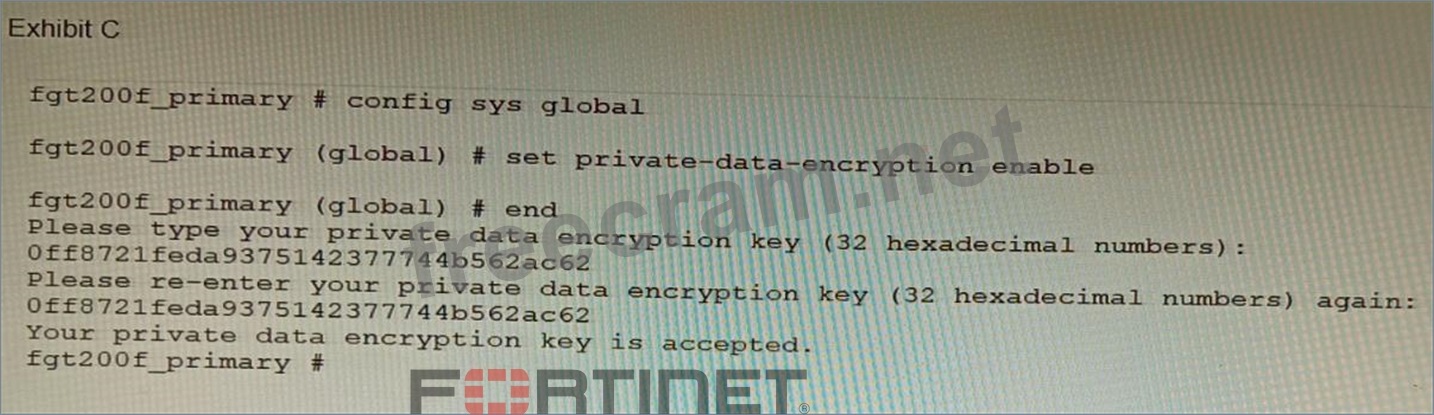
Refer to the exhibit. A customer has deployed a FortiGate 200F high-availability (HA) cluster that contains & TPM chip. The exhibit shows output from the FortiGate CLI session where the administrator enabled TPM. Following these actions, the administrator immediately notices that both FortiGate high availability (HA) status and FortiManager status for the FortiGate are negatively impacted. What are the two reasons for this behavior? (Choose two.)
Correct Answer: A,B
The two reasons for the negative impact on the FortiGate HA status and FortiManager status after enabling TPM are: The private-data-encryption key entered on the primary unit did not match the value that the TPM expected. This could happen if the TPM was previously enabled and then disabled, and the key was changed in between. The TPM will reject the new key and cause an error in the configuration synchronization. Configuration for TPM is not synchronized between FortiGate HA cluster members. Each cluster member must have the same private-data-encryption key to form a valid HA cluster and synchronize their configurations. However, enabling TPM on one unit does not automatically enable it on the other units, and the key must be manually entered on each unit. To resolve these issues, the administrator should disable TPM on all units, clear the TPM data, and then enable TPM again with the same private-data-encryption key on each unit. References: https://docs.fortinet.com/document/fortigate/6.4.0/cookbook/103437/inbound-ssl-inspection https://docs.fortinet.com/document/fortigate/6.4.0/cookbook/103438/application-detection-on-ssl-offloaded-traffic