- Home
- Fortinet
- Fortinet NSE 7 - FortiSASE 25 Enterprise Administrator
- Fortinet.NSE7_SSE_AD-25.v2026-11-09.q39
- Question 24
Valid NSE7_SSE_AD-25 Dumps shared by ExamDiscuss.com for Helping Passing NSE7_SSE_AD-25 Exam! ExamDiscuss.com now offer the newest NSE7_SSE_AD-25 exam dumps, the ExamDiscuss.com NSE7_SSE_AD-25 exam questions have been updated and answers have been corrected get the newest ExamDiscuss.com NSE7_SSE_AD-25 dumps with Test Engine here:
Access NSE7_SSE_AD-25 Dumps Premium Version
(109 Q&As Dumps, 35%OFF Special Discount Code: freecram)
<< Prev Question Next Question >>
Question 24/39
A customer needs to implement device posture checks for their remote endpoints while accessing the protected server. They also want the TCP traffic between the remote endpoints and the protected servers to be processed by FortiGate.
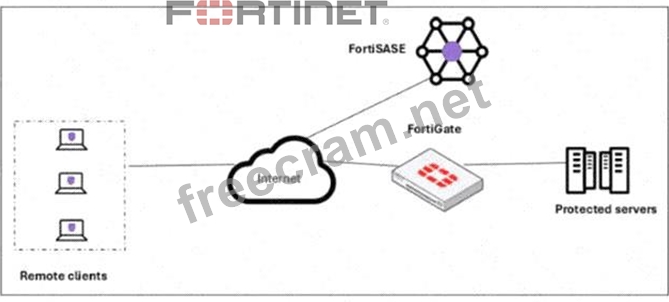
In this scenario, which two setups will achieve these requirements? (Choose two answers)
In this scenario, which two setups will achieve these requirements? (Choose two answers)
Correct Answer: B,C
To implement Zero Trust Network Access (ZTNA) where a FortiGate hub enforces device posture and processes traffic directly, specific architectural and configuration steps are required on the FortiGate appliance.
* ZTNA Access Proxy (B): The FortiGate must be configured as a ZTNA access proxy . In this role, the FortiGate acts as a secure gateway that mediates connections between remote users and internal applications. This setup ensures that all TCP traffic is intercepted and processed by the FortiGate, providing a direct, shortest-path connection that bypasses the FortiSASE cloud PoPs for the data plane.
* ZTNA Servers and Policies (C): Within the FortiGate configuration, administrators must define ZTNA servers (which identify the protected applications or resources) and ZTNA policies . ZTNA policies are the enforcement rules that check for valid client certificates and specific ZTNA tags (synchronized from FortiSASE) before allowing access to a resource. This configuration allows the FortiGate to perform continuous posture checks on every session.
* Posture Check Mechanism: While ZTNA tags are used, they are generally synchronized from the FortiSASE Endpoint Management Service (EMS) rather than manually configured on the FortiGate itself. This synchronization ensures the FortiGate has real-time visibility into the security posture (e.g., AV compliance, OS version) of the endpoints as reported by FortiClient.
* Analysis of Incorrect Options:
* Option A: Creating ZTNA tags manually on a FortiGate is technically possible but is not the recommended " setup " in a FortiSASE deployment, as tags are meant to be dynamically assigned by EMS and synced to the fabric.
* Option D: " Private access policies on FortiSASE " refers to the SD-WAN Secure Private Access (SPA) use case. In the SD-WAN SPA model, traffic is steered through the FortiSASE PoP first, whereas the requirement specifically asks for TCP traffic to be processed by the FortiGate using ZTNA.
* ZTNA Access Proxy (B): The FortiGate must be configured as a ZTNA access proxy . In this role, the FortiGate acts as a secure gateway that mediates connections between remote users and internal applications. This setup ensures that all TCP traffic is intercepted and processed by the FortiGate, providing a direct, shortest-path connection that bypasses the FortiSASE cloud PoPs for the data plane.
* ZTNA Servers and Policies (C): Within the FortiGate configuration, administrators must define ZTNA servers (which identify the protected applications or resources) and ZTNA policies . ZTNA policies are the enforcement rules that check for valid client certificates and specific ZTNA tags (synchronized from FortiSASE) before allowing access to a resource. This configuration allows the FortiGate to perform continuous posture checks on every session.
* Posture Check Mechanism: While ZTNA tags are used, they are generally synchronized from the FortiSASE Endpoint Management Service (EMS) rather than manually configured on the FortiGate itself. This synchronization ensures the FortiGate has real-time visibility into the security posture (e.g., AV compliance, OS version) of the endpoints as reported by FortiClient.
* Analysis of Incorrect Options:
* Option A: Creating ZTNA tags manually on a FortiGate is technically possible but is not the recommended " setup " in a FortiSASE deployment, as tags are meant to be dynamically assigned by EMS and synced to the fabric.
* Option D: " Private access policies on FortiSASE " refers to the SD-WAN Secure Private Access (SPA) use case. In the SD-WAN SPA model, traffic is steered through the FortiSASE PoP first, whereas the requirement specifically asks for TCP traffic to be processed by the FortiGate using ZTNA.


- Question List (39q)
- Question 1: When viewing the daily summary report generated by FortiSASE...
- Question 2: What are two benefits of deploying FortiSASE with FortiGate ...
- Question 3: An existing Fortinet SD-WAN customer is reviewing the FortiS...
- Question 4: A FortiSASE administrator is receiving reports that some use...
- Question 5: Your organization is currently using FortiSASE for its cyber...
- Question 6: Which two benefits come from integrating SoCaaS with FortiSA...
- Question 7: How does FortiSASE Secure Private Access (SPA) facilitate co...
- Question 8: Refer to the exhibit. To allow access, which web tiller conf...
- Question 9: Which two statements about the Hub Selection Method in Forti...
- Question 10: When you configure FortiSASE Secure Private Access (SPA) wit...
- Question 11: Refer to the exhibits. (Exhibit) A FortiSASE administrator i...
- Question 12: You are designing a new network, and the cybersecurity polic...
- Question 13: A customer wants to upgrade their legacy on-premises proxy t...
- Question 14: Which two advantages does FortiSASE bring to businesses with...
- Question 15: Refer to the exhibits. (Exhibit) When remote users connected...
- Question 16: You are designing a new network for Company X and one of the...
- Question 17: Which two settings are automatically pushed from FortiSASE t...
- Question 18: Which two statements about FortiSASE Geofencing with regiona...
- Question 19: Refer to the exhibits. (Exhibit) Jumpbox and Windows-AD are ...
- Question 20: Which authentication method overrides any other previously c...
- Question 21: What are two benefits of deploying secure private access (SP...
- Question 22: Which FortiSASE feature ensures least-privileged user access...
- Question 23: Refer to the exhibits. (Exhibit) A FortiSASE administrator h...
- Question 24: A customer needs to implement device posture checks for thei...
- Question 25: What happens to the logs on FortiSASE that are older than th...
- Question 26: What can be configured on FortiSASE as an additional layer o...
- Question 27: What are the two key features and benefits of Fortinet SOCaa...
- Question 28: What are the key differences between the FortiSASE BGP per o...
- Question 29: During FortiSASE provisioning, how many security points of p...
- Question 30: When deploying FortiSASE agent-based clients, which three fe...
- Question 31: When configuring the DLP rule in FortiSASE using Regex forma...
- Question 32: A customer wants to ensure secure access to private applicat...
- Question 33: Which statement about FortiSASE and SAML is true? (Choose on...
- Question 34: How does FortiSASE address the market trends of multicloud a...
- Question 35: What is the maximum number of Secure Private Access (SPA) se...
- Question 36: An organization must block user attempts to log in to non-co...
- Question 37: Refer to the exhibit. (Exhibit) A company has a requirement ...
- Question 38: When accessing the FortiSASE portal for the first time, an a...
- Question 39: You are configuring FortiSASE SSL deep inspection. What is r...

[×]
Download PDF File
Enter your email address to download Fortinet.NSE7_SSE_AD-25.v2026-11-09.q39.pdf