Valid FCP_FMG_AD-7.4 Dumps shared by ExamDiscuss.com for Helping Passing FCP_FMG_AD-7.4 Exam! ExamDiscuss.com now offer the newest FCP_FMG_AD-7.4 exam dumps, the ExamDiscuss.com FCP_FMG_AD-7.4 exam questions have been updated and answers have been corrected get the newest ExamDiscuss.com FCP_FMG_AD-7.4 dumps with Test Engine here:
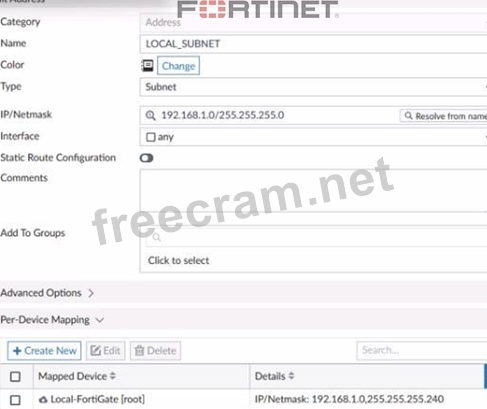
Refer to the exhibit. An administrator has created a firewall address object that is used in multiple policy packages for multiple FortiGate devices in an ADOM. After the installation operation is performed, which IP/netmask is shown on FortiManager for this firewall address object for devices without a Per-Device Mapping set?
Correct Answer: B
* Option B: 192.168.1.0/24is the correct answer. In FortiManager, when a firewall address object is defined and used across multiple policy packages without any Per-Device Mapping, the default value configured in the object definition (192.168.1.0/255.255.255.0) is applied to all devices. The exhibit shows that the address objectLOCAL_SUBNEThas a default IP/netmask of192.168.1.0/24. Therefore, FortiManager will use this default value for any FortiGate device that does not have a specific Per- Device Mapping configured. * Explanation of Incorrect Options: * Option A: FortiManager generates an error for each FortiGate without a per-device mapping defined for that objectis incorrect because FortiManager does not generate an error when a Per-Device Mapping is not set. Instead, it uses the default value provided in the object definition. * Option C: 192.168.1.0/28is incorrect because the default value is192.168.1.0/24, as seen in the exhibit, not/28. * Option D: FortiManager replaces the address object to noneis incorrect because FortiManager does not replace address objects to "none" when a Per-Device Mapping is missing; it uses the default value instead. FortiManager References: * Refer to the FortiManager 7.4 Administration Guide, specifically in sections related to "Address Object Management" and "Per-Device Mapping," which detail the behavior of address objects without specific device mappings.