- Home
- Cisco
- Deploying Cisco Service Provider Network Routing (SPROUTE)
- Cisco.642-883.v2018-06-25.q81
- Question 62
Valid 642-883 Dumps shared by ExamDiscuss.com for Helping Passing 642-883 Exam! ExamDiscuss.com now offer the newest 642-883 exam dumps, the ExamDiscuss.com 642-883 exam questions have been updated and answers have been corrected get the newest ExamDiscuss.com 642-883 dumps with Test Engine here:
Access 642-883 Dumps Premium Version
(175 Q&As Dumps, 35%OFF Special Discount Code: freecram)
<< Prev Question Next Question >>
Question 62/81
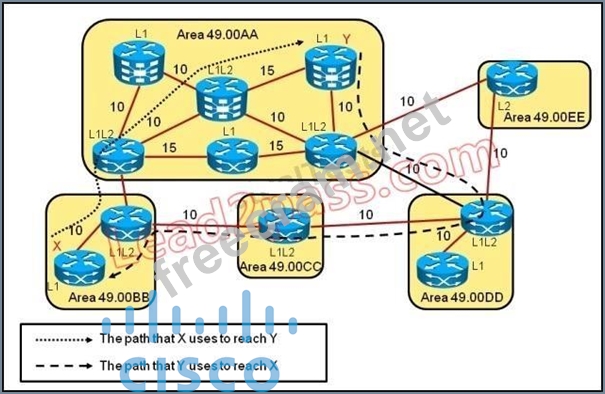
Refer to the topology diagram in the exhibit. Which IS-IS feature could be implemented so that the return path for the packets from router Y in area 49.00AA to router X in area 49.00BB will use the more optimal path?
Correct Answer: A
Explanation/Reference:
http://www.cisco.com/application/pdf/paws/13796/route-leak.pdf
The IS−IS routing protocol allows for a two−level hierarchy of routing information. There can be multiple Level 1 areas interconnected by a contiguous Level 2 backbone. A router can belong to Level 1, Level 2, or both. The Level 1 link−state database contains information about that area only. The Level 2 link−state database contains information about that level as well as each of the Level 1 areas. An L1/L2 router contains both Level 1 and Level 2 databases. It advertises information about the L1 area to which it belongs into L2.
Each L1 area is essentially a stub area. Packets destined for an address that is outside of the L1 area are routed to the closest L1/L2 router to be forwarded on to the destination area. Routing to the closest L1/L2 router can lead to sub−optimal routing when the shortest path to the destination is through a different L1/L2 router.
Route leaking helps reduce sub−optimal routing by providing a mechanism for leaking, or redistributing, L2 information into L1 areas. By having more detail about interarea routes, an L1 router is able to make a better choice with regard to which L1/L2 router to forward the packet.
http://www.cisco.com/application/pdf/paws/13796/route-leak.pdf
The IS−IS routing protocol allows for a two−level hierarchy of routing information. There can be multiple Level 1 areas interconnected by a contiguous Level 2 backbone. A router can belong to Level 1, Level 2, or both. The Level 1 link−state database contains information about that area only. The Level 2 link−state database contains information about that level as well as each of the Level 1 areas. An L1/L2 router contains both Level 1 and Level 2 databases. It advertises information about the L1 area to which it belongs into L2.
Each L1 area is essentially a stub area. Packets destined for an address that is outside of the L1 area are routed to the closest L1/L2 router to be forwarded on to the destination area. Routing to the closest L1/L2 router can lead to sub−optimal routing when the shortest path to the destination is through a different L1/L2 router.
Route leaking helps reduce sub−optimal routing by providing a mechanism for leaking, or redistributing, L2 information into L1 areas. By having more detail about interarea routes, an L1 router is able to make a better choice with regard to which L1/L2 router to forward the packet.


- Question List (81q)
- Question 1: How can you prevent multihomed customers with connections to...
- Question 2: Which four statements are correct regarding IS-IS operations...
- Question 3: Which AS path access list is used by a multihomed customer t...
- Question 4: Which reserved AS number or range of numbers is used for bac...
- Question 5: (Exhibit) Which router has the su 10.5.10.0/24 [20/115] entr...
- Question 6: Select and Place: (Exhibit)
- Question 7: What is defined by using the Cisco IOS XR policy-global conf...
- Question 8: When configuring Cisco IOS XR route policy nesting, which co...
- Question 9: When using the show bgp ipv6 unicast summary command to veri...
- Question 10: Routes that are received from an IBGP peer will be propagate...
- Question 11: BGP peerings can be secured using which protection mechanism...
- Question 12: Refer to the BGP and route map configurations exhibit. When ...
- Question 13: Hotspot (Exhibit) What is the configured IS-IS circuit-type ...
- Question 14: Which BGP attribute is a set of generic tags that can be use...
- Question 15: What is the default OSPF seed metric and type?...
- Question 16: When implementing LDP, what is liberal label retention mode?...
- Question 17: What are two ways to advertise networks into BGP? (Choose tw...
- Question 18: Refer to the exhibit. Which Cisco IOS XR configuration is mi...
- Question 19: When implementing OSPF, which type of networks require DR/BD...
- Question 20: The S bit in the MPLS header is used for what purpose?...
- Question 21: On Cisco IOS XR Software, which set of commands is used to e...
- Question 22: What is recursive lookup in BGP and how does it work?...
- Question 23: Select and Place: (Exhibit)
- Question 24: Refer to the Cisco IOS-XR route policy exhibit. Which statem...
- Question 25: Which two statements about a transit AS are correct? (Choose...
- Question 26: Refer to the network diagram in the exhibit. Assuming the IB...
- Question 27: Which three statements are true regarding the OSPF router ID...
- Question 28: Refer to the IS-IS configuration exhibit. This is the typica...
- Question 29: Refer to the Cisco IOS show command output shown in the exhi...
- Question 30: Refer to the exhibit. Which two configuration options can be...
- Question 31: When monitoring the OSPF operations in the network, you noti...
- Question 32: What are two characteristics of the multihomed customers to ...
- Question 33: (Exhibit) On the PE5 router, there are how many IPv4 and IPv...
- Question 34: What is function of the RP/0/RSP0/CPU0:PE1(config-ospf)#dist...
- Question 35: In an AS with 10 routers running IBGP, how many IBGP session...
- Question 36: Which two statements are true about an EBGP session or an IB...
- Question 37: The Cisco IOS XE Software summary-address router IS-IS confi...
- Question 38: Which high-availability mechanism is a detection protocol th...
- Question 39: Refer to the route policies exhibit. Which five route polici...
- Question 40: When redistributing routes into OSPF, which kind of routes w...
- Question 41: Which high-availability routing feature requires the neighbo...
- Question 42: Select and Place: (Exhibit)
- Question 43: When redistributing EIGRP routes into OSPF as type E2 extern...
- Question 44: Select and Place: (Exhibit)
- Question 45: You are implementing OSPF as the IGP using a single OSPF are...
- Question 46: When configuring Cisco IOS route maps, which command allows ...
- Question 47: When using the Cisco IOS-XR show bgp command to examine the ...
- Question 48: (Exhibit) There are how many IS-IS area(s) defined in this n...
- Question 49: Which two OSPF network scenarios require OSPF virtual link c...
- Question 50: Refer to the OSPF command exhibit. Which effect does the no-...
- Question 51: Which three BGP configuration groupings are supported on Cis...
- Question 52: Refer to the PE1 router routing table output exhibit. What i...
- Question 53: Which of the following is a characteristic of dual-multihome...
- Question 54: When using the Cisco IOS XR route policy language to define ...
- Question 55: In which network environment is IS-IS adjacency check import...
- Question 56: Select and Place: (Exhibit)
- Question 57: In comparing IS-IS with OSPF, a Level-1-2 IS-IS router is si...
- Question 58: What are two consequences of having constant link flaps, res...
- Question 59: Which OSPF feature allows a router with redundant route proc...
- Question 60: Refer to the Cisco IOS XE IS-IS configuration exhibit. What ...
- Question 61: When configuring IPv4 and IPv6 IS-IS routing on Cisco IOS XR...
- Question 62: Refer to the topology diagram in the exhibit. Which IS-IS fe...
- Question 63: (Exhibit) Which router(s) is/are IS-Type L1/L2 IS-IS router?...
- Question 64: Refer to the Cisco IOS route map configuration exhibit. Whic...
- Question 65: What are two purposes of the BGP scan-time command? (Choose ...
- Question 66: (Exhibit) Which three statements are correct regarding the O...
- Question 67: In Cisco IOS and Cisco IOS XE Software images, when redistri...
- Question 68: When configuring BGP on Cisco IOS XR Software, which address...
- Question 69: Which two statements regarding OSPFv2 or OSPFv3 authenticati...
- Question 70: Refer to the Cisco IOS XR route policy exhibit. Which two st...
- Question 71: Refer to the show command output in the exhibit. For which r...
- Question 72: Refer to the Cisco IOS XR route policy exhibit. If the origi...
- Question 73: Which of the following is used by an IS-IS router to detect ...
- Question 74: Refer to the network diagram in the exhibit. If both ASBRs a...
- Question 75: When troubleshooting OSPF neighbor errors, which three verif...
- Question 76: What are three common problems that can cause a BGP neighbor...
- Question 77: Select and Place: (Exhibit)
- Question 78: Refer to the exhibit. Based on the Cisco IOS XR route policy...
- Question 79: Hotspot (Exhibit) How many total OSPF virtual links are conf...
- Question 80: Referring to the partial Cisco IOS-XR BGP configuration exhi...
- Question 81: (Exhibit) Which statement Is correct regarding the DR electi...
