- Home
- Anthropic
- Claude Certified Architect - Professional
- Anthropic.CCAR-P.v2026-11-09.q53
- Question 35
Valid CCAR-P Dumps shared by ExamDiscuss.com for Helping Passing CCAR-P Exam! ExamDiscuss.com now offer the newest CCAR-P exam dumps, the ExamDiscuss.com CCAR-P exam questions have been updated and answers have been corrected get the newest ExamDiscuss.com CCAR-P dumps with Test Engine here:
Access CCAR-P Dumps Premium Version
(130 Q&As Dumps, 35%OFF Special Discount Code: freecram)
<< Prev Question Next Question >>
Question 35/53
You are a solution architect evaluating candidate use cases for a Claude-based program.
For each scenario, select Yes if Claude is appropriate as the primary solution at the architectural level.
Otherwise, select No.
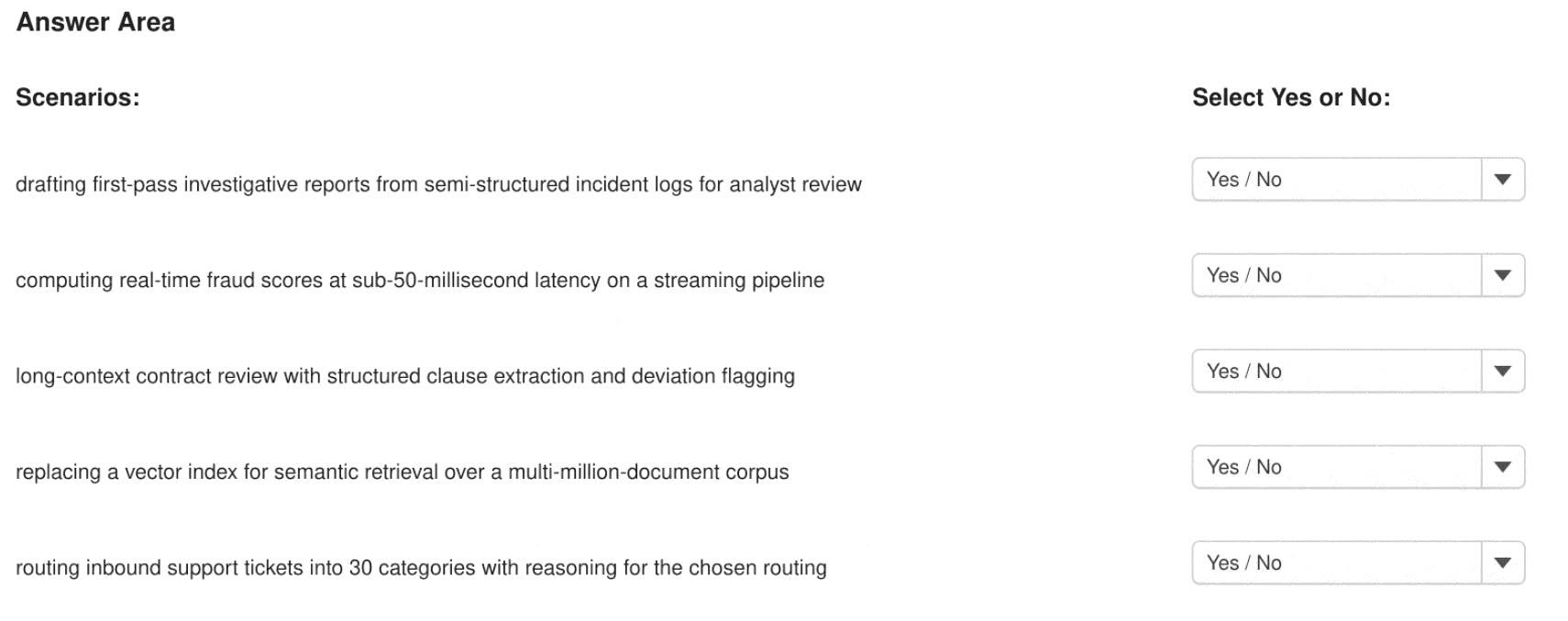
For each scenario, select Yes if Claude is appropriate as the primary solution at the architectural level.
Otherwise, select No.
Correct Answer:
Explanation:
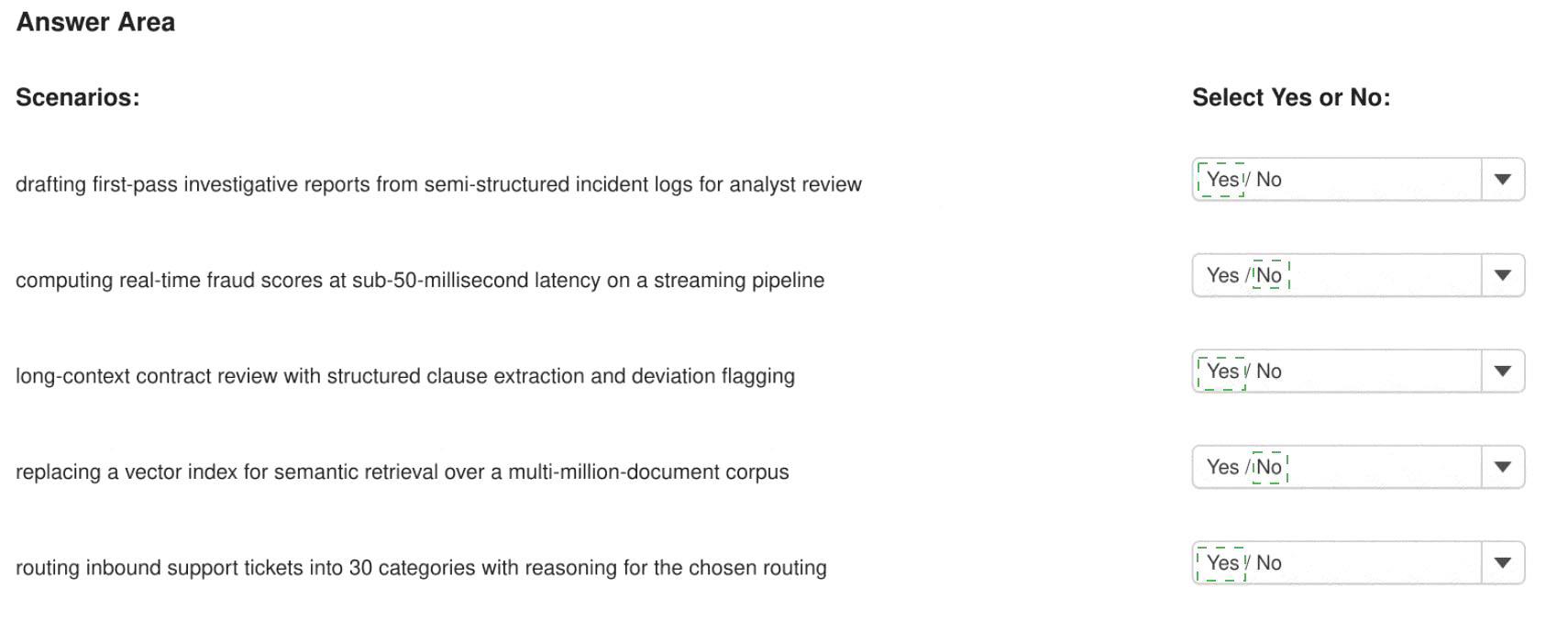
* Drafting first-pass investigative reports from semi-structured incident logs for analyst review - Yes
* Computing real-time fraud scores at sub-50-millisecond latency on a streaming pipeline - No
* Long-context contract review with structured clause extraction and deviation flagging - Yes
* Replacing a vector index for semantic retrieval over a multi-million-document corpus - No
* Routing inbound support tickets into 30 categories with reasoning for the selected route - Yes Claude is well suited to language-intensive analysis, summarization, extraction, classification, and drafting.
Investigative-report drafting, contract analysis, and support-ticket routing all require interpretation of unstructured or semi-structured language and can incorporate human review. A sub-50-millisecond fraud- scoring path requires deterministic, specialized real-time processing and should not place LLM inference on the critical path. Claude also does not replace the retrieval index used to search millions of documents; it consumes the results produced by that infrastructure. The correct architectural decision separates tasks requiring semantic language reasoning from deterministic computation and information-retrieval infrastructure. Model selection and evaluation must then confirm that the chosen Claude model satisfies quality, latency, and cost requirements.


- Question List (53q)
- Question 1: You are compiling guardrail tactics for a customer-facing as...
- Question 2: You are reviewing a peer's draft system prompt that contains...
- Question 3: You are identifying inefficiency in a Claude Code workflow w...
- Question 4: You must present an architectural recommendation to deploy a...
- Question 5: You are compiling continuity practices that span the deploym...
- Question 6: You are preparing a HIPAA-eligible deployment for a healthca...
- Question 7: You are running a risk assessment on a planned Claude-based ...
- Question 8: You are a platform architect designing an internal Claude-ba...
- Question 9: During an architectural review, the security team identifies...
- Question 10: You are listing characteristics of robust guardrail design f...
- Question 11: A document analysis service processes legal filings averagin...
- Question 12: A managed agent deployment for claims triage has grown from ...
- Question 13: You are responding to an adversarial input pattern in which ...
- Question 14: You are auditing a procurement-assistant agent whose defined...
- Question 15: You are assessing data-exfiltration risk in a Claude-based a...
- Question 16: An architect is reviewing a set of architecture documentatio...
- Question 17: An engineering organization is adopting Claude Code across 2...
- Question 18: You are assessing a Claude-based system whose dominant risk ...
- Question 19: You are supporting a team whose Claude Code sessions consist...
- Question 20: A technical team is debating whether to implement a new capa...
- Question 21: You are evaluating model-selection claims used by a peer tea...
- Question 22: You are explaining the precedence of Claude Code configurati...
- Question 23: An architect is reviewing a Claude-based candidate-screening...
- Question 24: The engineering lead at Trenova Systems, Inc. is evaluating ...
- Question 25: You are defining transparency practices for a customer-facin...
- Question 26: You are designing a human-in-the-loop validation workflow fo...
- Question 27: You are an architect supporting the iteration phase of a dep...
- Question 28: When communicating an architectural decision to a security a...
- Question 29: The platform team at Trenova Systems, Inc. needs to reduce p...
- Question 30: You are integrating Claude Code into the team's pull-request...
- Question 31: You are evaluating prompting claims in a peer's design docum...
- Question 32: You are compiling a diagnostic toolkit for Claude Code opera...
- Question 33: You are identifying signals that a deployment should re-ente...
- Question 34: You are transitioning a Claude-based deployment from design ...
- Question 35: You are a solution architect evaluating candidate use cases ...
- Question 36: A research summarization assistant has been deployed for six...
- Question 37: You are identifying the highest-impact optimization for a de...
- Question 38: Engineering leadership wants to roll out Claude Skills to 28...
- Question 39: A Claude architect at a health services organization is defi...
- Question 40: You are selecting a pattern for a compliance Q & A assis...
- Question 41: You are responding to a stakeholder request that adds signif...
- Question 42: A Claude architect is leading the discovery phase for a new ...
- Question 43: You are distinguishing functional from non-functional requir...
- Question 44: A business sponsor has requested an AI solution to "improve ...
- Question 45: The compliance team has authored a regulatory disclosure pro...
- Question 46: The compliance team at a firm has approved a Claude Skill th...
- Question 47: You are producing an architecture guide for a new deployment...
- Question 48: A Claude architect is designing a HIPAA-compliant pipeline t...
- Question 49: You are configuring tool permissions for a Claude-based assi...
- Question 50: You are choosing the level of detail for an implementation g...
- Question 51: You are classifying token-management tactics by where each t...
- Question 52: You are defining escalation criteria for ambiguous cases in ...
- Question 53: You are building an ethics-review checklist for deployments ...
