- Home
- Anthropic
- Claude Certified Architect - Professional
- Anthropic.CCAR-P.v2026-10-26.q56
- Question 15
Valid CCAR-P Dumps shared by ExamDiscuss.com for Helping Passing CCAR-P Exam! ExamDiscuss.com now offer the newest CCAR-P exam dumps, the ExamDiscuss.com CCAR-P exam questions have been updated and answers have been corrected get the newest ExamDiscuss.com CCAR-P dumps with Test Engine here:
Access CCAR-P Dumps Premium Version
(130 Q&As Dumps, 35%OFF Special Discount Code: freecram)
<< Prev Question Next Question >>
Question 15/56
You are auditing a procurement-assistant agent whose defined responsibility is to draft purchase requests for review.
For each tool currently configured on the agent, select yes if the tool should remain after a least-privilege audit. Otherwise, select no if it should be removed.
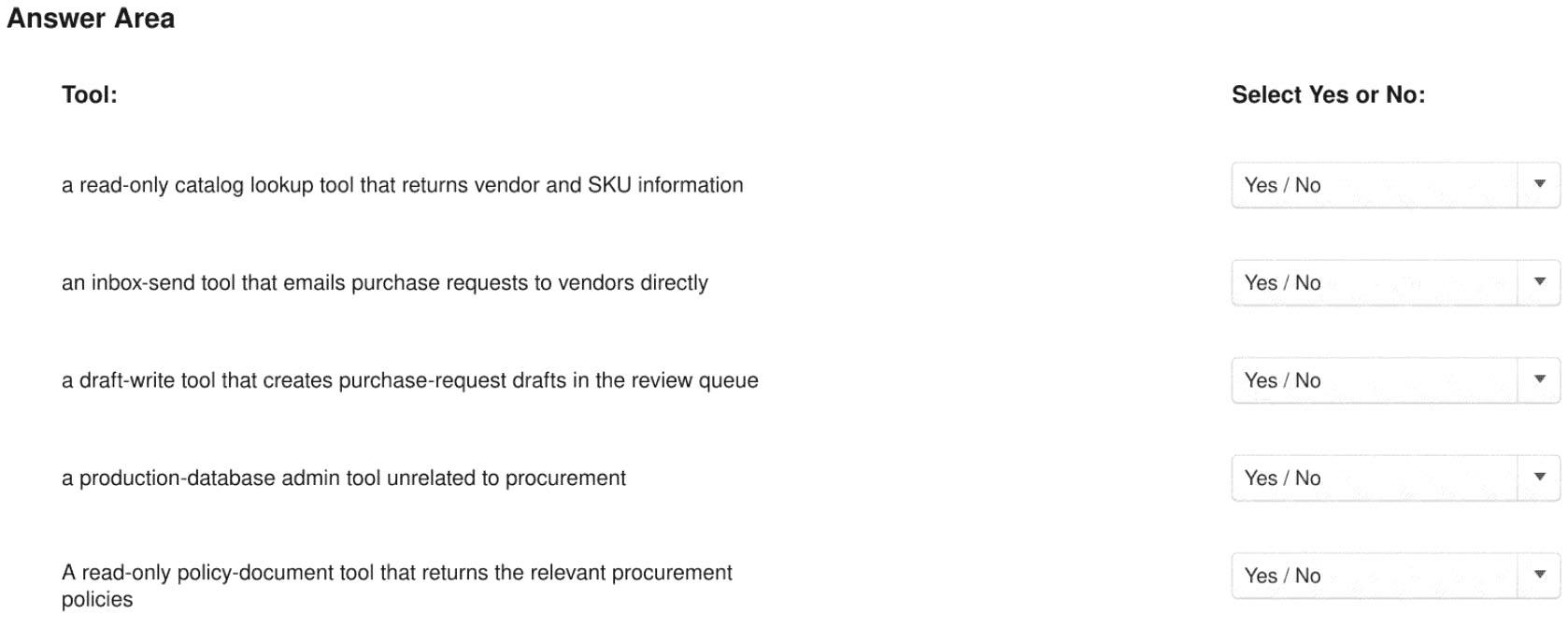
For each tool currently configured on the agent, select yes if the tool should remain after a least-privilege audit. Otherwise, select no if it should be removed.
Correct Answer:
Explanation:
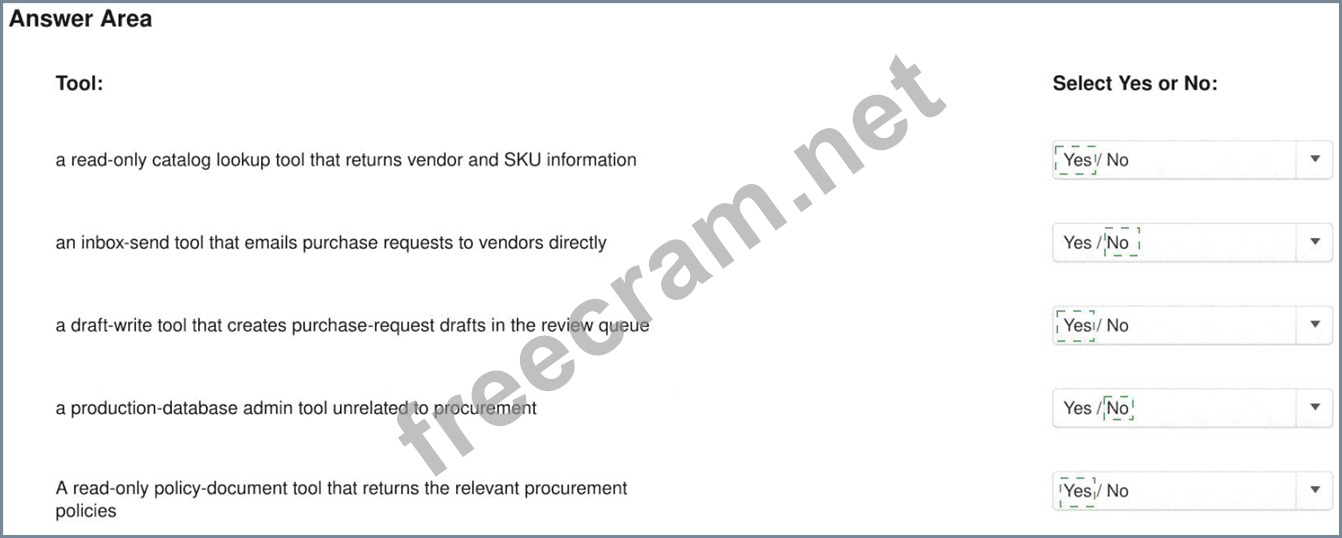
Yes, No, Yes, No, Yes
Least privilege requires each retained tool to be necessary for the agent's assigned responsibility and restricted to the minimum action level needed. Catalog lookup is appropriate because vendor and SKU information is needed to prepare an accurate request. The policy-document tool is similarly justified because the agent must ground the draft in applicable procurement rules. The draft-write tool is also aligned because it writes only to a review queue, preserving the required human approval boundary.
The inbox-send tool exceeds the stated responsibility. Sending a request directly to a vendor converts a drafting assistant into an externally acting purchasing agent and bypasses the review stage. The production- database administrator tool is unrelated to procurement and introduces unnecessary destructive capability, privilege-escalation exposure, and potential data-access risk.
Anthropic's prompt-injection guidance recommends limiting access to sensitive data and actions and applying least privilege so that a compromised agent can cause minimal damage. Claude Code also supports tool- specific allow, ask, and deny rules that are enforced outside the model. Prompt-Injection Mitigation, Claude Code Permissions Study Guide references/topics: Capability-bloat auditing; least privilege; tool scoping; human review gates; separation of drafting and execution authority.


- Question List (56q)
- Question 1: You are listing characteristics of strong architectural-deci...
- Question 2: An engineering organization is adopting Claude Code across 2...
- Question 3: You are identifying inefficiency in a Claude Code workflow w...
- Question 4: You are designing the prompt for a ticket-triage classifier ...
- Question 5: You are responding to a stakeholder request that adds signif...
- Question 6: A Claude architect is designing a HIPAA-compliant pipeline t...
- Question 7: You are distinguishing functional from non-functional requir...
- Question 8: You are designing a human-in-the-loop validation workflow fo...
- Question 9: You are assessing a Claude-based system whose dominant risk ...
- Question 10: The compliance team at a firm has approved a Claude Skill th...
- Question 11: A Claude architect is implementing safety controls for a cus...
- Question 12: You are preparing a HIPAA-eligible deployment for a healthca...
- Question 13: A Claude-based research assistant begins producing responses...
- Question 14: You are reviewing a peer's end-to-end design for a Claude-ba...
- Question 15: You are auditing a procurement-assistant agent whose defined...
- Question 16: You are preparing an operational runbook for a Claude-based ...
- Question 17: A Claude architect at a health services organization is defi...
- Question 18: You are supporting a team whose Claude Code sessions consist...
- Question 19: You are reviewing a peer's Claude Code permission rules for ...
- Question 20: You are diagnosing a Claude Code session whose subagent uses...
- Question 21: An architect at Trenova Systems, Inc. is reviewing two draft...
- Question 22: You are supporting an engineer whose Claude Code session rep...
- Question 23: You are transitioning a Claude-based deployment from design ...
- Question 24: You are reviewing a customer-support agent's configuration. ...
- Question 25: When communicating an architectural decision to a security a...
- Question 26: You are defining where human review must remain in a planned...
- Question 27: You are assessing data-exfiltration risk in a Claude-based a...
- Question 28: You are producing an architecture guide for a new deployment...
- Question 29: You are designing a test strategy for a Claude-based pipelin...
- Question 30: You are evaluating model-selection claims used by a peer tea...
- Question 31: You are classifying chunking strategies by the corpus type e...
- Question 32: You are responding to an adversarial input pattern in which ...
- Question 33: A Claude architect needs to ensure that a security-hardening...
- Question 34: You are defining when to introduce a project subagent versus...
- Question 35: You are designing a content moderation classifier that proce...
- Question 36: You are explaining the precedence of Claude Code configurati...
- Question 37: You are configuring tool permissions for a Claude-based assi...
- Question 38: You are listing characteristics of robust guardrail design f...
- Question 39: You are defining transparency practices for a customer-facin...
- Question 40: You are presenting an architectural decision to a mixed audi...
- Question 41: You are building an ethics review checklist for deployments ...
- Question 42: You are classifying token-management tactics by where each t...
- Question 43: You are running a risk assessment on a planned Claude-based ...
- Question 44: You are compiling factors that should drive the choice betwe...
- Question 45: A document analysis service processes legal filings averagin...
- Question 46: A healthcare organization is evaluating two Claude-powered A...
- Question 47: You are evaluating prompting claims in a peer's design docum...
- Question 48: You are an architect supporting the iteration phase of a dep...
- Question 49: A team manager wants all engineers working on the same repos...
- Question 50: You are a platform architect designing an internal Claude-ba...
- Question 51: Engineering leadership wants to roll out Claude Skills to 28...
- Question 52: You are designing a feedback session for a deployment in fli...
- Question 53: A Claude architect is configuring a shared Claude Code envir...
- Question 54: You are selecting a pattern for a compliance Q & A assis...
- Question 55: You are identifying signals that a deployment should re-ente...
- Question 56: You are choosing the level of detail for an implementation g...
